Beijing Temple of Confucius
A cypress tree in this temple compound has a reputation. According to a story from the Ming dynasty, a notoriously corrupt official was walking past when the tree reached out and knocked his hat clean off his head. The tree has been known ever since as the Touch-Evil Cypress, and visitors still eye it with a mix of amusement and wariness. It is a fitting guardian for a place dedicated to Confucius, the philosopher who spent his life insisting that rulers should be moral.
Seven Hundred Years of Scholarship
The Beijing Temple of Confucius was built in 1302, during the reign of Temur Khan, Emperor Chengzong of the Yuan dynasty. It is the second-largest Confucian temple in China, after the one in Qufu, Confucius's hometown in Shandong Province. The compound was enlarged twice, once under the Ming and again under the Qing, eventually reaching roughly 20,000 square meters. For the entire span of those three dynasties -- Yuan, Ming, and Qing -- imperial officials gathered here to conduct ceremonies honoring Confucius, a tradition that continued until the Xinhai Revolution of 1911 brought the imperial era to an end. The temple stands on Guozijian Street, next to the Imperial Academy where scholars once prepared for the civil service examinations that could make or break their careers.
Fifty-One Thousand Names in Stone
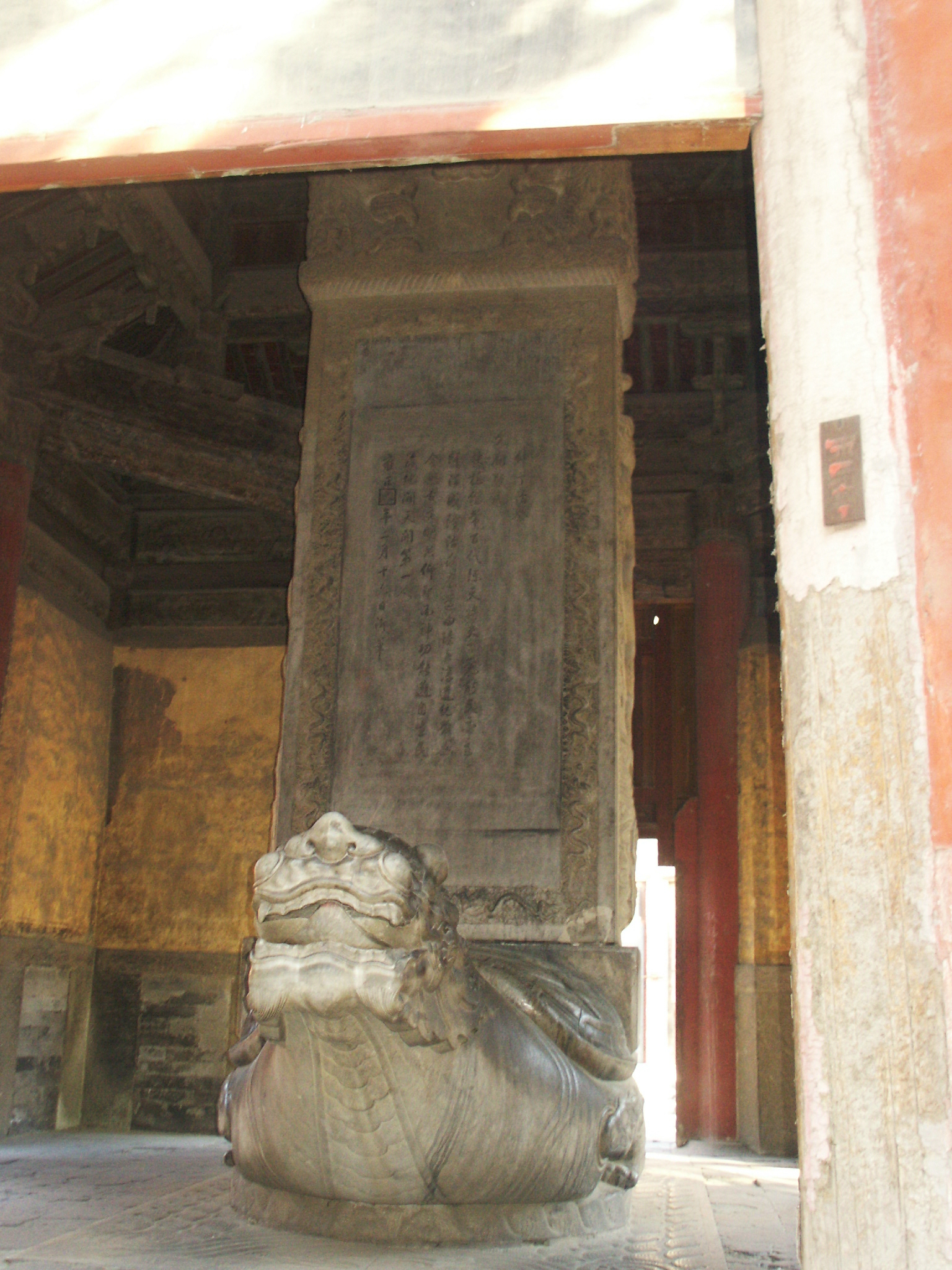
Walk through the front courtyard and you are flanked by 198 stone tablets. Carved into their surfaces are the names of more than 51,624 jinshi -- advanced scholars who passed the highest level of China's imperial examinations during the Yuan, Ming, and Qing dynasties. Each name represents years of grueling study, a multi-day examination conducted in cramped cells, and the rare achievement of joining the empire's educated elite. Fourteen stone stele pavilions from the Ming and Qing periods house additional historical documents. These tablets are not decorative; they are a civilization's record of intellectual achievement, a registry of the minds that staffed an empire's bureaucracy for six centuries.
Dragons, Classics, and Hidden Treasures
The complex unfolds along a central axis through four courtyards. From south to north, visitors pass through the Gate of the Late Master, the Gate of Great Accomplishment, the Hall of Great Accomplishment, and the Hall for Admiration of the Sage. Inside, the carvings reward close attention. One famous relief depicts two flying dragons playing with a pearl among the clouds, an image typically reserved for the emperor and rare among Confucian temples. The temple also houses stone steles inscribed with the Thirteen Confucian Classics, the canonical texts that formed the foundation of Chinese education for millennia. These steles were presented by the city of Jintan in Jiangsu Province. From 1981 to 2005, the temple served double duty, housing part of the art collection of the Capital Museum before it relocated to its own building.
Stillness in the Middle of Beijing
Modern Beijing presses close on every side, but inside the temple walls the old trees create a canopy of quiet. The ancient cypresses are themselves landmarks -- some hundreds of years old, their twisted trunks suggesting the kind of endurance that Confucius would have admired. Among them stands the Touch-Evil Cypress, still upright, still implicitly judging passersby. The temple's calm is genuine, not manufactured for tourists. It remains a working cultural site, a place where the weight of Chinese intellectual history is tangible in stone and bark. Guozijian Street outside, one of the few hutong lanes in Beijing that still retains its old character, extends the feeling of stepping backward through time.
From the Air
Located at 39.95°N, 116.41°E in the Dongcheng District of central Beijing, near the old Imperial Academy. Not individually visible from altitude, but situated in the historic hutong area northeast of the Forbidden City. Nearest major airport is Beijing Capital International (ZBAA/PEK), approximately 24 km to the northeast.