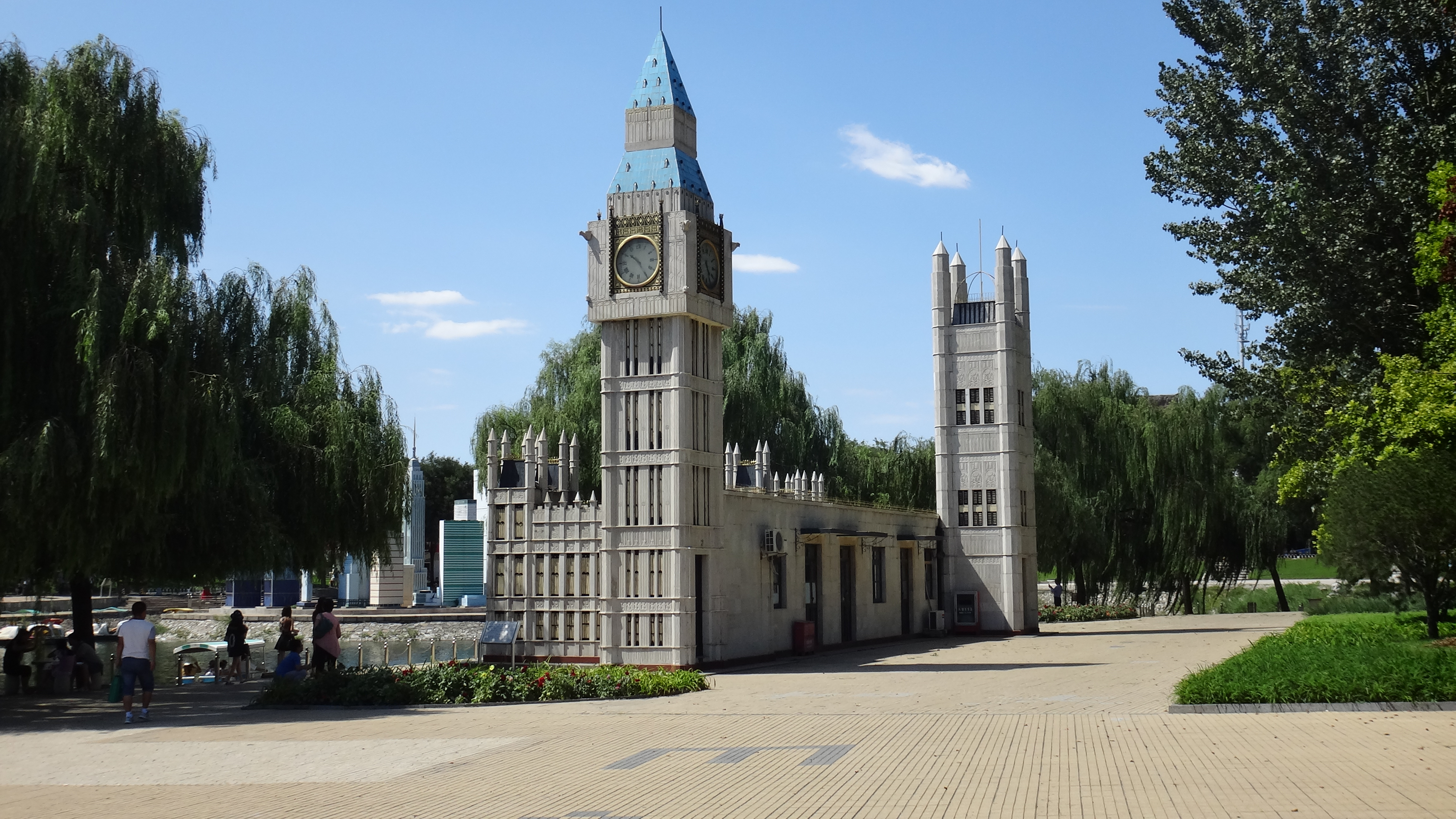
Beijing World Park
You can stand at the foot of the Eiffel Tower, glance left at the Pyramids of Giza, and catch the Taj Mahal in your peripheral vision. The illusion lasts exactly as long as you choose not to look at scale. Beijing World Park, opened in 1993 in the southwestern Fengtai District, compresses roughly one hundred of the world's most famous landmarks into 46.7 hectares, about 17 kilometers from Tiananmen Square. The park receives an estimated 1.5 million visitors annually, many of whom have never left China. For them, the miniature Statue of Liberty and shrunken Tower Bridge are not kitsch but geography made accessible.
The Whole World in a Garden
The entrance sets the tone immediately: a Gothic castle facade gives way to a Roman corridor, then opens onto an Italian Renaissance terrace garden complete with grand staircases, fountains, and sculptures. From there, the park unfolds across five "continents" connected by four "oceans" that visitors can traverse by speedboat. A monorail loops the entire perimeter for those who want the aerial survey. Around a hundred miniature statues dot the lawns, including Copenhagen's Little Mermaid, Michelangelo's David, and the Venus de Milo. The international landmarks range from Australia's Sydney Opera House and Belgium's Atomium to the Great Sphinx of Giza and India's Taj Mahal. A special garden section juxtaposes Chinese, Japanese, and American landscaping traditions side by side.
Performance and Spectacle
Beijing World Park is not simply a static display of miniatures. Each continental zone features live cultural performances, from dance troupes representing their home traditions to daily opening ceremonies with large-scale float parades. Indoor theaters and open-air arenas host folklore performances that rotate with the seasons. In 2005, the park hosted a Thai elephant that performed four times daily from May through October. The shopping and dining area, designed in Euro-American architectural styles, lets visitors sample cuisines from the regions represented in the scenic portion. The ambition is total immersion, a world tour compressed into an afternoon, complete with food, music, and souvenirs.
The World Behind the World
Director Jia Zhangke saw something deeper in Beijing World Park. His 2004 film "The World" was shot entirely on location here, but its subject was not the miniature landmarks. The film follows the park's workers, young migrants from rural China who spend their days surrounded by replicas of places they will likely never visit. The Eiffel Tower is always in view but Paris is impossibly far away. Jia's camera finds in the park a metaphor for modern China's relationship with globalization: proximity without access, familiarity without experience. The film premiered at the Venice Film Festival and brought international attention to the park, though the attention it attracted was more melancholy than the park's marketing team might have preferred.
Olympic Footnote and Modern Legacy
During the 2008 Beijing Summer Olympics, the park served an unexpected role: it was designated one of the city's three official protest zones where demonstrators could legally voice grievances. Whether any protests actually occurred there became its own story. The park continues to operate as a popular family destination, offering battery-operated car tours and monorail rides alongside its cultural programming. Just 500 meters southeast of the south entrance lies the Dabaotai Western Han Dynasty Mausoleum, where 2,000-year-old tombs of a Han prince and his wife provide a jarring contrast. The juxtaposition is pure Beijing: two millennia of genuine history sitting half a kilometer from a theme park dedicated to shrinking the entire world down to size.
From the Air
Located at 39.81N, 116.28E in Fengtai District, southwestern Beijing. The park's 46.7-hectare footprint is visible from moderate altitude as a green space with distinctive miniature structures. Beijing Daxing International Airport (ZBAD) lies approximately 35 km to the south. Beijing Capital International Airport (ZBAA) is about 40 km northeast. The Yongding River runs to the west, and the park sits near the Dabaotai Station of Beijing Subway's Fangshan Line.