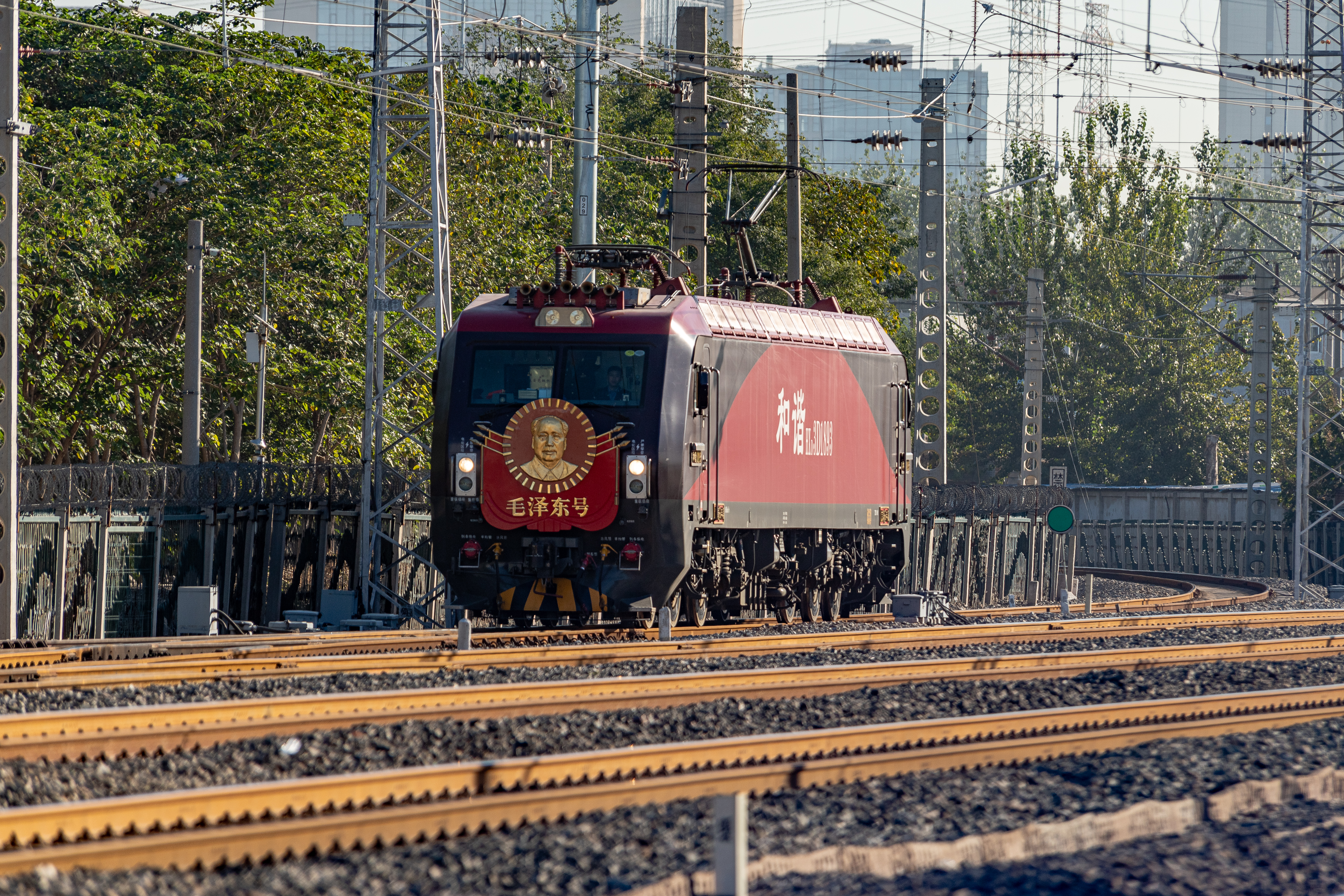
Beijing-Zhangjiakou Railway
The solution looked like a Chinese character. When engineer Zhan Tianyou needed to get a railway through the steep Badaling mountains northwest of Beijing, he designed a switchback track shaped like the character "ren" -- meaning "people." Trains would climb to a junction, reverse direction, and continue upward along the second stroke of the character, gaining elevation without the impossible gradients that a straight route would require. The technique also allowed him to shorten the Badaling Tunnel by using vertical shafts to excavate from multiple points simultaneously. It was 1905, and every foreign engineer who had assessed the route had declared it impossible for Chinese builders. Zhan Tianyou proved them wrong in four years.
A Railway Against Empires
The Beijing-Zhangjiakou Railway emerged from a tangle of imperial rivalries. In the late 1890s, Britain and Russia competed fiercely for the right to build railways across northern China, each viewing rail infrastructure as a tool of colonial influence. The Qing government rejected both, but Russia forced a commitment in 1899 that China would consult Russian interests before allowing third-party rail construction north of Beijing. After the Boxer Rebellion, Britain extracted its own concessions. The result was an impasse: foreign powers wanted to build the railway, but neither could tolerate the other doing so. The compromise, brokered through diplomacy and sealed in treaty language, was that the railway between Beijing and Zhangjiakou would be built with no foreign capital, and its revenues would never serve as foreign collateral. China would build it alone, or not at all.
Zhan Tianyou's Impossible Route
In 1905, Yuan Shikai, then Viceroy of Zhili, proposed the railway at a projected cost of five million taels of silver. He chose Zhan Tianyou as chief engineer on the recommendation of diplomat Liang Dunyan. Zhan, who had studied at Yale University, faced a route that climbed from Beijing's plain into the mountains guarding the Juyong Pass -- the same terrain that had shaped military strategy for centuries. The Guan'gou Valley section presented the greatest challenge, with gradients that conventional rail design could not overcome. Zhan's switchback solution was elegant and practical: by reversing the train's direction at a zigzag point, he kept gradients manageable while reducing the tunnel length needed to penetrate the mountains. The railway opened in 1909 with 14 stations, 4 tunnels, and 125 bridges, connecting Beijing to Zhangjiakou across terrain that had once separated the capital from the northern frontier.
Through Revolution, Invasion, and Expansion
The railway's first decades tracked China's turbulent history. In September 1912, Sun Yat-sen, who had recently resigned as interim president of the Republic of China, traveled to Zhangjiakou by train for an inspection tour, meeting Yuan Shikai in Beijing along the way. In 1916, the line merged into the Beijing-Suiyuan Railway, which eventually extended to Baotou by 1923. The Japanese army seized the railway during World War II, and flood damage in 1939 forced the relocation of ten kilometers of track in the Huailai section. After the founding of the People's Republic, the railway became part of the Beijing-Baotou Railway, and urban growth gradually consumed its Beijing sections. As the city expanded, rail lines that had once crossed open countryside found themselves bisecting neighborhoods and university campuses.
Dismantled but Not Forgotten
By the early 21st century, the Beijing-Zhangjiakou Railway's physical presence in the capital had largely vanished. The section between Guang'anmen and Xizhimen was dismantled in 1968 to accommodate urban traffic. In 2016, the remaining tracks within Beijing were removed to make way for the Beijing-Zhangjiakou intercity railway, a high-speed line that now covers the same route in less than an hour -- a journey that took Zhan Tianyou's original trains the better part of a day. The Qinghuayuan Station closed permanently. But the railway's legacy proved more durable than its infrastructure. The Nankou-to-Badaling section was designated a Major Historical and Cultural Site Protected at the National Level in 2013. The switchback that Zhan designed to solve the mountain problem remains a landmark in Chinese engineering history: the first time China built something the world said it could not, using a character that means "people" as the shape of its ambition.
From the Air
The railway route runs from Beijing northwest to Zhangjiakou, passing through the Guan'gou Valley and the Badaling mountains. The switchback section is located near 40.24N, 116.12E in the mountainous terrain near Nankou. The route roughly parallels the modern Badaling Expressway. Nearest airport is Beijing Capital International (ZBAA/PEK), approximately 70 km southeast of the switchback section.