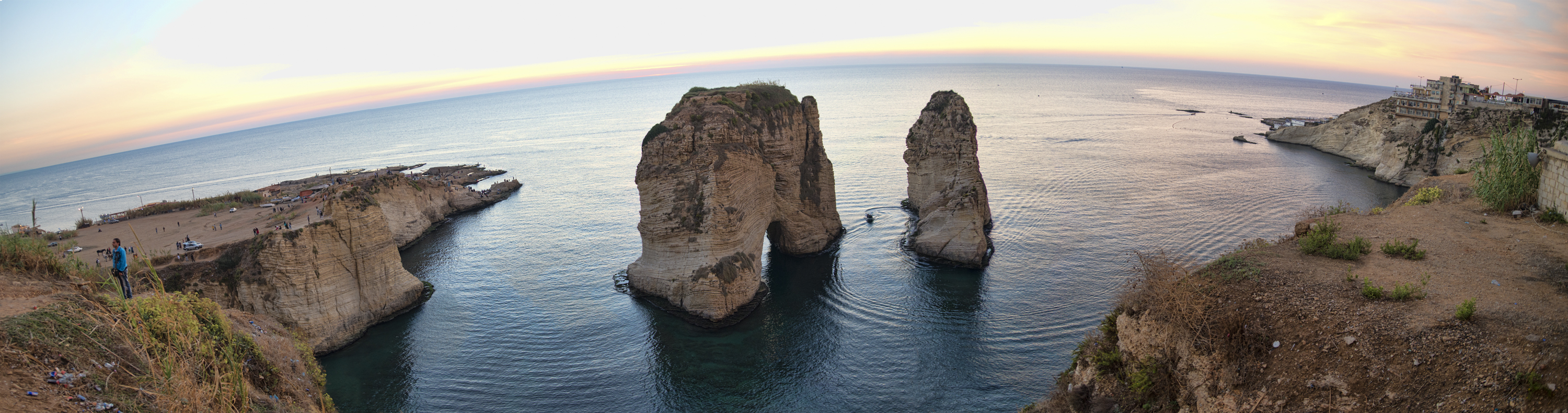
Beirut
No capital on earth has died and risen as many times as Beirut. This Lebanese metropolis of 2.4 million people has watched war destroy what peace rebuilt, then rebuilt again. The civil war from 1975 to 1990 gutted the city center. Reconstruction created the Downtown that now stands. Then the 2020 port explosion destroyed entire neighborhoods, and reconstruction began once more. Through it all, Beirut held onto the nightlife, cuisine, and culture that earned it the title 'Paris of the Middle East.' Resilience is not just a word here; it is Lebanese identity. Roman ruins lie beneath modern streets. Ottoman buildings survived what modern weapons could not destroy. French Mandate architecture still defines entire neighborhoods. Civilization after civilization compressed itself into this city, and the city simply refused to quit.
The Downtown
After the civil war ended, Downtown Beirut rose from rubble. The Solidere development replaced destruction with a mix of restoration and new construction, drawing both praise and sharp critique. Parliament meets at the Place de l'Etoile. The blue dome of the Mohammad Al-Amin Mosque marks the skyline. Below the modern streets, archaeological gardens reveal Roman baths. This is what post-war Beirut chose to become.
Controversy still clings to the project. Developers profited enormously while residents were displaced, and many feel the result is a sanitized version of Beirut. Some reconstructed streets sit eerily empty; shops opened and then quietly closed. Rebuilding buildings, it turns out, is far easier than rebuilding city life. Is the Downtown Beirut's future, or has it lost the city's soul? Locals continue that debate.
The Neighborhoods
Beirut's actual life pulses through its neighborhoods. Gemmayzeh and Mar Mikhael concentrate the nightlife. Hamra, home to the American University, carries an intellectual atmosphere. In Achrafieh, Christian Beirut maintains its character. During the civil war, religion divided these neighborhoods, and deadly checkpoints made crossing between them a gamble with your life. Those divisions have softened since, but they have not disappeared. Different streets serve different communities, yet certain places still draw everyone together. Beirut's geography mirrors its complicated society.
The 2020 explosion devastated Gemmayzeh and Mar Mikhael worst of all. These neighborhoods sat closest to the port where the ammonium nitrate ignited. Heritage buildings collapsed. Bars and restaurants lay in ruins. And then, somehow, they reopened anyway. Reconstruction continues block by block, demonstrating once again what Beirut does after disaster.
The Food
Lebanese food is Beirut's gift to the world. Mezze spreads across tables in dizzying abundance. Hummus, tabbouleh, and fattoush traveled far beyond Lebanon's borders, borrowed by cuisines everywhere. Grilled meats and fresh fish arrive at your table with Mediterranean views stretching to the horizon. This food culture survived war intact, providing the normalcy that crisis demands. Beirut eats well because eating well is resistance to despair.
Restaurants line the Corniche. Rooftop bars pulse with DJs spinning late into the night. Corner bakeries serve manakish for breakfast. Fine dining here competes with European capitals, while street food costs almost nothing. The range reflects a society where deep inequality coexists with a shared, fierce love of good food.
The History
Five thousand years of history run through Beirut. Phoenician port became Roman colony, then Ottoman city, then French mandate territory, then independent capital. Archaeology peels back one layer after another: Roman baths, Crusader fortifications, Ottoman souks. Few capitals anywhere can match this depth. And few have survived as many disasters.
During the civil war, the National Museum closed its doors. Staff walled the collection in concrete to protect it from shelling. When the museum reopened, the artifacts had survived. Today those collections document every civilization Beirut has hosted. History gives context to current crises in a way nothing else can. Beirut has survived worse. That is the reassurance Beirutis offer themselves and every visitor who arrives wondering how this city keeps going.
The Nightlife
In a region where nightlife is often constrained, Beirut's is legendary. Clubs and bars keep the music going until dawn. Rooftop cocktails come with Mediterranean panoramas. Even during the civil war, people went out. After explosions, the bars reopened. Nightlife defines this city as much as ancient ruins do. The partying is defiance, therapy, and Lebanese identity all at once.
International DJs fly in to play Beirut's clubs. Conversations at the bar shift between three languages mid-sentence. Restaurants transform into dance floors as the night deepens. Tourists discover this scene with astonishment; residents simply need it. The nightlife is not an escape from crisis. It exists because of crisis, because war makes the act of living feel urgent.
From the Air
Beirut (33.89N, 35.50E) sits on the Mediterranean coast of Lebanon, built on a promontory between two bays. Rafic Hariri International Airport (OLBA/BEY) lies 9km south, its single runway 03/21 (3,395m) extending into the sea. The airport bears the name of the assassinated prime minister. From the air, the city center and reconstructed Downtown are visible on the promontory, while the 2020 port explosion site stands out north of the downtown area. Mountains of the Lebanon Range rise immediately to the east, often snow-capped in winter. The climate is Mediterranean: hot dry summers, mild wet winters. Sea breezes moderate coastal temperatures.