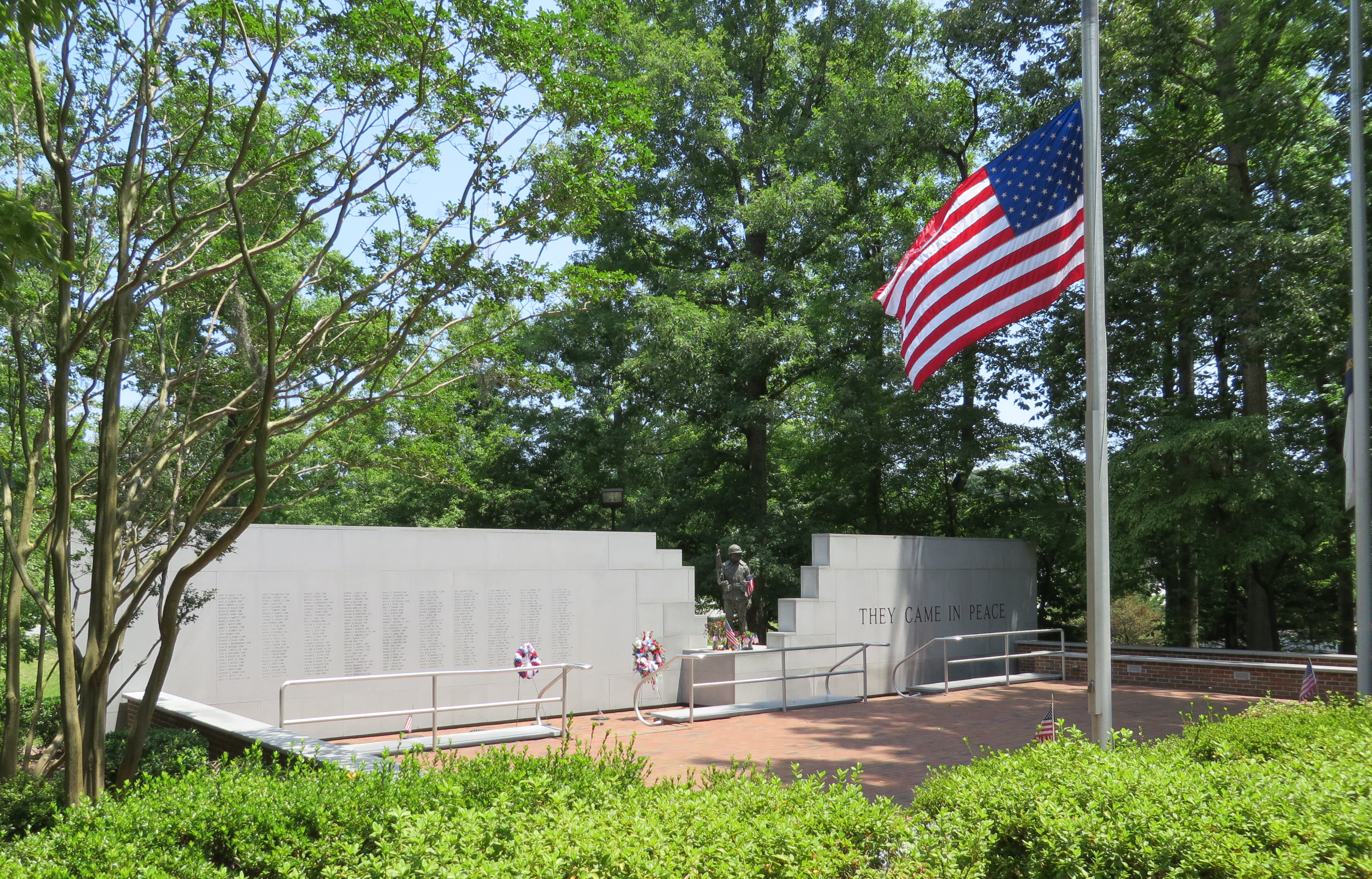
Beirut Memorial
"They Came in Peace." Four words, engraved on a wall inside the USO in Jacksonville, North Carolina, carry the weight of 241 lives lost in a single, devastating instant. The Beirut Memorial stands outside the gate of Camp Gilbert H. Johnson, a satellite camp of Marine Corps Base Camp Lejeune, and every October, survivors, families, and fellow Marines gather here to remember a Sunday morning in 1983 when a truck loaded with explosives shattered a barracks building -- and the illusion that peacekeeping could be a safe mission.
A Sunday Morning in Beirut
In the summer of 1982, the United States agreed to establish a military presence in Lebanon at the request of the Lebanese government. American forces, alongside French and Italian contingents, were deployed as peacekeepers to stabilize a nation fractured by conflict between warring Muslim and Christian factions. On March 24, 1983, the 24th Marine Amphibious Unit, stationed at Camp Lejeune, received orders to Beirut. Initially, the multinational force brought a measure of calm. But as diplomatic efforts stalled, the Marines came to be seen not as neutral arbiters but as combatants. Artillery, mortar, and small arms fire began targeting Marine positions. Then, in the predawn darkness of October 23, 1983, a truck -- an unremarkable vehicle of the kind seen daily at Beirut's airport -- drove into the First Battalion, 8th Marines headquarters building. The truck carried compressed gas-enhanced explosives. The resulting blast was, at the time, the largest non-nuclear explosion ever detonated. The building collapsed instantly, killing 220 Marines, 18 sailors, and 3 soldiers.
The Reckoning
Investigations would later trace the attack to Hezbollah, identifying Imad Mughniyeh as the mastermind. Mughniyeh himself would die in a car bomb in Syria years later. In 2003, U.S. District Court Judge Royce C. Lamberth ruled Iran responsible for the attack, finding that Hezbollah and its agents had received massive material and technical support from the Iranian government. Major Robert T. Jordan, one of the Marine officers present that morning, later wrote that the men who served with the 24th MAU during those final grim months of 1983 had taken their place alongside Marines who endured at Samar, Wake Island, Chosin Reservoir, and Khe Sanh. The bombing became a permanent entry in Marine Corps historical lore -- a reminder, Jordan wrote, for future generations of military planners and political policymakers to consider even the unthinkable.
Stone, Trees, and Memory
The memorial at Jacksonville is not the only place where the fallen are remembered. Inside the USO in Jacksonville, a wall bears the names of every service member killed, beneath the inscription "They Came in Peace." At Fort Jackson in Columbia, South Carolina, the Armed Forces Chaplaincy Center displays a haunting artifact: the partially destroyed plywood sign from the barracks chapel. Navy Chaplain Arnold Resnicoff, who was present during the attack, recalled finding the hand-painted board amid the rubble. The words "Peace-keeping" were still legible above the Chaplain Corps seal, but the lower portion -- where "Chapel" had been written -- was burned and splintered away. The idea of peace above; the reality of war below. At Arlington National Cemetery, a Lebanese cedar grows near the graves of some of the victims. A plaque at its base reads: "Let peace take root."
Across Oceans and Borders
Perhaps the most unexpected tribute stands on the slopes of Mount Carmel in Haifa, Israel. Gilla Gerzon, director of the Haifa USO, coordinated the creation of a memorial park containing 241 olive trees -- one for each American life lost. The trees lead to an overpass that looks out toward Beirut, bridging the distance between remembrance and the place where it all happened. Back in Jacksonville, annual ceremonies are held at the memorial on or near the anniversary of the attack. At the anniversary ceremony in October 2011, a plaque honoring Gold Star Mothers -- mothers who have lost a child in military service -- was dedicated as an addition to the site. Since 2008, a parallel Beirut Remembrance Day ceremony has been held at the Vietnam Memorial in Phoenix, Arizona, linking the sacrifices of different generations. The National Museum of the Marine Corps in Quantico, Virginia, unveiled an exhibit in 2008 dedicated to the attack and its victims.
The Weight of Four Words
Every memorial tells its own story in its own language. The Beirut Memorial speaks in the silence between the names of the dead, in the annual gathering of aging survivors and their families, in the olive trees growing on a hillside six thousand miles from North Carolina. It speaks in four words that capture the cruelest irony of the attack: the men who died had not come to fight. They had come in peace. The memorial stands as both a tribute and a warning -- that the line between peace and war can vanish in a single, shattering moment, and that the cost of misjudging that line is measured in human lives. For the Marines who gather here each October, the memorial is not stone or bronze. It is the living act of remembering.
From the Air
Located at 34.748N, 77.414W, adjacent to Marine Corps Base Camp Lejeune in Jacksonville, North Carolina. Best viewed below 3,000 feet AGL. The memorial grounds are outside Camp Gilbert H. Johnson's main gate. Nearby airports include Albert J. Ellis Airport (KOAJ) approximately 10 nm to the northwest and Marine Corps Air Station New River (KNCA) about 5 nm to the west. The sprawling Camp Lejeune complex and the New River are prominent visual references.