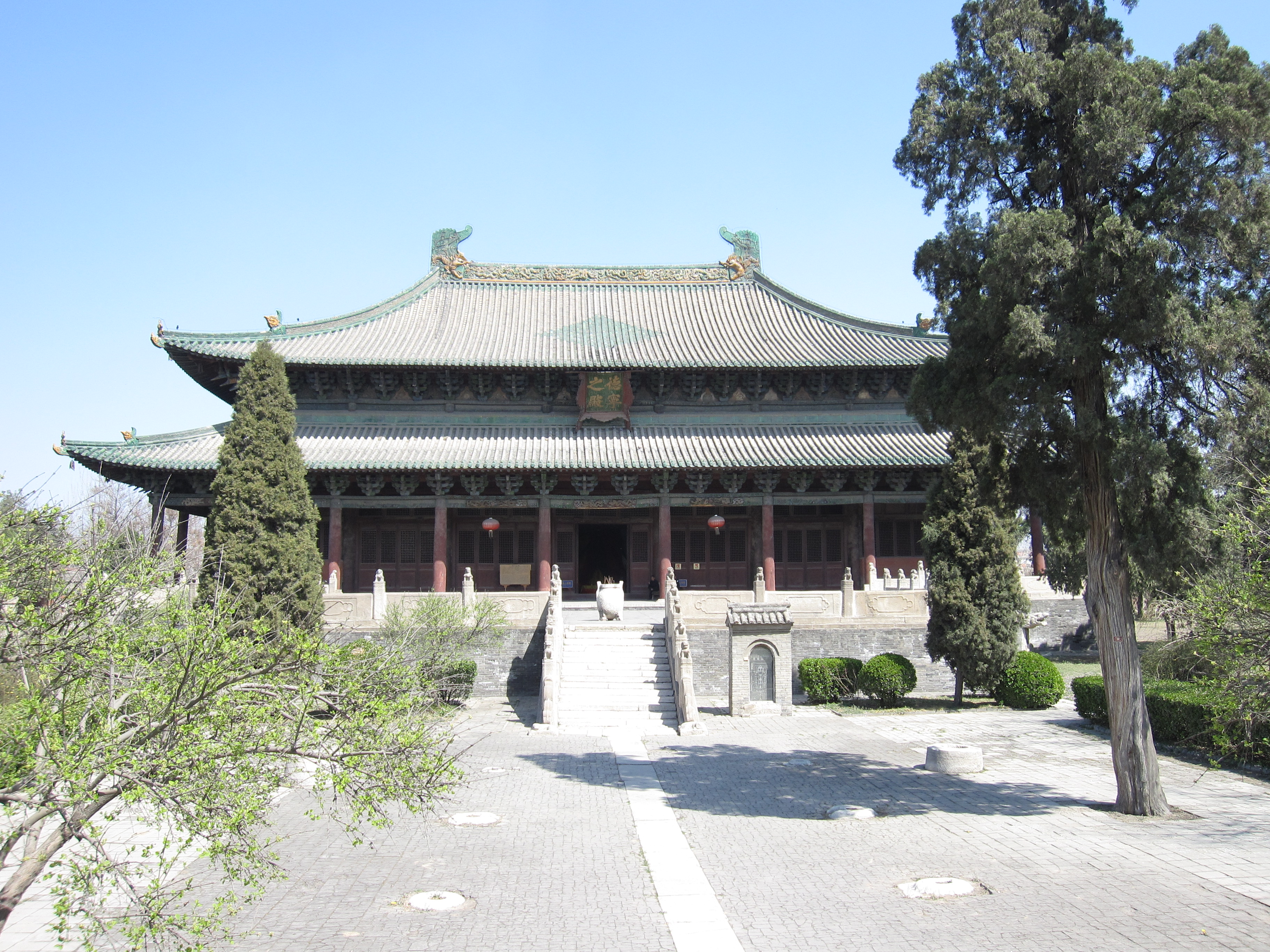
Beiyue Temple
The Song dynasty emperors had a problem. Mount Heng -- one of China's five sacred mountains and the 'Northern Peak' of Taoist cosmology -- lay beyond their borders, occupied by the rival Liao dynasty and its Khitan rulers. Imperial sacrifices to the mountain were not optional; they were a pillar of dynastic legitimacy. The solution was creative, if unusual. The emperors believed that a geomantic vein, an invisible channel of spiritual energy, could carry their offerings through enemy territory and reach the mountain. Beiyue Temple, in the town of Quyang in Hebei Province, became the proxy -- the place where sacrifices were performed to a mountain no Song emperor could safely visit.
A Temple Older Than Its Records
The earliest possible founding of Beiyue Temple traces to the Northern Wei dynasty, sometime between 386 and 534. Other accounts place it in the Tang dynasty, between 618 and 907. But the site itself may be far older -- archaeological evidence suggests ritual use dating to the 2nd century BCE, during the Han dynasty. What is certain is that by the Song period, the temple had become the designated location for imperial sacrifices to Mount Heng, a role it played with full court ceremony. Over 137 stelae survive on the temple grounds, their inscriptions spanning from the Northern Wei to the Qing dynasty, creating a stone archive of more than fifteen centuries of dedications, repairs, and imperial patronage.
The Dening Hall
The centerpiece of Beiyue Temple is the Dening Hall, identified by architectural historian Nancy Shatzman Steinhardt as one of the two most eminent and important extant wooden halls from the Yuan dynasty. The building sits on a dramatically elevated platform, accessible by a central staircase or two side staircases attached to a massive yuetai -- a 'moon platform' measuring 25 by 20 meters. A white marble balustrade capped with carved lions runs the perimeter. The hall itself spans seven by four bays and is surrounded by a covered arcade. Its 6th-level puzuo brackets are the most complex to survive from the Yuan period. Steinhardt notes that these features closely match written descriptions of architecture at the Yuan capital of Dadu -- modern Beijing -- making the Dening Hall not just a provincial temple building but a surviving example of what the imperial capital's finest structures looked like.
Murals of Water Gods and Dragon Kings
Three of the Dening Hall's interior walls bear Taoist murals of remarkable scale. The western wall's painting, attributed to the Tang dynasty, measures 17 by 7 meters and depicts a local water deity, with a winged being hovering at the top of the composition. The eastern wall mural, of similar dimensions, portrays the Dragon King -- a deity governing rain and water, vital concerns for the agricultural communities of the North China Plain. These murals serve as reminders that Beiyue Temple operated not only as a site of imperial sacrifice but as a living center of local religious life, where farmers prayed for rain and officials sought cosmic favor. The hall also contains nine statues, all dating from a later period than the building itself, their newer presence underscoring the temple's continuous use across dynasties.
Where City Wall Meets Sacred Ground
The wall surrounding Beiyue Temple was not built specifically for the temple -- it was part of the city wall that once enclosed the entire town of Quyang. The temple's south gate doubled as one of the main gates of the town, blurring the boundary between civic and sacred space. Of that larger city wall, nothing survives except the remnant incorporated into the temple complex. An octagonal pavilion called Tianyi Pavilion, built during the Ming dynasty, stands between the south gate and the Dening Hall. The layout follows a strict north-south axis, with six extant buildings marking a processional path from gate to great hall. Many of the structures were rebuilt in the late 20th century, but the Dening Hall and its murals survived intact -- a Yuan dynasty wooden building still standing while the city that once surrounded it has vanished.
From the Air
Beiyue Temple is located at 38.62°N, 114.69°E in Quyang County, Hebei Province, on the North China Plain south of the Taihang Mountains. The temple complex is visible as a walled compound within the town of Quyang. Mount Heng (the Northern Peak), the sacred mountain the temple was built to honor, lies to the northwest in Shanxi Province. Nearest major airport is Shijiazhuang Zhengding International Airport (ICAO: ZBSJ), approximately 100 km to the south. Best viewed at 3,000-5,000 feet AGL.