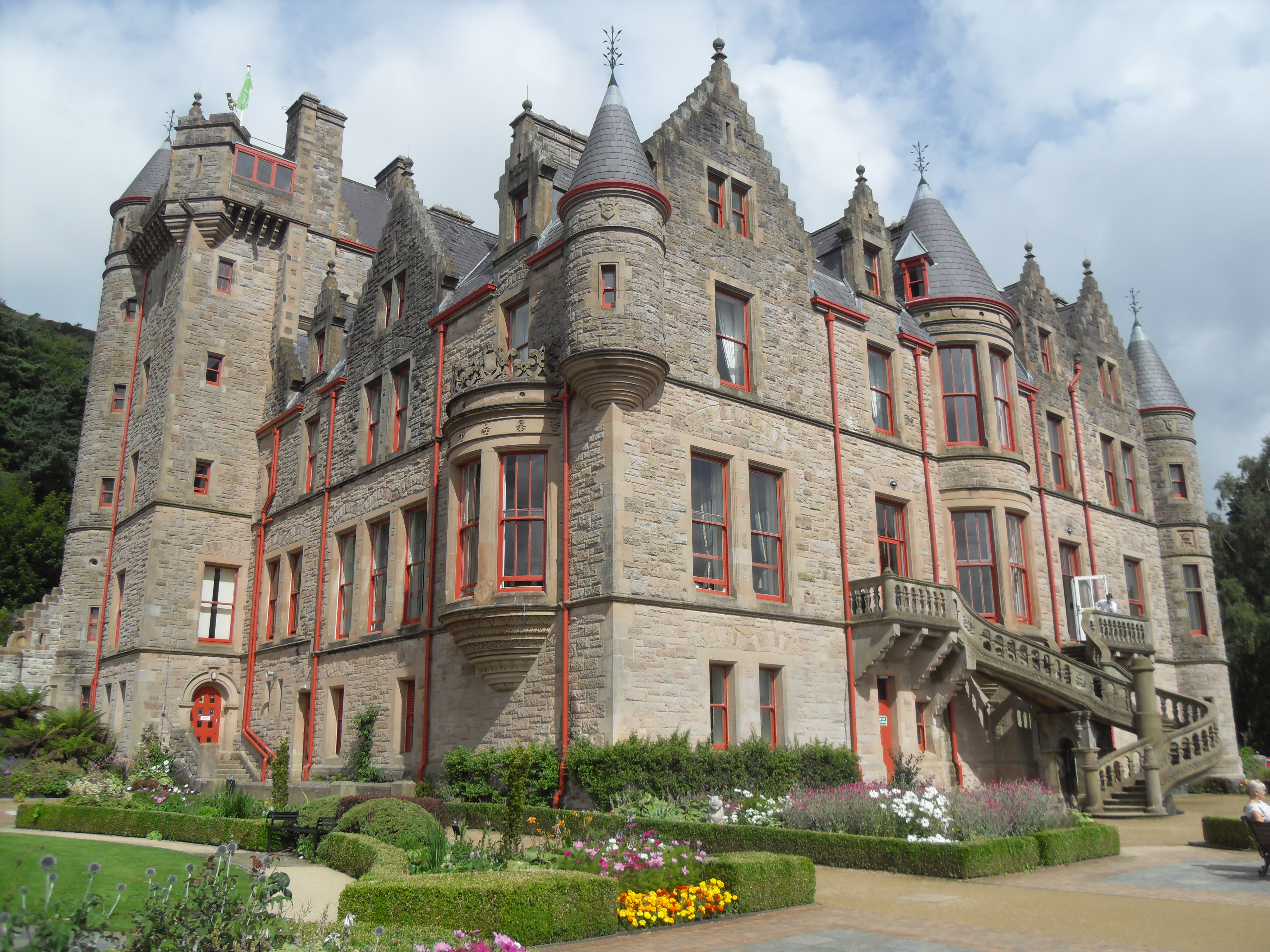
Belfast Castle
There have been several Belfast Castles, and none of them has lasted. The Norman original, probably near what is now Castle Place in the city center, was seized by the O'Neill dynasty in the fourteenth century and rebuilt as a Gaelic towerhouse. The Plantation-era castle, constructed in brick by Sir Arthur Chichester around 1610, burned down in 1708, killing three of the Earl of Donegall's sisters. The current building -- a Victorian country house that is not, strictly speaking, a castle at all -- sits four hundred feet up the slopes of Cave Hill, looking out over Belfast Lough. It is the most successful of the three, if only because it is still standing.
Conquest, Massacre, and Fire
The medieval castle changed hands repeatedly as rival powers fought over Belfast. The Earls of Kildare seized it in 1503, 1512, and 1523. In October 1574, the 1st Earl of Essex was invited to a feast at the castle by Sir Brian McPhelim O'Neill, Lord of Lower Clandeboye. During the meal, Essex's soldiers turned on their hosts, killing O'Neill's followers in what became known as the Clandeboye Massacre. O'Neill himself was arrested and later executed in Dublin along with his wife and brother. After the Nine Years' War left the castle in ruins, Sir Arthur Chichester -- one of the architects of the Plantation of Ulster -- rebuilt it in the early 1610s. The Chichester family, later titled Earls and then Marquesses of Donegall, would own Belfast itself for over two centuries. Their castle lasted until April 24, 1708, when an accidental fire destroyed it and the family left the city.
The Marquess Who Sold Belfast
The 3rd Marquess of Donegall spent most of his life in England and sold off nearly all of his family's Belfast estate in the 1850s. Curiously, it was only after he no longer owned the city that he became interested in living there. In the 1860s, he commissioned a new residence on what had been the family's deer park on Cave Hill, on the northern outskirts of Belfast. The architect was Charles Lanyon, Belfast's most prominent Victorian designer. Built between 1867 and 1870 in the Scottish Baronial style, the new Belfast Castle was a princely mansion raised just a decade after the Great Famine had ended -- a display of aristocratic ambition amid a landscape still scarred by catastrophe.
The Shaftesburys and the Gift
The 3rd Marquess died in 1883 and the castle passed, through his daughter's marriage, to the Earls of Shaftesbury. The 9th Earl threw himself into Belfast public life, serving as Lord Mayor in 1907 and adding an elaborate Baroque stone staircase to the castle's garden facade in 1894. He and his wife Constance held charity events on the grounds, becoming fixtures of the city's social world. But the Land Acts broke up the great Irish estates, and running the castle became an increasing financial burden. In January 1934, Lord Shaftesbury gifted Belfast Castle and its surrounding demesne to the City of Belfast. It was a generous act born of necessity -- the kind of transfer that marked the end of the Anglo-Irish landed class across the island.
Cave Hill and the View That Inspired Rebellion
Belfast Castle's setting on Cave Hill is as significant as the building itself. The hill rises to 1,207 feet and its distinctive basalt cliff face -- known as Napoleon's Nose for its profile -- is one of Belfast's most recognizable natural landmarks. In 1795, Wolfe Tone and other United Irishmen met on Cave Hill's summit to swear an oath to establish an Irish republic, a conspiracy that led to the 1798 Rebellion. The hill is also said to have inspired Jonathan Swift's depiction of a sleeping giant in Gulliver's Travels. Today, the castle and its surrounding Cave Hill Country Park offer walking trails through mixed woodland with views across Belfast, the lough, and on clear days the Scottish coast. The castle, restored and reopened in 1988 after a decade-long refurbishment, serves as a venue for weddings and events -- a domestic role that none of its predecessors survived long enough to fulfill.
From the Air
Belfast Castle is at 54.64N, 5.94W on the slopes of Cave Hill, overlooking Belfast from the north. The Victorian castle and Cave Hill's distinctive basalt cliff (Napoleon's Nose) are prominent visual landmarks from the air. Nearest airports: Belfast City (EGAC) about 5 nm southeast, Belfast International (EGAA) about 10 nm northwest. Cave Hill rises to 1,207 ft so maintain appropriate altitude. Best viewed at 2,000-4,000 ft AGL approaching from the east over Belfast Lough.