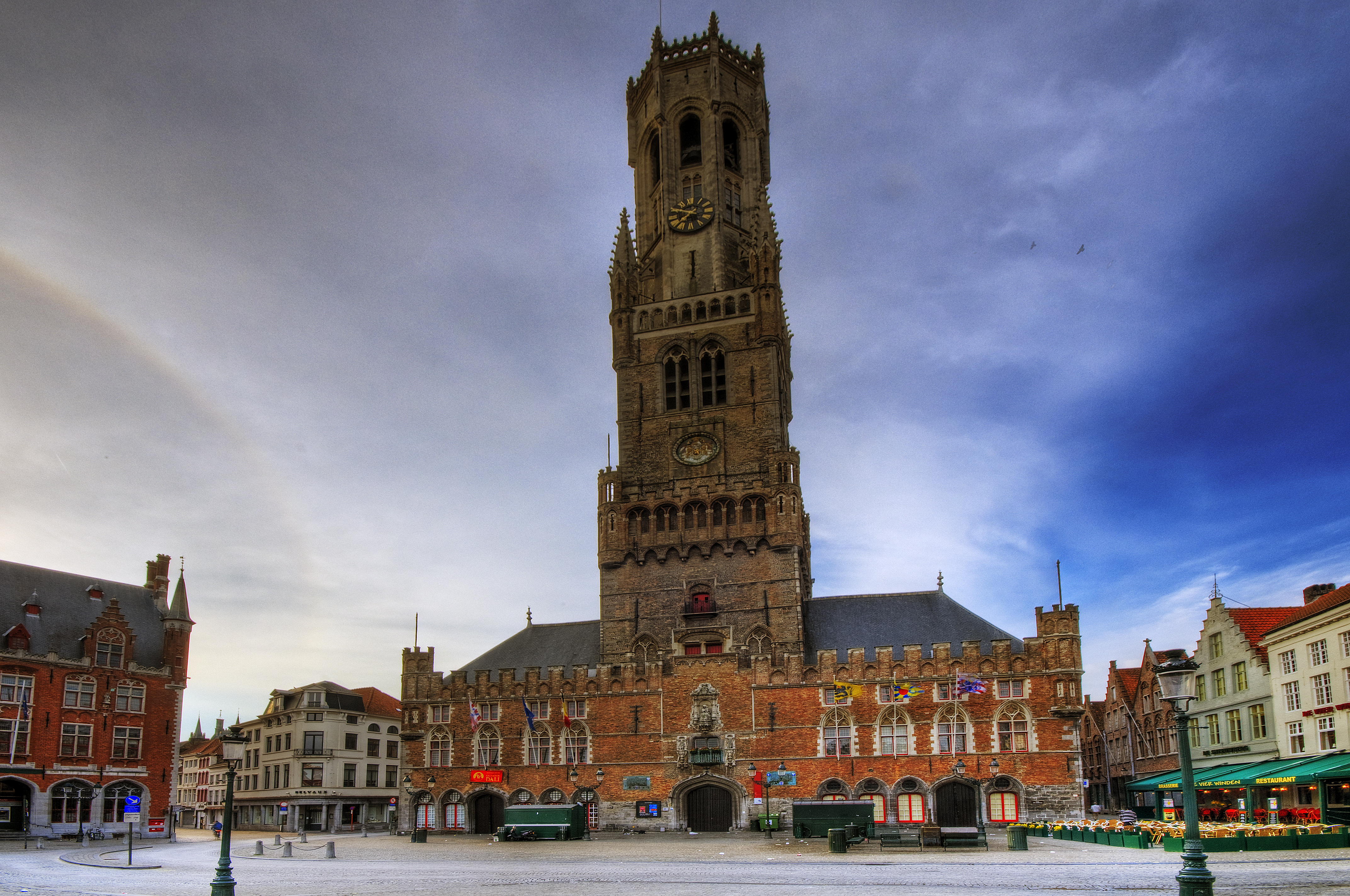
Belfry of Bruges
Henry Wadsworth Longfellow captured it perfectly: 'In the market-place of Bruges stands the belfry old and brown; thrice consumed and thrice rebuilded, still it watches o'er the town.' The Belfry of Bruges has endured fire in 1280, lightning in 1493, and flames again in 1741. Each time the tower burned, the city rebuilt it. The wooden spire that once crowned its summit, bearing an image of Saint Michael with banner raised and dragon underfoot, was never restored after the 1741 fire. Yet the 83-meter tower that remains has become one of the most recognizable silhouettes in Belgium, a UNESCO World Heritage Site that draws visitors to climb its 366 steps and listen to its 47 bells ring out over the medieval rooftops below.
When Cloth Was King
The belfry rose above the Markt around 1240, when Bruges was emerging as a center of the Flemish cloth trade. In an age when most disputes were settled by custom or sword, the bell tower represented something new: civic authority independent of noble or church. The bells announced the time, called workers to their looms, warned of fires, and marked the rhythms of commercial life. The tower also housed the city's treasury and archives, making it both symbol and stronghold of municipal power. When fire swept through in 1280, the upper half of the tower was destroyed along with the irreplaceable records of the city's early history. The citizens rebuilt, but those lost archives could never be recovered.
Saint Michael's Short Reign
Between 1483 and 1487, builders added the octagonal upper stage that gives the belfry its distinctive crown. They capped their work with a wooden spire bearing a gilded statue of Saint Michael, the archangel who defeats evil, shown with banner in hand and a dragon crushed beneath his feet. The spire lasted only six years. In 1493, lightning struck the tower, reducing the wooden structure to ash and destroying the bells it housed. A replacement spire stood for some two-and-a-half centuries before the fire of 1741 claimed it as well. This time, the city chose not to rebuild the spire. Instead, in 1822, they added an openwork stone parapet in Gothic Revival style. The result changed the tower's profile permanently, from a soaring 102 meters to the 83 meters it remains today.
Forty-Seven Voices
The first carillon was installed in the 16th century, allowing the bells to be played from a keyboard. By 1604, the city employed a carillonneur to perform during Sundays, holidays, and market days. The bells designed by Melchior de Haze of Antwerp in 1675 were lost in the 1741 fire. Their replacement, cast by Joris Dumery, included 26 bells that remain in use today. The current carillon numbers 47 bells weighing a combined 27.5 tonnes. They range from instruments weighing just two pounds to the massive bourdon that strikes the hours at 11,000 pounds. An intricate mechanical drum controls the automatic chiming, while the carillonneur still performs live on Wednesdays, Saturdays, and Sundays, filling the Markt with melodies that have echoed across this square for over four centuries.
A Tower for the Ages
The belfry leans slightly to the east, a gentle tilt accumulated over nearly eight centuries. Visitors who climb the narrow, steep staircase of 366 steps pass the former treasury where medieval charters and coffers were once secured, then continue past the mechanical drum and the carillonneur's keyboard to emerge at the summit with panoramic views over Bruges. Since 1999, the tower has been inscribed as part of the UNESCO World Heritage serial property 'Belfries of Belgium and France.' The following year, the entire historic center of Bruges received its own World Heritage designation, with the belfry as a key component. The tower featured prominently in the 2008 film 'In Bruges' and appears in the 2004 novel 'Cloud Atlas.' Below, the Grote Markt hosts a traditional market every Wednesday, much as it has since the belfry first rose above this square in the age when Flemish cloth dressed the nobility of Europe.
From the Air
Located at 51.21N, 3.22E in the heart of Bruges, Belgium. The 83-meter belfry is the dominant vertical landmark in the historic center, visible from considerable distance over the flat Flemish landscape. Best viewed at 1,500-3,000 feet to appreciate its position above the medieval street pattern. The Markt square at its base and the network of canals that define Bruges are clearly visible from altitude. Nearest airports include Ostend-Bruges (EBOS) approximately 25 km to the west. The tower's octagonal upper stage and its slightly eastward lean are distinctive identifying features.