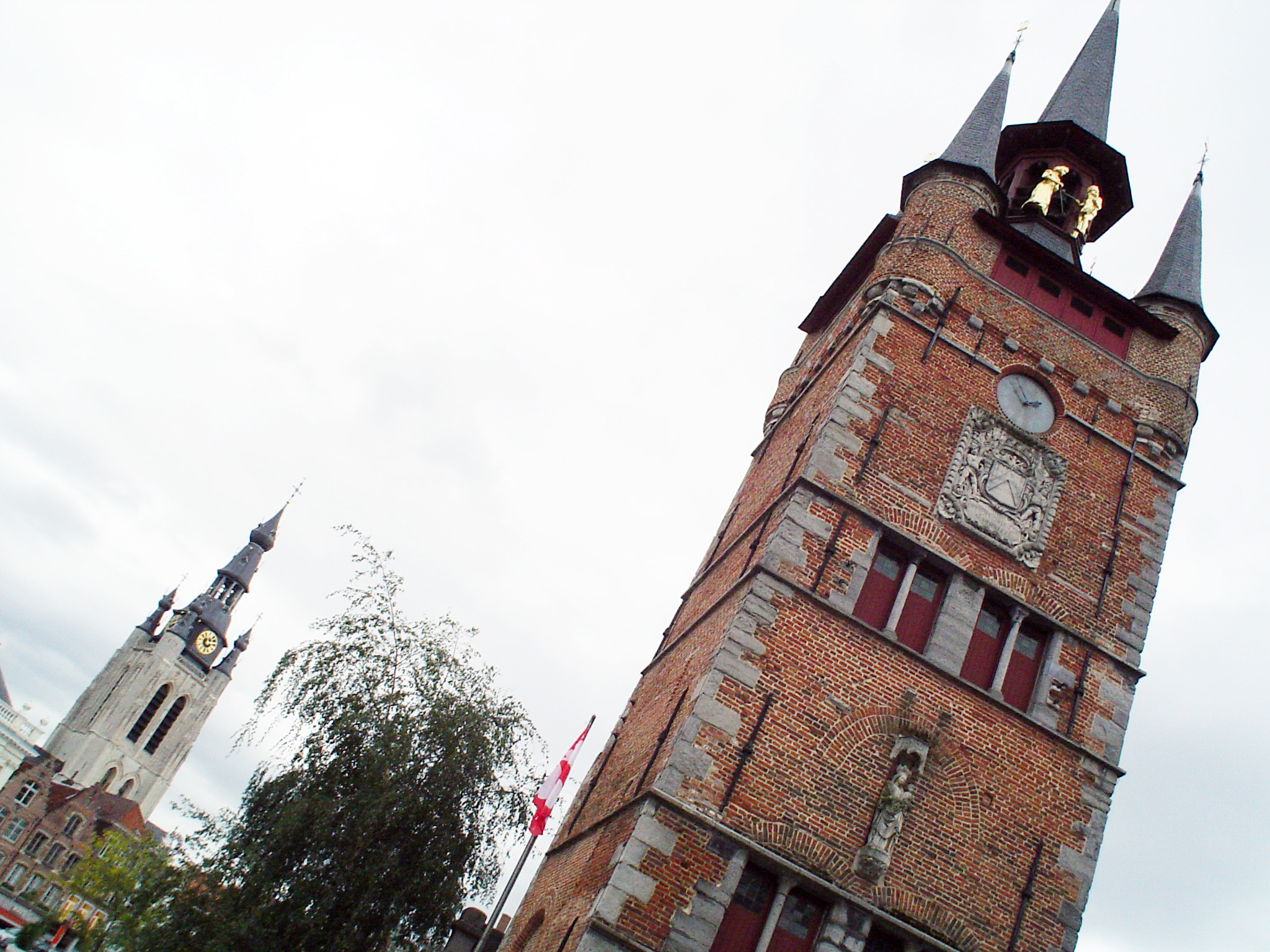
Belfry of Kortrijk
Manten and Kalle live at the top of the belfry, and twice an hour they raise their hammers and hit the bell. They are not real, but everyone in Kortrijk talks about them as if they are. He wears a hat. She does not. They are made of bronze and dressed by the city for the seasons. What is strange is not that the two figures strike a bell - belfries across Flanders have jacquemarts - but that these particular two have been gone for almost six hundred years. The originals were taken away to Dijon in 1382 as part of the spoils of a battle Flanders lost. The Manten and Kalle visitors see today were cast in 1961, after the city decided that some things are owed back, even to towers.
A Cloth Town's Pulse
The belfry went up around 1307, on the main market square, when Kortrijk - then usually written Courtray - was prospering on the back of Flemish cloth. The town's wealth was its looms, and the looms needed a clock. The bell tower kept the rhythm of the working day, signalling fire, alarm, the start and end of shifts, the death of a magistrate, the announcement of a treaty. The original tower was taller, but it had stability problems, and the upper section was shortened and crowned with a lower spire flanked by four small corner spires. That silhouette is the one you see today, though it now leans a measurable amount to the west, the way old Flemish towers tend to in soft river clay.
The Cloth Hall That Disappeared
For most of its life the belfry was not freestanding. It was the main tower of the city's Cloth Hall, built in 1410, a long arcaded building where wool merchants stored bales and conducted business. When that hall became too small in the 15th century, a larger one went up on what is now Theatre Square, and the old halls were turned into twenty-two small houses with a shared courtyard - a small medieval co-op that lasted, in various forms, until the late 19th century. In 1896 the city authorities, in the name of urban hygiene and traffic flow, bought up the houses and tore them down. The belfry was supposed to come down too. It blocked the sightline toward Tournai Street. Citizens protested. The architect Joseph Viérin restored it. The tower stayed.
Mercury on Top
Look up. The golden figure on top of the spire is not a saint. It is Mercury, the Roman god of merchants and thieves and travellers - which Kortrijk's wool traders evidently saw as a single category. He was added in 1712 and carries his caduceus and his winged hat above a city that has always lived by trade. On the frontispiece below, the city's coat of arms shares space with a statue of the Virgin, the two patrons of a working town: commerce in front of God, or God in front of commerce, depending on which window you look out of. The Second World War nicked the belfry but did not destroy it. A proper restoration in the 1950s put it right again.
Manten, Kalle, and Westrozebeke
On 27 November 1382, a French army crushed a Flemish uprising at the Battle of Westrozebeke, about 25 kilometres north of Kortrijk. Some 26,000 Flemings died, along with their leader Philip van Artevelde. Among the punishments inflicted on Kortrijk afterwards was the removal of the city's bell jacks - Manten the man and Kalle the woman, cast figures whose job was to strike the bell. They were carted off to Dijon, Burgundy's capital, where they served a duchy for centuries. In 1961, after restoration of the belfry was largely complete, the sculptor Victor Cassiman cast new ones, and Manten and Kalle came home in modern bronze. They mark the hours now. Children point at them. Locals dress them for Christmas. A city that lost something in 1382 made it again in 1961, which is, in its way, what European towns do.
Climbing the Stairs
Unlike most of Belgium's UNESCO belfries, this one is free. A narrow steep staircase, open to the public without charge, leads up past the carillon's clock chamber and out toward the leaning crown. In 1999 the belfry was added to the World Heritage List as one of the Belfries of Belgium and France - fifty-six towers across two countries, recognised not as religious buildings but as civic ones. The point of a belfry, UNESCO's citation notes, is that it does not belong to a bishop or a king. It belongs to the town. A carillonneur plays from a hand keyboard on Sundays, holidays, and market days. In summer there are concerts. The 16th-century carillon was replaced again in 1994. The bells, like the towns that rang them, have been recast many times.
From the Air
50.828°N, 3.266°E, in the centre of Kortrijk, West Flanders. The belfry stands free on the Grote Markt, with the Lys/Leie River 200 m to the north. From the air the tower's slight westward lean is just discernible against the surrounding square. Cruise at 1,500-2,500 ft for a clear look at the medieval centre. Nearest airports: Kortrijk-Wevelgem (EBKT, ~5 km west) and Lille-Lesquin (LFQQ, ~28 km southwest).