Bell Centre: Where Montreal's Heart Beats Loudest
On November 9, 1997, Bret Hart locked Shawn Michaels in his own finishing move at the Bell Centre, and the referee called for the bell. Hart had never submitted. The crowd erupted. Vince McMahon had secretly ordered the match ended, betraying one of wrestling's biggest stars in his home country. The "Montreal Screwjob" became the most talked-about moment in professional wrestling history -- and it happened in an arena that was barely eighteen months old. The Bell Centre had opened on March 16, 1996, replacing the beloved Montreal Forum as the home of the Canadiens. Within two years it had already generated a moment that would define it far beyond hockey. That capacity for drama -- planned and unplanned, on ice and off -- is what makes this building more than a venue. It is where Montreal goes to feel something together.
Born from a Championship
Construction on the Bell Centre began on June 22, 1993, almost two weeks after the Montreal Canadiens defeated the Los Angeles Kings at the Forum to win their 24th Stanley Cup -- which remains their most recent championship. The timing was symbolic: the team celebrated a glorious past even as they broke ground on a future that would leave the Forum behind. Originally named the Molson Centre after the brewing company that owned the Canadiens, the arena was renamed in 2002 when Bell Canada acquired the naming rights. What Molson built, however, was more than a corporate venue. With 20,962 seats in hockey configuration, it is the largest indoor arena in Canada and the second-largest hockey arena in the world. The design was handled entirely by a local consortium rather than the usual American arena firms, resulting in steeply sloped grandstands that give even upper-deck fans a sense of proximity to the ice.
Twenty-Four Banners and One Empty Seat
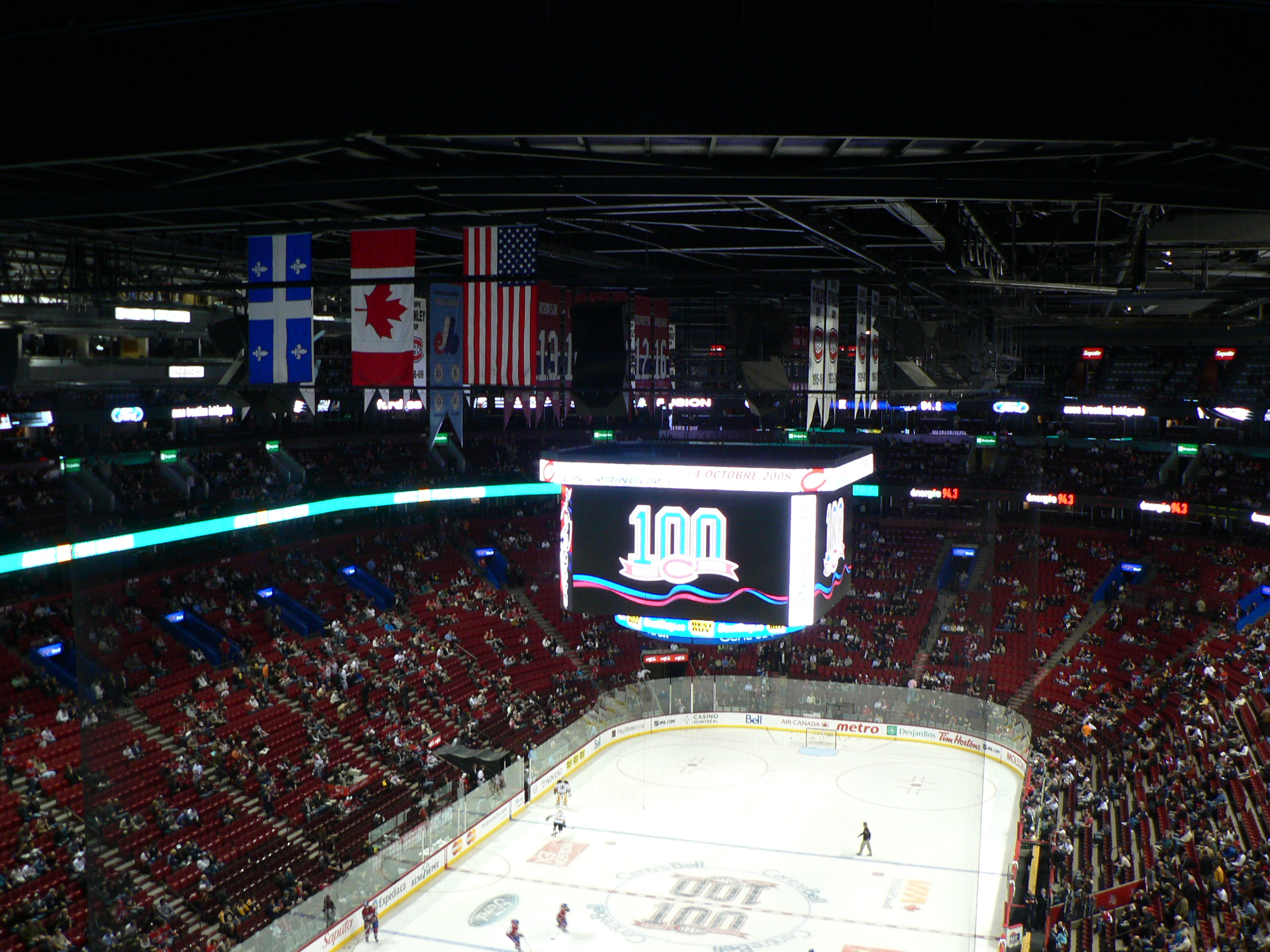
The Canadiens are the most decorated franchise in NHL history, and the Bell Centre serves as their living museum. Championship banners hang from the rafters alongside the retired numbers of legends: Maurice Richard, Jean Beliveau, Guy Lafleur, Patrick Roy. On October 18, 2005, the team raised the numbers of Montreal Expos legends Gary Carter, Andre Dawson, Rusty Staub, and Tim Raines on a single banner -- a tribute to the baseball team that had left for Washington, D.C. after the 2004 season. The arena's most poignant gesture came on December 9, 2014, when the Canadiens hosted the Vancouver Canucks in their first home game after Jean Beliveau's death. A memorial tribute preceded the game. The building was sold out at 21,286 -- but the official attendance was listed as one fewer, leaving a symbolic empty seat for Beliveau.
The Stage Beyond the Ice
Celine Dion has performed at the Bell Centre fifty times -- more than any other artist -- from her Falling into You tour in 1996 through the Courage World Tour in 2020. On New Year's Eve 1999, she closed her Let's Talk About Love tour in the arena before stepping away from music for three years. The roster of performers reads like a half-century of popular music compressed into three decades: The Rolling Stones, Paul McCartney, Metallica, Lady Gaga, Taylor Swift, Drake. In August 1999, the third national tour of Les Miserables stopped for a twelve-day run, with Robert Marien -- who had originated the role of Jean Valjean in Paris in 1980 -- rejoining the cast exclusively for the Montreal performances. The building has also hosted UFC events, NBA preseason games, World Figure Skating Championships, and the 2009 NHL All-Star Game. It is, in every sense, Montreal's living room for spectacle.
Sirens, Screwjobs, and Sold-Out Nights
The Bell Centre is one of only two NHL arenas that uses an old-style siren to mark the end of periods instead of a horn -- a tradition inherited from the Montreal Forum, just as the TD Garden in Boston inherited its siren from the old Boston Garden. Canadiens home games have been virtually sold out since October 2005, giving the arena a permanent atmosphere of intensity. During the 2021 Stanley Cup Final, when the Canadiens played the Tampa Bay Lightning in a pandemic-limited arena, thousands of fans gathered outside the building to watch on a screen beside the La Cage sports bar. On April 20, 2024, the arena hosted its first PWHL game -- Montreal Victoire versus the Toronto Sceptres -- and the sellout crowd of 21,105 set a new attendance record for women's hockey. In February 2025, the Bell Centre hosted four round-robin games of the NHL 4 Nations Face-Off alongside TD Garden in Boston.
Downtown Montreal's Anchor
The Bell Centre sits in the borough of Ville-Marie in downtown Montreal, connected to the Lucien-L'Allier commuter rail terminal, two Metro stations, and the underground city -- the 20-mile network of tunnels that makes Montreal navigable in winter. The 1250 Rene-Levesque skyscraper stands across the street. The arena underwent a $100 million renovation starting in 2015, replacing all seats, renovating concourses, adding restaurants and public Wi-Fi, and converting the avenue in front into a pedestrian street. Outside, a statue of Guy Lafleur stands as permanent sentinel. Inside, the three-tier layout climbs steeply from the red seats of the 100 level to the Club Desjardins corporate boxes to the upper 300 section, where the Ford Zone features cheerleaders and flashing lights on one end and the Family Zone offers child-priced tickets on the other. It is democratic in its way -- 21,000 people watching the same puck, hearing the same siren, sharing the same sharp intake of breath.
From the Air
The Bell Centre sits at 45.496N, 73.569W in downtown Montreal's Ville-Marie borough. From the air, the arena's large rectangular roof is visible near the intersection of De la Gauchetiere and de la Montagne streets, adjacent to the Lucien-L'Allier rail terminal and across from the 1250 Rene-Levesque skyscraper. Nearby airports include Montreal-Trudeau International (CYUL) approximately 20 km west and Montreal-Saint-Hubert (CYHU) 15 km southeast. Best viewed at 3,000-5,000 feet AGL. Mount Royal rises to the north, and the St. Lawrence River waterfront lies to the south.