Bell Labs
Nine Nobel Prizes in Physics. The transistor. The laser. The Unix operating system. The C programming language. Information theory. Solar cells. Radio astronomy. The charge-coupled device. All of it came from a cluster of buildings on Mountain Avenue in Murray Hill, New Jersey, where for the better part of the twentieth century, Bell Telephone Laboratories operated what may have been the most consequential research institution the world has ever seen. By one accounting, eleven Nobel Prizes and five Turing Awards trace their origins to work done here - a record unmatched by any corporate lab, and rivaled by only a handful of universities.
From a Shack on West Street
Bell Labs began not with a grand vision but with a practical problem: the telephone needed to get better. In 1925, AT&T and Western Electric consolidated their scattered engineering departments into Bell Telephone Laboratories, Inc., headquartered at 463 West Street in New York City. The new organization started with 3,600 engineers, scientists, and support staff in roughly 400,000 square feet of space. Its mandate was straightforward - improve the Bell System's telephone network. But the charter was broad enough, and the funding generous enough, that researchers could follow problems wherever they led. It was this combination of practical purpose and intellectual freedom that made Bell Labs extraordinary. A scientist tasked with reducing static on long-distance phone lines might, as Karl Jansky did in 1931, discover that the static was coming from the center of the Milky Way - and thereby found an entire field of science.
The Transistor and Everything After
On December 23, 1947, John Bardeen, Walter Brattain, and William Shockley demonstrated the first transistor - a tiny point-contact germanium device that would ultimately replace the vacuum tube and reshape civilization. The three shared the 1956 Nobel Prize in Physics for the invention. But the transistor was only the most famous product of a staggering run of discoveries. In 1948, Claude Shannon published 'A Mathematical Theory of Communication,' which established information theory and laid the mathematical foundation for the digital age. In 1954, Daryl Chapin, Calvin Fuller, and Gerald Pearson created the first practical solar cell. In 1958, Arthur Schawlow and Charles Hard Townes published the theoretical description of the laser, and in 1960, Ali Javan built the first gas laser at the Murray Hill campus. That same year, Mohamed Atalla and Dawon Kahng demonstrated the first working MOS transistor, the building block of every modern integrated circuit.
Unix, C, and the Software Revolution
In 1969, Dennis Ritchie and Ken Thompson, working in a corner of the Murray Hill facility, created the Unix operating system. Ritchie went on to develop the C programming language to write Unix more efficiently. These were not billion-dollar initiatives with hundreds of engineers. They were the work of a small group of brilliant people given the freedom to solve interesting problems. The culture that produced Unix also produced the programming languages B, C++, S, SNOBOL, AWK, and AMPL. It produced the one-time pad cipher, negative feedback amplifiers, the vocoder, the electret microphone, the charge-coupled device, orthogonal frequency-division multiplexing, and molecular beam epitaxy. The breadth is almost absurd. Bell Labs researchers were investigating the origins of the universe - Arno Penzias and Robert Wilson discovered the cosmic microwave background radiation in 1965, earning the 1978 Nobel Prize in Physics - while their colleagues down the hall were developing the switching systems that routed phone calls.
Decline of an Empire
The breakup of the Bell System in 1984 began Bell Labs' slow unraveling. Separated from its guaranteed funding stream, the laboratory became a subsidiary of AT&T Technologies, and budgets shrank. In 1996, AT&T spun off its technology divisions as Lucent Technologies, which took Bell Labs with it. The split with AT&T also carved off AT&T Laboratories as a separate entity. Lucent merged with French telecom company Alcatel in 2006, and Nokia acquired the combined company in 2016. Through each transition, the scope and headcount contracted. The iconic Holmdel complex, a 1.9-million-square-foot mirrored-glass building designed by architect Eero Saarinen and set on 473 acres, was closed in 2007 and later redeveloped as the mixed-use Bell Works project. The Murray Hill campus, where the transistor was born and Unix was written, remains Nokia's global Bell Labs headquarters, but with a fraction of its former population.
What Murray Hill Made
What distinguished Bell Labs from other great research institutions was not just the quality of its scientists but the environment they worked in. Researchers were encouraged to wander - literally and intellectually. The long corridors of the Murray Hill building were deliberately designed so that a physicist walking to lunch would pass a mathematician, a chemist, and an electrical engineer. Cross-pollination was not a management buzzword; it was an architectural principle. The results speak for themselves: eleven Nobel Prizes, five Turing Awards, and a catalogue of inventions that underpins modern computing, telecommunications, and physics. Today Nokia Bell Labs operates from ten locations worldwide, from Murray Hill to Espoo, Finland, to Shanghai. But the golden age - when a single campus in suburban New Jersey routinely produced discoveries that reshaped the world - belongs to a model of corporate research that the industry has largely abandoned.
From the Air
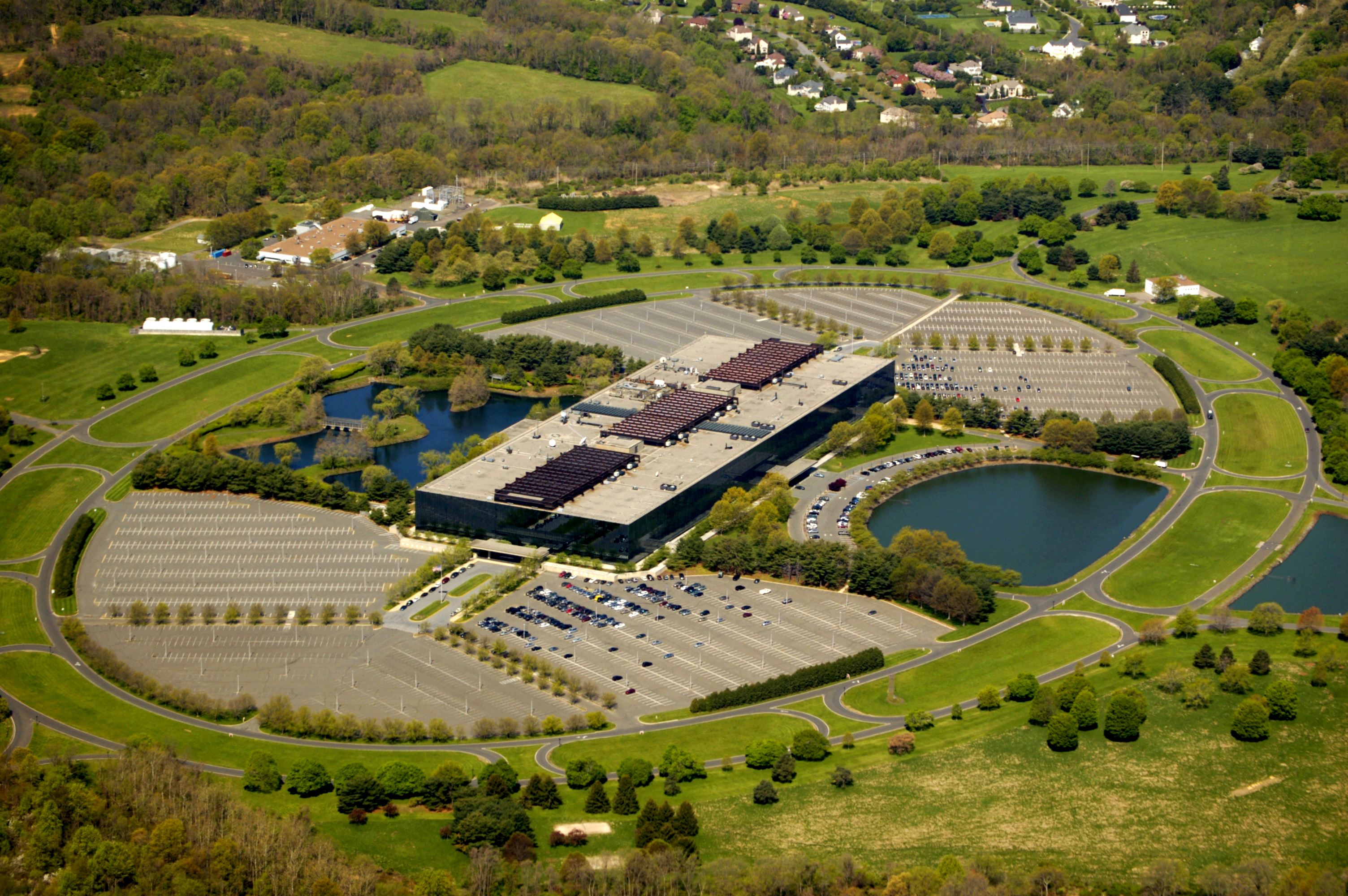
Located at 40.683°N, 74.400°W in Murray Hill, New Providence Township, Union County, New Jersey. The campus at 600 Mountain Avenue is visible as a large complex amid suburban greenery. Newark Liberty International Airport (KEWR) is approximately 12 nm to the east. Morristown Municipal Airport (KMMU) is 8 nm to the northwest. Best viewed at 3,000-4,000 ft AGL.