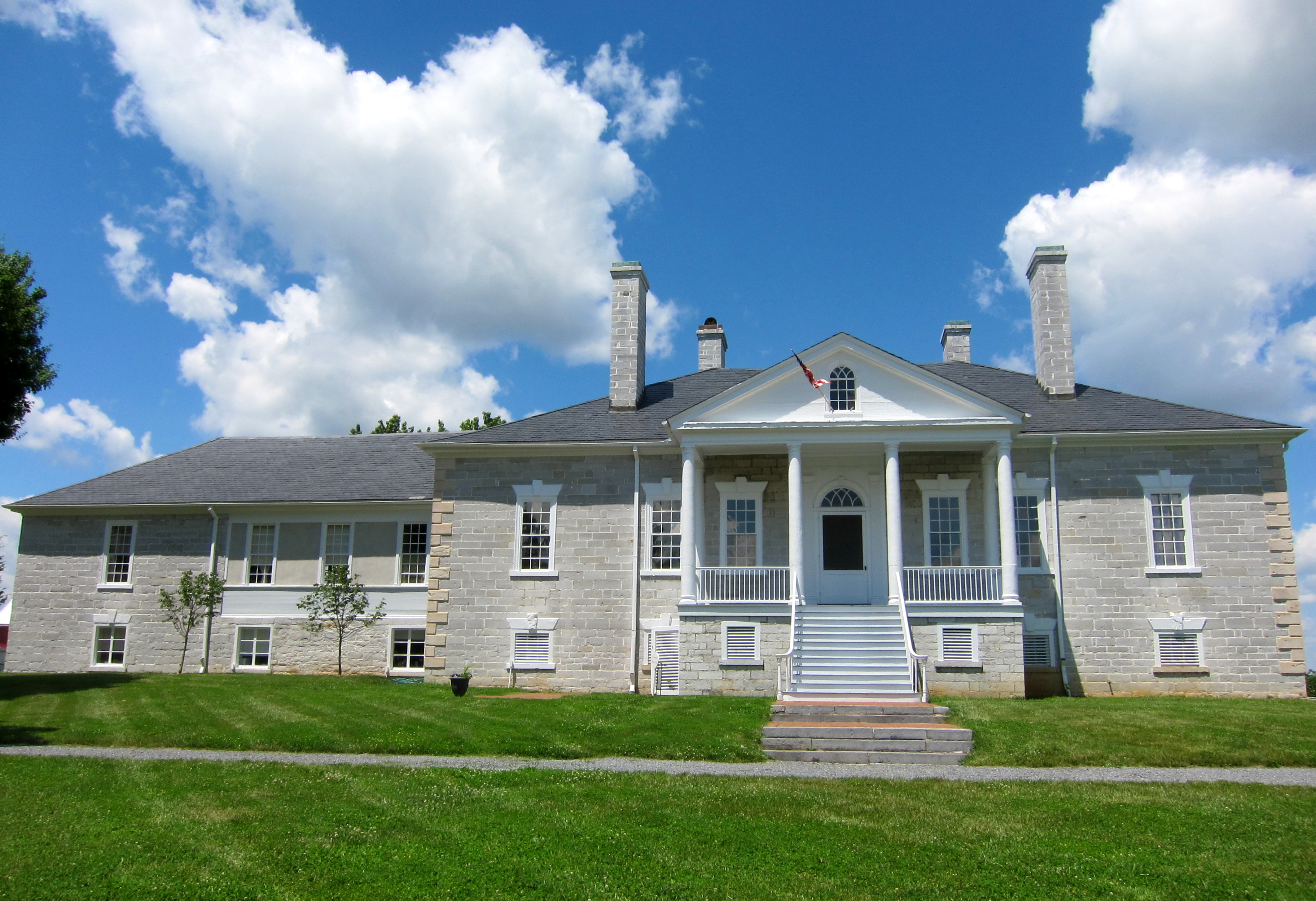
Belle Grove Plantation
Thomas Jefferson never visited Belle Grove Plantation, but his fingerprints are all over it. When Major Isaac Hite Jr. began planning a grand new manor house in 1794, his brother-in-law James Madison asked Jefferson -- then between terms as Secretary of State and Vice President -- to review the architect's plans. Jefferson made a number of suggestions that strongly influenced the final design, lending the house its refined Federal-style symmetry: the prominent portico with four Tuscan columns, the seven-bay facade, the elegant proportions of a building meant to announce its owner's place in the world. The result, built between 1794 and 1797 from limestone quarried on the property, still stands in the northern Shenandoah Valley of Virginia, one of the best-preserved eighteenth-century homes in the country.
The German Pioneer's Legacy
The story of Belle Grove begins a generation before the house itself. Jost Hite, Isaac Jr.'s grandfather, was a German immigrant who journeyed into the Shenandoah Valley in 1732 with his partner Robert McKay and sixteen other families. They traveled the Valley Pike into the northern valley to settle land acquired through two colonial grants. Jost's son, Isaac Hite Sr., purchased property southwest of what would become Middletown -- first a parcel in 1748, then more in 1770. Together, these tracts formed the Belle Grove estate. The first structure on the site, a large limestone building later called the "Old Hall," was built around 1750 for a tenant farmer. Its foundations are still visible near the smokehouse. Isaac Jr. attended the College of William & Mary and served in the Continental Army during the Revolutionary War. In 1783, his father gave him and his bride, Nelly Conway Madison -- sister of the future president -- the Belle Grove house and grounds.
A President's Honeymoon
The Madison connection ran deep. James Madison visited Belle Grove several times during its early years, even staying in the Old Hall during his own honeymoon in 1794 while the new mansion was under construction. Through Madison, Jefferson channeled his architectural suggestions to the builder. The finished house was a statement of ambition: a symmetrical main block with a basement, a piano nobile main floor, and an attic half-story, its corners decorated with quoins and its south facade finished in dressed limestone. Originally, neo-classical porticos graced all four sides, though only the front and back survive today. Inside, the woodwork traces a transitional style from Georgian to Federal, each room reflecting the confident taste of the new republic's planter class. After Nelly's death in 1802, Major Hite married Ann Tunstall Maury and expanded the estate dramatically -- to 103 enslaved workers, a general store, grist-mill, saw-mill, and distillery. A west wing was added in 1815, completing the facade that stands today.
Blood on the Doorstep
The Civil War brought Belle Grove into history a second time. In October 1864, Union General Philip Sheridan used the plantation as his headquarters during the Battle of Cedar Creek, a pivotal engagement in the Shenandoah Valley Campaign. Confederate forces launched a surprise dawn attack that initially routed the Union line, but Sheridan rallied his troops in a famous counterattack that turned the tide. Among the Confederate casualties was Major General Stephen Dodson Ramseur, one of the youngest division commanders in Lee's army. Wounded in the fighting, Ramseur was carried to Belle Grove, where he died. A monument at the plantation entrance, erected in 1919, marks his memory. The battlefield surrounding the estate, now part of the Cedar Creek and Belle Grove National Historical Park, encompasses 3,593 acres of the valley floor where the fighting raged.
Preservation Against the Odds
After Major Hite's death in 1836 and his widow Ann's in 1851, Belle Grove was sold out of the family. The estate passed through a succession of owners, losing much of its original character. The Brumback family purchased it in 1907 and ran an inn there in the 1920s. Then, in 1929, Francis Welles Hunnewell of Wellesley, Massachusetts, bought the property and devoted two decades to its careful restoration. When Hunnewell died in 1964, he bequeathed the house, 100 acres, and a $100,000 endowment to the National Trust for Historic Preservation. Belle Grove opened as a museum in 1967 and has remained both a public historic site and a working farm ever since. Today, the plantation's 283 acres include the limestone manor, an 1815 icehouse and smokehouse, a slave cemetery, a heritage orchard, and a demonstration garden designed by the Garden Club of Virginia. From its grounds, the views sweep across the Shenandoah Valley to the Blue Ridge in the east and the Alleghenies to the west -- the same vistas that greeted Jost Hite's family when they first walked this valley nearly three centuries ago.
From the Air
Belle Grove Plantation lies at approximately 39.02°N, 78.30°W in Frederick County, Virginia, about one mile southwest of Middletown in the northern Shenandoah Valley. From the air, the limestone manor house and its outbuildings are visible amid open farmland flanked by the Blue Ridge to the east and the Alleghenies to the west. The Cedar Creek battlefield extends to the south. Nearby airports include Winchester Regional Airport (KOKV) about 12 miles to the north and Front Royal-Warren County Airport (KFRR) about 15 miles to the northeast. The Valley Pike (US Route 11) runs nearby. Best viewed at 1,500-2,500 feet AGL to appreciate the plantation's setting within the broader valley landscape.