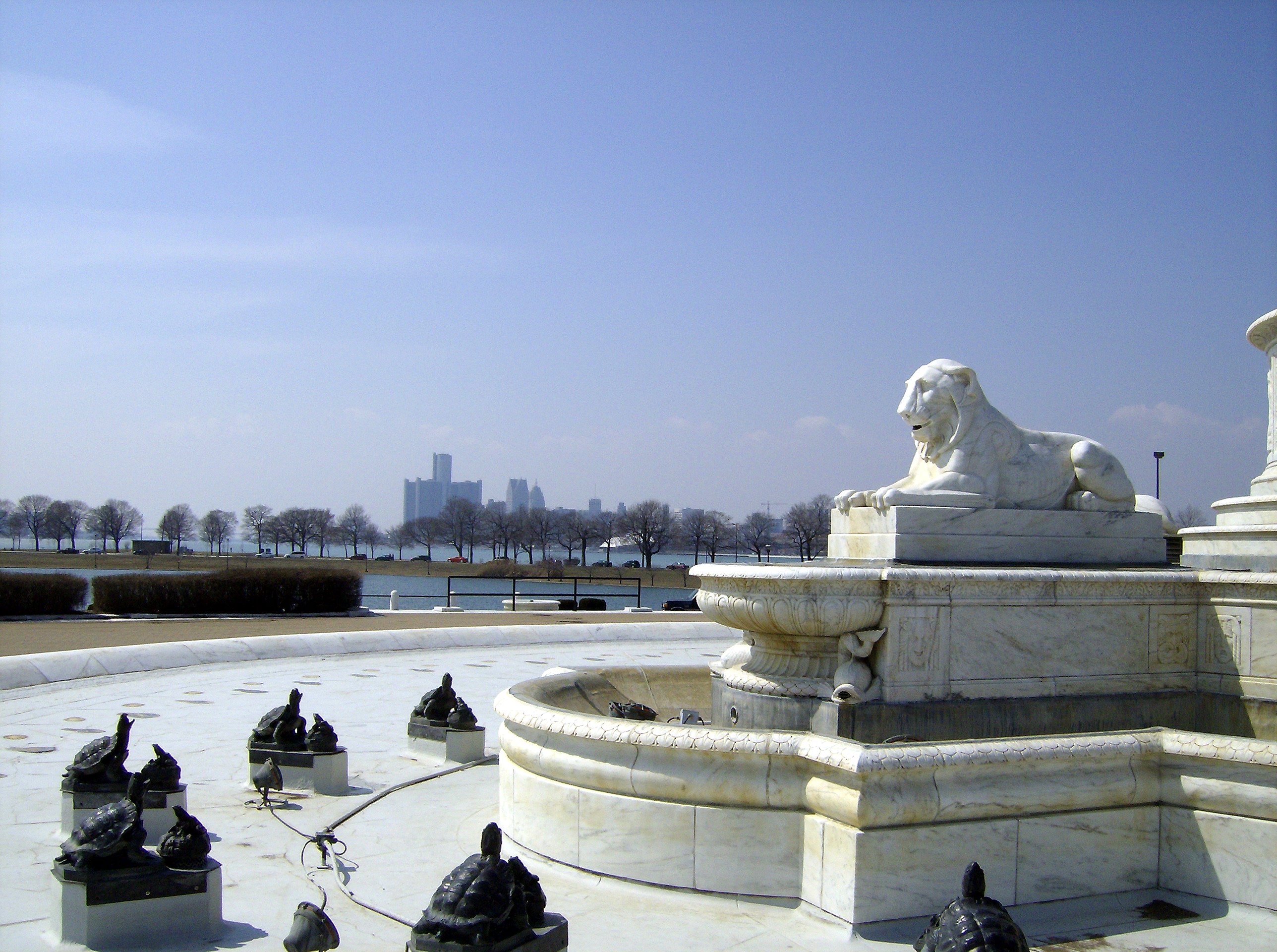
Belle Isle Park
The French called it Ile aux Cochons -- Hog Island -- because they let their pigs roam free on it. On July 4, 1845, picnickers on the island decided that name would not do. They rechristened it Belle Isle in honor of Isabelle Cass, daughter of Michigan's territorial governor, and the French words did their work: beautiful island. Today Belle Isle sits in the Detroit River between the United States and Canada, a 982-acre green jewel connected to the city by the MacArthur Bridge. It is the largest city-owned island park in the United States, the second most-visited state park in the nation after Niagara Falls, and a place where Frederick Law Olmsted's landscaping vision, Albert Kahn's architecture, and Detroit's own turbulent history all meet on a single piece of ground surrounded by international waters.
From Livestock to Landscape Architecture
Belle Isle's transformation from pastureland to public park began in the 1880s, when Detroit hired Frederick Law Olmsted -- the designer of New York's Central Park -- to lay out the island. Only some elements of Olmsted's plan were completed, but his vision of winding waterways, naturalistic plantings, and open meadows set the tone. The island accumulated landmarks at a remarkable pace: a conservatory and aquarium both designed by Albert Kahn opened in 1904, the same Kahn who would go on to design Cadillac Place and the Ford Rouge Factory. The Belle Isle Casino appeared in 1908 (never a gambling house -- it served as a public gathering hall). And architect Cass Gilbert, who also designed the United States Supreme Court Building, contributed the James Scott Memorial Fountain, completed in 1925 at a cost of $500,000, with a lower bowl 510 feet in diameter and a central spray reaching 125 feet.
The Spark That Started Every Engine
One night in 1908, automaker Byron Carter stopped on Belle Isle to help a woman whose Cadillac had stalled. When he hand-cranked the engine, it kicked back and shattered his jaw. Complications led to pneumonia, and Carter died. Henry Leland, founder of Cadillac Motors, was haunted by the death. "The Cadillac car will kill no more men if we can help it," he declared, and hired inventor Charles Kettering. Kettering developed the electric self-starter at his new company, Delco, and within a few years the hand crank vanished from automobiles entirely. A single roadside assist on Belle Isle had changed the design of every car on earth. The island's connection to automotive history deepened during World War II, when the military used it for training and staged a mock Pacific island invasion, temporarily renaming it "Bella Jima" after the Battle of Iwo Jima.
A Marble Lighthouse and a Herd of Deer
Belle Isle collects oddities. The William Livingstone Memorial Light, on the island's eastern tip, is the only marble lighthouse in the United States, named for the president of the Lakes Carriers Association who championed Great Lakes navigational safety. The Dossin Great Lakes Museum holds one of the world's largest collections of model ships and the bow anchor of the legendary SS Edmund Fitzgerald. From the 1890s until 2004, a herd of European fallow deer roamed the island, but generations of inbreeding left the population vulnerable to disease. The last 300 were captured and relocated to the Detroit Zoo and the island's own nature center. And in 2022, the park's giant playground slide -- a beloved fixture since 1967 -- made national news when a fresh coat of wax sent riders airborne at alarming speeds, inspiring Detroit comedy rapper Gmac Cash to record a tribute song that landed him a spot on Jimmy Kimmel Live.
Rescue and Renaissance
By 2013, Detroit had declared bankruptcy and Belle Isle was struggling. The state of Michigan stepped in, signing a 30-year lease to operate the island as a state park. Governor Rick Snyder pledged up to $20 million in improvements over three years. Belle Isle formally became a state park on February 10, 2014, and the investment has paid off: the state has since poured $32 million into renovations, attendance topped 4 million in 2016, and the Anna Scripps Whitcomb Conservatory -- home to one of the largest municipally owned orchid collections in the country -- has been undergoing a major restoration. The island hosts IndyCar racing, a cross-state trail terminus for the Iron Belle Trail, Flower Day in May, and a roster of festivals that keep the sheds and grounds busy from spring through fall. Belle Isle has outlasted pigs, wars, bankruptcies, and over-waxed playground slides. The picnickers of 1845 chose well.
From the Air
Belle Isle is at 42.340N, 82.987W, an unmistakable island in the Detroit River directly east of downtown Detroit. From the air, the island's oval shape, internal canal system, and MacArthur Bridge connection to the mainland are clearly visible. The U.S.-Canada border runs through the channel south of the island. The James Scott Memorial Fountain on the island's western end is a distinctive circular feature. Nearest airports: Coleman A. Young International (KDET) 4nm west, Detroit Metropolitan Wayne County (KDTW) 18nm southwest, Windsor Airport (CYQG) 7nm south across the river in Canada. Best viewed at 2,000-4,000 feet AGL to appreciate the island's full layout against the Detroit skyline.