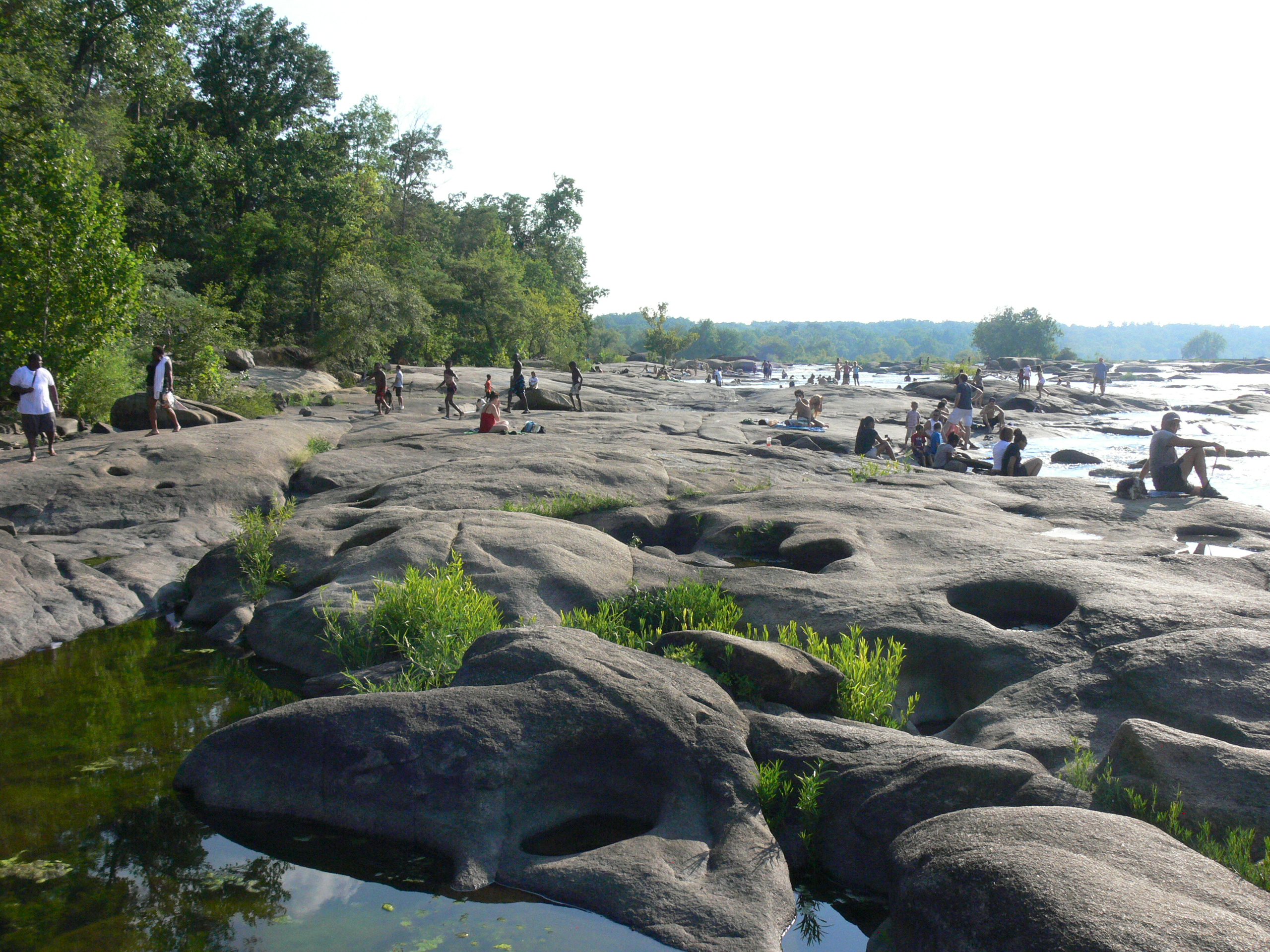
Belle Isle (Richmond, Virginia)
On a cold November morning in 1863, First Sergeant John L. Ransom of the Ninth Michigan Cavalry was marched across Richmond's long bridge and into a place he described as "a cold, bleak piece of ground" where "the winter winds have free sweep from up the river." The prison was Belle Isle, a 54-acre island in the James River enclosed not by walls but by a ditch -- step across it, and the guards shot. Today joggers cross a suspension footbridge beneath the Lee Memorial Bridge to reach the same island, where bike trails wind through woods alive with herons and cormorants, past the crumbling shell of a hydroelectric plant and the ghost outlines of a nail factory. Few urban parks carry so many layers of history so quietly.
Before the English Came
In the 1600s, the island and the surrounding stretch of the James River were part of the Tsenacommacah, the homeland of the Powhatan people. The English called it Broad Rock Island. Captain John Smith of Jamestown mapped it in 1607, noting the river's fall line and the rapids that made navigation above this point impossible for ocean-going ships. That geographic fact -- the end of navigable water -- would determine Richmond's location and the island's fate. By the eighteenth century, a fishery operated on Belle Isle, harvesting the shad and herring that ran thick in the James each spring. In 1814, the Old Dominion Iron and Nail Company built a nail factory, and by the 1860s a small village had grown on the island, complete with school, church, and general store.
The Ditch and the Dead Line
When the Civil War came to Richmond, Belle Isle became a prison camp for captured Union enlisted men. Between 1862 and 1865, roughly 30,000 prisoners passed through the island, held in the open air behind nothing more than an earthen breastwork with a ditch that served as the dead line. Lieutenant Bossieux commanded the camp with two sergeants described by prisoners as cruel. Half the six thousand men held at any given time had tents; the rest slept exposed to Virginia's winters. Accounts of conditions varied wildly between North and South, but the testimony of Peter DeWitt, an assistant surgeon at Jarvis Hospital in Baltimore who examined released prisoners in 1864, left little room for dispute. He described men in a "semi-state of nudity," suffering from scurvy, frostbite, chronic diarrhea, and starvation so severe that many had "partially lost their reason." As many as 1,000 prisoners died on the island. The Battle of Walkerton was fought as a failed Union attempt to free them.
Lincoln's Shock
In May 1864, President Abraham Lincoln sent Lucius Eugene Chittenden, Assistant Secretary of the Treasury, to investigate the condition of freed prisoners from Belle Isle. What Chittenden saw and reported back shook even a president who had grown accustomed to the war's horrors. Union soldiers had been left to freeze and starve within sight of the Confederate capital. Chittenden later published his eyewitness account in "Recollections of President Lincoln and His Administration" in the late 1890s, recording Lincoln's dismay that such suffering could occur in the shadow of a government that claimed to be fighting for human dignity. The island prison camp became one of the war's enduring symbols of the cost borne by ordinary soldiers caught in the machinery of opposing governments.
Turbines and Celluloid
After the war, Belle Isle reinvented itself through industry. The Virginia Electric Power Company built a hydroelectric plant on the island in 1904, harnessing the James River rapids that had always defined the site's geography. The plant operated until 1963, when it was abandoned along with several other buildings. The hulking concrete shell still stands, its turbine rooms open to the sky, slowly being reclaimed by Virginia creeper and river birch. The original Lee Bridge was built over the island in 1934 and replaced by the current span in 1988. Belle Isle was formally made a park in 1973, becoming part of the James River Park System. The island even made it to Hollywood: in the 2001 film Hannibal, the old power plant is visible as Agent Starling runs across the bridge on the island's south side.
An Island in the City
Today Belle Isle is one of Richmond's most popular urban escapes. A suspension footbridge slung beneath the Lee Memorial Bridge connects the northern bank to the island, while a wooden bridge provides access from the south. When the James runs low, you can boulder-hop across from the southern shore. From the island, the views encompass Hollywood Cemetery on its bluff, the old Tredegar Iron Works, and Richmond's downtown skyline. Songbirds, ducks, cormorants, and great blue herons fish the rapids. Squirrels and small mammals move through the underbrush. A small cliff face serves as a beginner's rock climbing wall. Sections of the trail system connect to the East Coast Greenway. It is a place where you can stand on ground that held Powhatan fishermen, colonial nail makers, starving prisoners of war, and hydroelectric turbines, and hear nothing but the James River pouring over its fall-line rocks.
From the Air
Belle Isle is located at 37.529N, 77.453W in the James River in downtown Richmond, Virginia. From the air, the island is clearly visible as a wooded 54-acre landmass in the middle of the James, directly beneath the Robert E. Lee Memorial Bridge (US-1/US-301). The James River rapids are prominent around the island. Hollywood Cemetery sits on the bluff to the north, and the Tredegar Iron Works complex is visible on the north bank just downstream. Nearest airports: Richmond International Airport (KRIC) approximately 8 nm east; Chesterfield County Airport (KFCI) approximately 9 nm southwest. Best viewed at 1,000-2,000 ft AGL following the James River through downtown Richmond. The island, bridge, and surrounding rapids make an unmistakable visual landmark.