Belle Meade Plantation
In 1881, a stallion named Iroquois became the first American-bred horse to win the Epsom Derby in England. Bred in Pennsylvania by Aristides Welch at Erdenheim Stud, Iroquois was purchased by William Hicks Jackson and brought to stand at stud at Belle Meade in 1886 -- five years after his Derby triumph. Belle Meade -- whose name means "beautiful meadow" in a blend of French and Old English -- was that sprawling farm outside Nashville where the Harding family had spent decades perfecting thoroughbred bloodlines on land that once bordered the ancient Natchez Trace. For nearly a century, those meadows produced some of the finest racehorses in America, powered by the labor of 136 enslaved people whose own stories are only now being fully told.
A Farm on the Trace
In 1807, a Virginian named John Harding purchased a log cabin and acreage along the Natchez Trace, the ancient Native American path connecting settlements in present-day Tennessee and Mississippi. Harding operated a blacksmith shop, cotton gin, and grist and saw mills, but it was horses that would define the property. By 1816 he was boarding thoroughbreds for neighbors, including Andrew Jackson, and breeding and racing his own. In 1823, Harding registered his racing silks with the Nashville Jockey Club. His son William Giles Harding inherited the farm in 1839 and expanded it relentlessly, accumulating land that would eventually total 5,400 acres. In 1853, William transformed his father's red brick Federal-style house into a Greek Revival mansion, covering the bricks in stucco and adding a two-story veranda with six solid limestone pillars quarried right on the property, styled in the Doric order.
War at the Racetrack
When the Civil War broke out in 1861, William Giles Harding donated $20,000 of his own money and raised $500,000 total for the Confederate cause. He was made a Brigadier General and placed in charge of the Nashville Munitions Factory. After Union forces took Nashville in April 1862, Harding was arrested and shipped north to Fort Mackinac in Michigan, where he spent six months imprisoned before paying a $20,000 bond and swearing an oath of allegiance. The plantation itself became a headquarters for Confederate General James Chalmers during the Battle of Nashville. On December 15, 1864, Union and Confederate forces clashed at the family's racetrack, about a mile northeast of the mansion. Bullet holes from that engagement are still visible in the limestone columns of the front veranda.
After Emancipation
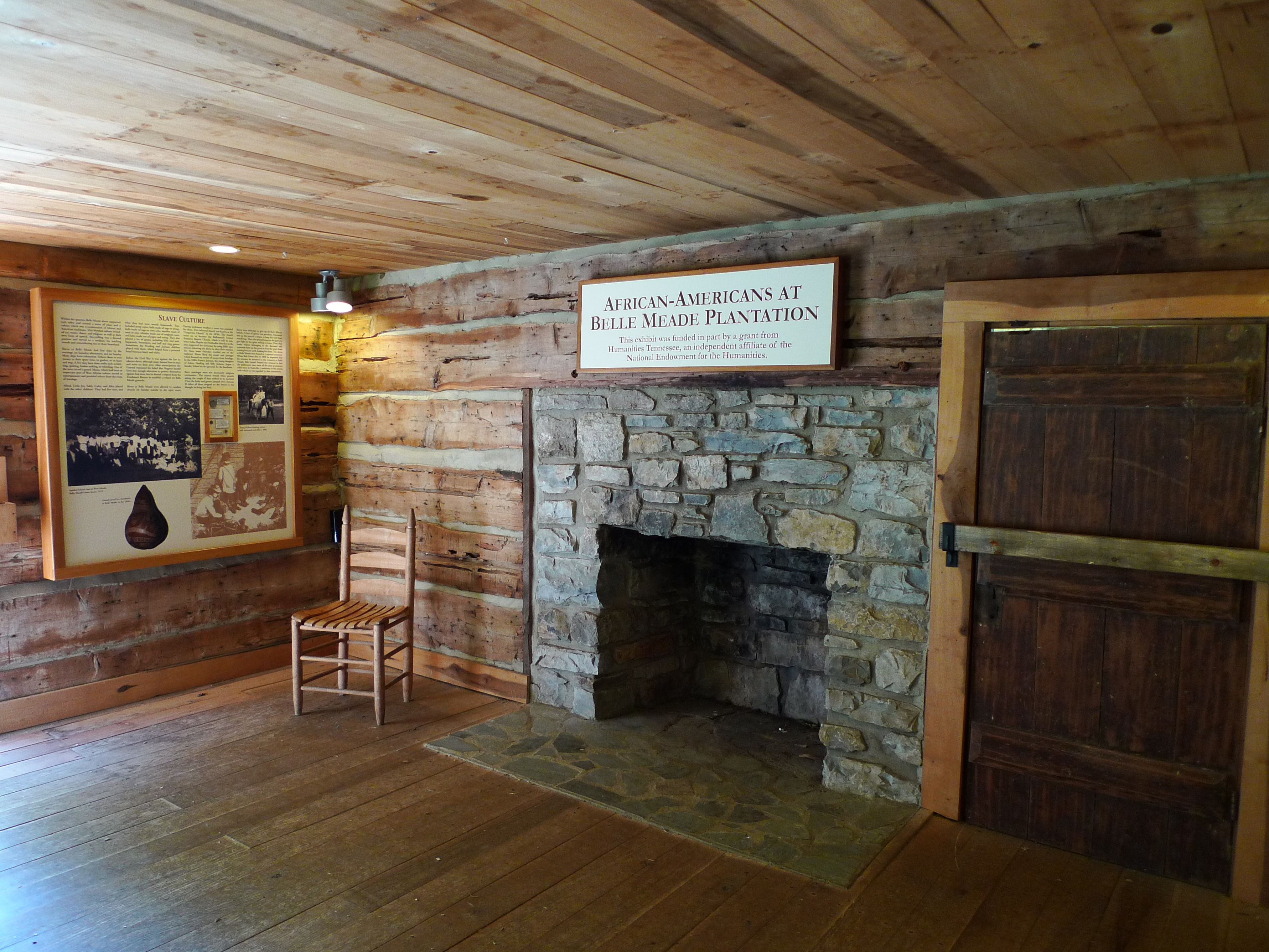
Of the 136 enslaved people who had lived and worked at Belle Meade before the war, 72 chose to stay on as paid employees after emancipation. Most moved into housing off the property, though some continued to live in cabins on site. Everyone who remained had to sign a contract of "18 Rules and Regulations" that included fines for infractions. Harding resumed his horse breeding operations with this reduced workforce and rebuilt Belle Meade's reputation. The farm's thoroughbreds became nationally celebrated, and the grounds even hosted the U.S. Wing Shot Championship in 1898. Annie Oakley visited the Belle Meade Gun Club on October 26, 1899, as a special guest in a shooting competition. Since the 1990s, the site's management has made a deliberate effort to tell the stories of the African Americans who built and sustained Belle Meade, both before and after emancipation.
Decline and Preservation
The Panic of 1893 hit the estate hard. Horse racing was losing ground to baseball as America's favorite pastime, and the temperance movement was turning public opinion against the gambling associated with the track. When William Hicks Jackson died in 1903 and his son William Harding Jackson followed the same year from typhoid fever, the family's hold on Belle Meade was finished. The estate was sold in 1906. A syndicate called The Belle Meade Land Company bought much of the acreage to develop an upscale residential community. In 1938, that community incorporated as the independent City of Belle Meade, an enclave that today includes Cheekwood Botanical Gardens and Percy Warner Park. The mansion and 30 remaining acres were preserved by private owners until 1953, when the State of Tennessee stepped in. Listed on the National Register of Historic Places in the 1970s, the site now operates as a museum, winery, and restaurant.
Inside the Mansion
The central Entrance Hall runs the full length of the house from west to east, aligned with the prevailing wind for natural cooling. Its walls display thoroughbred paintings by 19th-century artists Edward Troye, Harry Hall, and Henri De Lattre. The double parlors feature tulip poplar wood, Tennessee's state tree, while the library and dining rooms hold Harding family portraits and chandeliers once lit by methane gas. A winding cantilevered staircase carved from cherry rises through the upper floors in the Second Empire style. In 1883, William Hicks Jackson modernized the interior with three full bathrooms offering hot and cold running water, powered by a steam engine and boiler in the basement, a remarkable luxury for the era. The grounds still hold ten original outbuildings, including the 1790s log cabin that started it all.
From the Air
Located at 36.106N, 86.865W in southwestern Nashville, Tennessee. The mansion sits on a small hill near Richland Creek, surrounded by the residential City of Belle Meade. Best viewed at 2,000-3,000 feet AGL. Nearby airports include Nashville International (KBNA) approximately 12 nm east and John C. Tune Airport (KJWN) approximately 6 nm north. Percy Warner Park's forested ridges to the southwest provide a visual reference. The area is generally flat with rolling terrain.