Bellefontaine Cemetery
William Massie, a riverboat captain buried at Bellefontaine Cemetery, lived for decades with the bullet that killed Wild Bill Hickok lodged in his wrist. The slug had passed through Hickok's skull, hit the captain at the poker table, and stayed there for the rest of Massie's life. It is exactly the kind of improbable detail that defines this place. Bellefontaine is not just a cemetery -- it is a 314-acre outdoor museum of St. Louis ambition, a place where the explorer who mapped the West, the brewer who made the city's most famous beer, the inventor of the mechanical calculator, and the author of Naked Lunch all rest within walking distance of each other, surrounded by architecture that rivals any gallery in the region.
Born from Cholera
Bellefontaine Cemetery exists because of a catastrophe. In 1849, a cholera pandemic killed more than 4,000 people in St. Louis, overwhelming the city's graveyards, which were clustered along Jefferson Avenue near the city center. Residents feared that fumes from the crowded cemeteries were spreading the disease -- a belief rooted in the prevailing miasma theory. On March 7, 1849, banker William McPherson and lawyer John Fletcher Darby assembled the city's most prominent citizens to found the Rural Cemetery Association. They purchased the former Hempstead family farm five miles northwest of the city and modeled their design on Pere Lachaise in Paris and Mount Auburn Cemetery in Massachusetts. They hired landscape architect Almerin Hotchkiss, who had helped design Green-Wood Cemetery in Brooklyn, as superintendent. He served for 46 years. The first burial took place on April 27, 1850.
A Roll Call of American History
The 87,000 graves at Bellefontaine read like an encyclopedia of American ambition. William Clark, who explored the Louisiana Purchase territory with Meriwether Lewis, was reinterred here in the 1850s from his original burial site at the farm of his nephew John O'Fallon. Adolphus Busch, founder of the Anheuser-Busch brewing empire, rests in a mausoleum designed by Barnett, Haynes and Barnett in 1915. Thomas Hart Benton, the senator who championed western expansion, lies near Susan Blow, the 'Mother of Kindergarten.' William S. Burroughs the novelist rests not far from William Seward Burroughs the inventor, who created the mechanical calculator and founded the Burroughs Corporation. Horace Bixby, the steamboat pilot whose 'cub pilot' was Mark Twain, is here. So is James Eads, who engineered bridges, railroads, and ironclad warships for the Union.
Sullivan's Tomb
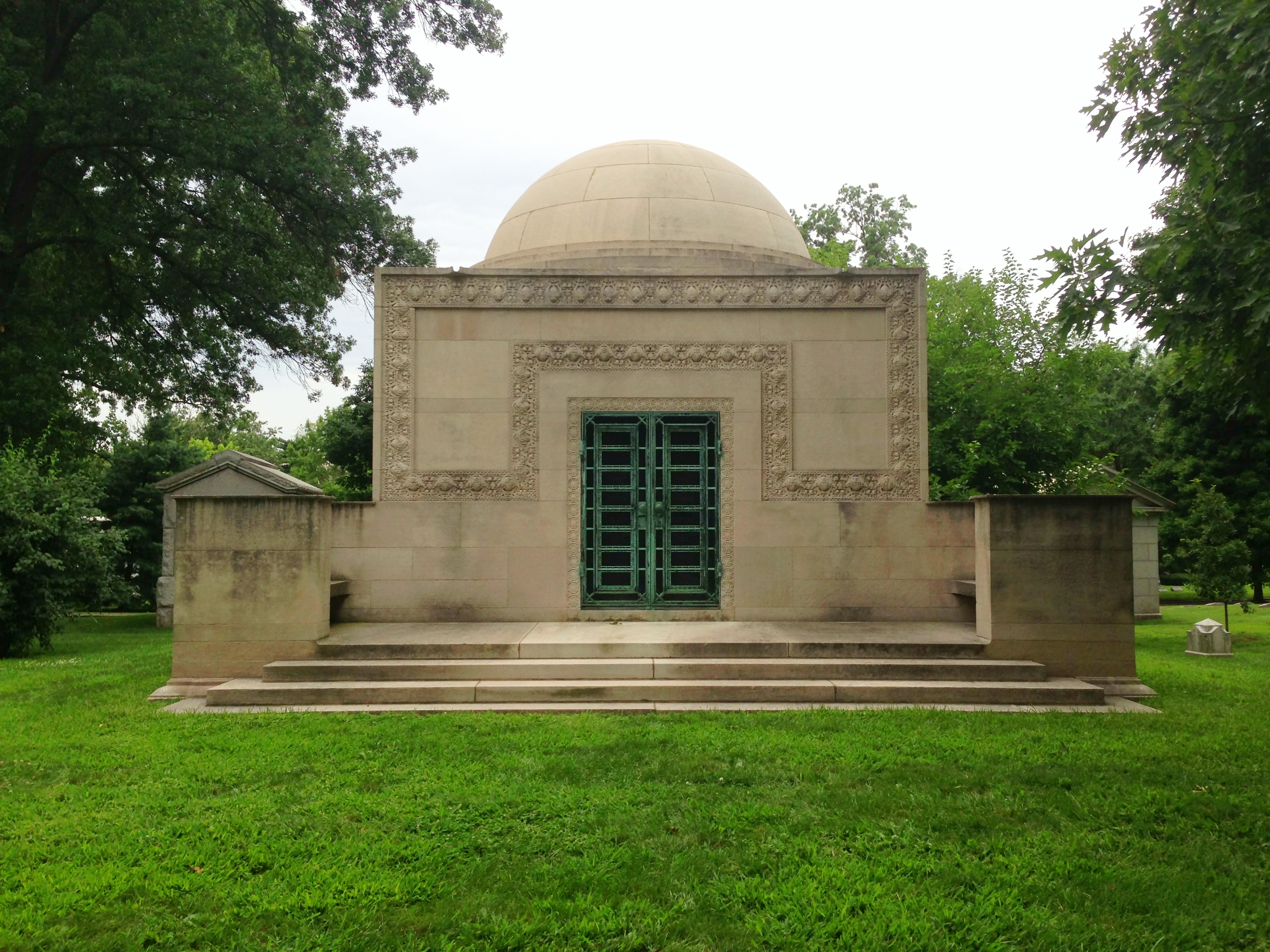
Bellefontaine holds the largest collection of private mausoleums and sarcophagi in Missouri, and its architectural crown jewel is the Wainwright Tomb, designed by Louis Sullivan in 1892 for Charlotte Dickson Wainwright. Sullivan, the father of the Chicago School of architecture and mentor to Frank Lloyd Wright, created a structure that the National Register of Historic Places recognized as architecturally significant. The tomb's ornamental terra cotta panels are considered among Sullivan's finest decorative work. Other mausoleums overlook the Mississippi River in Classical, Romanesque, Gothic, and Egyptian styles. The Busch Mausoleum for Adolphus Busch and his wife Lilly Anheuser is a monumental Romanesque structure. The cemetery's architecture spans nearly two centuries of American funerary design, from tall obelisks to elaborate family crypts.
A Living Landscape
Bellefontaine is also an accredited arboretum with more than 180 species of trees and shrubs across its 314 acres of rolling terrain. Hotchkiss designed the roadways and plantings to create the picturesque landscapes that Victorian Americans prized -- winding paths, wooded hillsides, and carefully framed views. The cemetery was listed on the National Register of Historic Places in 2014. With more than enough open land for 200 years of burials at current rates, some unused acreage has been converted to prairie and woodland, creating habitat alongside headstones. About 100 graves are added each year. The Hotchkiss Chapel, renovated in 2009, hosts weddings and memorial services. Guided tours cover the main historical and architectural highlights for a public that increasingly sees Bellefontaine not as a place of death but as one of St. Louis's most extraordinary collections of art, history, and landscape design.
From the Air
Located at 38.697°N, 90.234°W in north St. Louis, approximately 5 nm north of downtown. The 314-acre cemetery is visible from altitude as a large green space with winding roads, mature tree canopy, and scattered white monuments along a ridge overlooking the Mississippi River. Nearest airports: KSTL (St. Louis Lambert International, 8 nm NW), KCPS (St. Louis Downtown, 7 nm SE). The Mississippi River and Chain of Rocks Bridge are visible to the north and east.