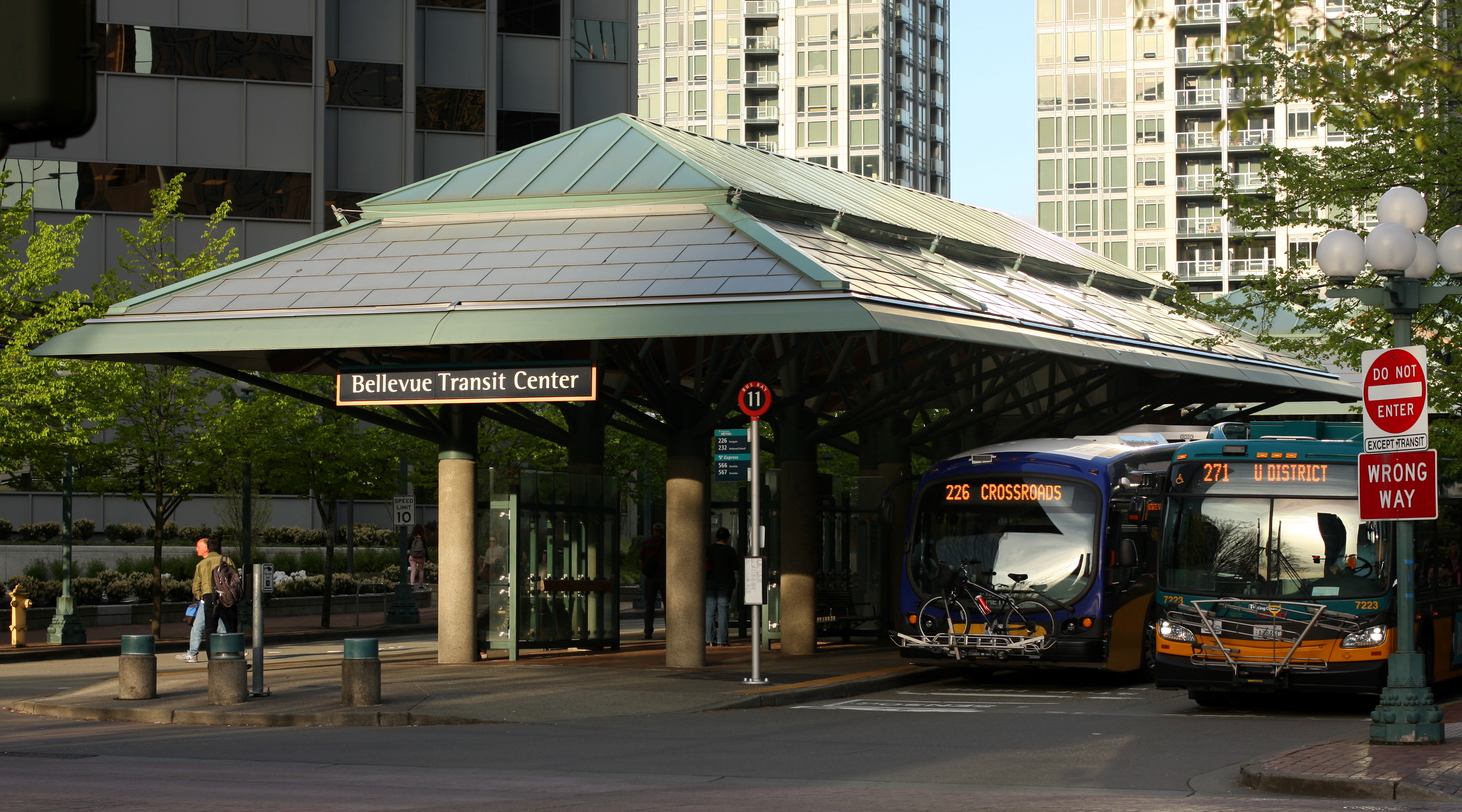
Bellevue
From the air, Bellevue announces itself with a cluster of towers rising from the Eastside of Lake Washington - a skyline that barely existed thirty years ago. Today this city of 150,000 has become the largest in King County outside Seattle, propelled by the tech industry that has transformed the entire region. Microsoft's campus in nearby Redmond drew the first wave; Amazon, Meta, and others followed, filling office towers with engineers and transforming quiet suburbs into something denser and more urban. The result is a city that looks surprisingly vertical for its age, connected to Seattle by the world's largest floating bridge.
The Floating Connection
The Evergreen Point Floating Bridge - SR-520 to locals - crosses Lake Washington on pontoons, the world's longest floating structure of its kind. The approach rises from Seattle, then drops to water level for the crossing, an unusual sensation for drivers accustomed to bridges that arc overhead. Interstate 90's floating bridge provides an alternative crossing to the south via Mercer Island.
Both bridges are tolled, with rates that vary by time of day and traffic conditions - rush hour costs more, reflecting the congestion that plagues the crossings. The new Link light rail extension will eventually provide an alternative, running from downtown Seattle through Bellevue to Redmond, but for now most commuters still cross by car, their tolls automatically deducted via transponders on their windshields.
The Tech Economy
Bellevue owes its transformation to the tech industry that has made the Seattle region one of America's economic powerhouses. Microsoft's campus lies just to the east in Redmond, but many of its employees live in Bellevue, and other tech giants have established significant presences in the city itself. The downtown office towers fill and empty with engineers, product managers, and the ecosystem of professionals that supports them.
The influx of international tech workers has changed the city's character. What was once a predominantly white suburb has become genuinely diverse, with a vibrant Chinese community and restaurants representing cuisines from around the world. Some visitors joke that Bellevue has better Chinese food than Seattle - a claim that would have been unthinkable a generation ago.
Upscale and Urban
Bellevue is perhaps the most upscale part of the Seattle metro area. The downtown hosts luxury retail that Seattle lacks - the only Neiman Marcus in the region, for instance. Large homes fill the neighborhoods, many with water views that command premium prices. The city is generally considered safer and cleaner than Seattle, though some find it blander, the sterility of new construction lacking the character of older neighborhoods.
Between the lakes that bracket the city - Washington to the west, Sammamish to the east - the terrain offers natural vistas and park space unusual for such a dense urban area. The Botanical Garden showcases Pacific Northwest horticulture. The parks provide trails and green space for residents seeking relief from the glass towers downtown.
Beyond the Towers
The Mountains to Sound Greenway continues east from Bellevue into the Cascade foothills, offering quick access to hiking trails, ski areas, and the outdoor recreation that draws people to the Pacific Northwest. Interstate 90 climbs through the pass to eastern Washington; weekend traffic can be fierce as city residents flee for the mountains.
Closer to town, Mercer Island sits in Lake Washington between Bellevue and Seattle, accessible by the I-90 floating bridge. Kirkland to the north offers waterfront parks and a slightly more relaxed atmosphere. Issaquah to the southeast marks the edge of the suburbs and the beginning of the foothills, trailheads minutes from the last strip malls.
From the Air
Located at 47.62N, 122.19W on the east shore of Lake Washington, directly across from Seattle. The downtown skyline is clearly visible as a cluster of high-rise buildings. Look for the SR-520 floating bridge crossing Lake Washington to the north and the I-90 floating bridge crossing via Mercer Island to the south - both bridges rest on pontoons at water level, an unusual sight. Seattle-Tacoma International Airport (KSEA) is about 15 miles to the southwest. The Cascade foothills rise to the east; Interstate 90 climbs to Snoqualmie Pass 45 miles distant. Lake Sammamish is visible to the east of the city.