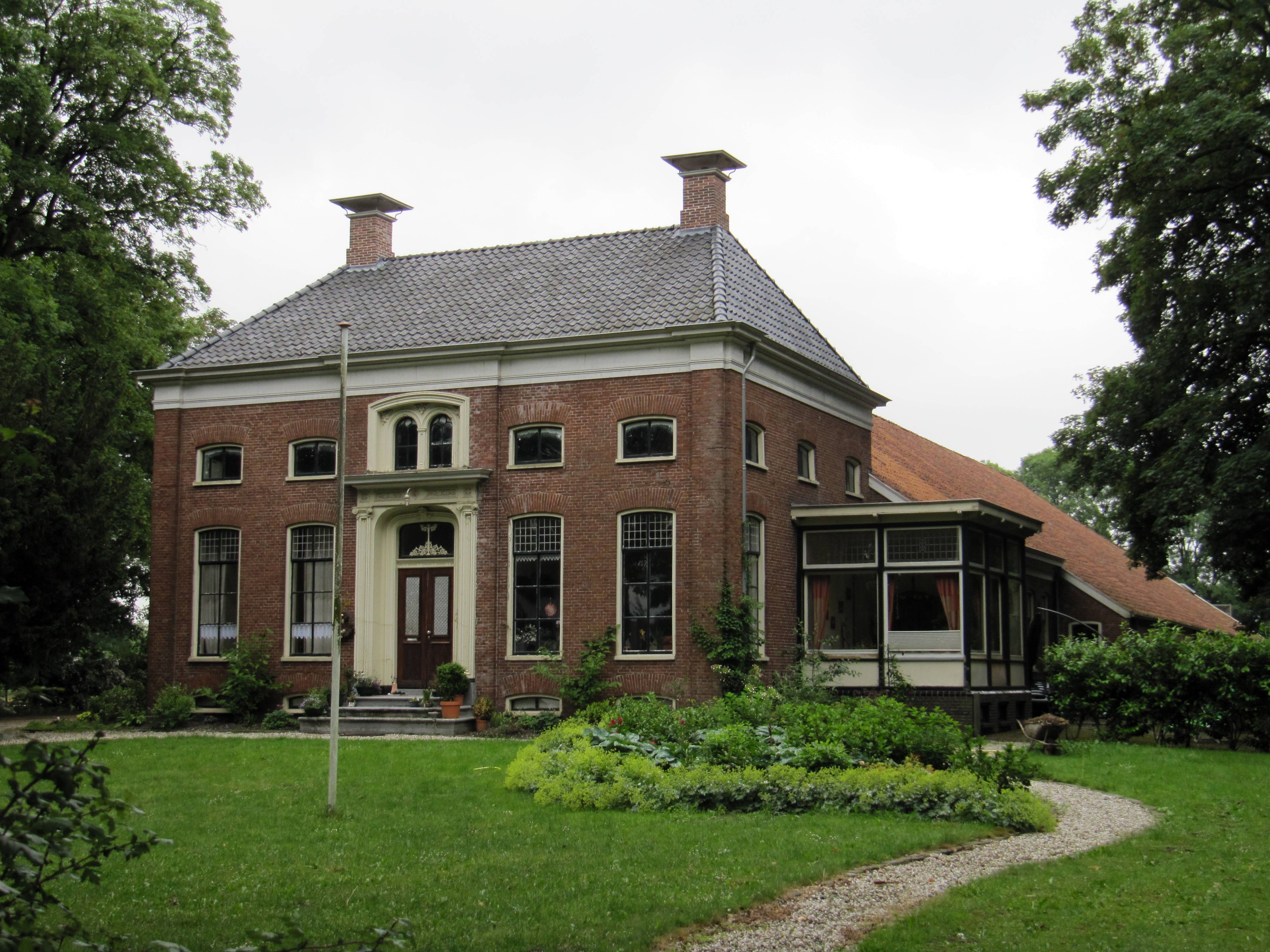
Bellingwolde
The cassette tape was invented by someone born here. Lou Ottens, who in 1963 unveiled the compact audio cassette at the Berlin Radio Show and changed how the twentieth century listened to music, was born in 1926 in Bellingwolde - a long, low village in the far east of the province of Groningen, pressed up against the German border. There is no monument to him beside the main road. Bellingwolde is a place that absorbs its famous sons quietly, the way it absorbed centuries of Dollard floods, the way it absorbed the difference between clay soil and peat soil into one continuous brick-house ribbon along a single sandy ridge. About 2,655 people live here now. The houses face the road. The road follows the ridge. The ridge has decided everything.
Built on the Edge of Two Soils
The settlement dates to the eleventh century. The reason it is where it is comes down to geology: Bellingwolde sits on a thin sand ridge that runs roughly north-south through Westerwolde, dividing the heavy clay grounds of the Oldambt region to the north from the peat country to the south. On either side of the ridge, the land could not be built on without engineering. On the ridge itself, you could put a house and trust that it would still be there in the morning. Even so, the morning was not guaranteed. Until the sixteenth century, Bellingwolde flooded again and again, swamped by storm surges out of the Dollard - a great bay that the North Sea had carved into the Groningen-East Frisian coast during the medieval storms. Only after parts of the Dollard were impoldered did the village stop being a place that occasionally drowned.
What Survives Along the Road
Eighteenth and nineteenth century prosperity, when the impoldered Oldambt clay produced excellent grain harvests, left Bellingwolde with something rare in rural Groningen: an officially state-protected village area, dozens of monumental brick farmhouses, the Magnus Church dating to the sixteenth century, the seventeenth-century Law House where local magistrates once met, and Veldkamp's Mill turning over the village rooflines. Walking the Hoofdweg today is walking a streetscape laid out by farmers who could afford to build for their grandchildren. The houses are large and confident. The barns behind them are larger. Many bear the date of construction in iron numerals fixed to the gable. The road continues for kilometers in either direction, never quite stopping, because the village never quite chose a center.
The Inventor of How We Listened
Lou Ottens spent most of his career at Philips - first at the Hasselt factory in Belgium, then at Eindhoven - far from the Groningen border. But the work he did changed everything. The compact cassette he led the design of in 1962-63 was a deliberately humble object: a plastic shell small enough to fit in a jacket pocket, holding a magnetic tape that ordinary people could record on, copy, share, mail, hide under a mattress. By the 1980s, it was the format of the Walkman, the bootleg, the mixtape, the dictaphone, the language-learning kit. Ottens went on to help lead the team that developed the compact disc. He died in 2021 at age ninety-four. He never made a fuss about being from Bellingwolde. The village does not make a fuss about him. But the next time you remember a tape someone made you, you might remember the village too.
The Other Famous Native
Bellingwolde also produced Jan Mulder, born in 1945, a footballer who played for Anderlecht and the Dutch national team in the 1960s and 70s and later reinvented himself as a writer and television commentator beloved for his looping, unpredictable Dutch prose. He, like Ottens, left the village young. They both belong to a particular kind of small-town story: places too small to hold their most ambitious children, but unforgotten by them. Ask in the village and people will mention Mulder more readily than Ottens. Footballers are easier to be proud of than electrical engineers. The cassette is silent. A goal is not.
A Border Village's Map
Bellingwolde sits on the actual Dutch-German border. The nearest German town, Papenburg, is about thirty-five kilometers east through the village of Wymeer; the nearest Dutch city, Winschoten, is to the west via Blijham. To the northwest stands Oudeschans, a perfectly preserved seventeenth-century star-shaped fortress village that used to be called Bellingwolderschans - the sconce of Bellingwolde - back when the border was something to be defended. The municipality of Bellingwedde, formed in 1968 when Bellingwolde merged with Wedde, lasted until 2018 and then itself merged into the larger Westerwolde municipality. Bellingwolde keeps shrinking on the administrative map and staying exactly the same on the ground. The houses still face the road. The road still follows the ridge.
From the Air
Bellingwolde lies at 53.12°N, 7.17°E in the far east of the Dutch province of Groningen, immediately on the German border. From altitude the village appears as a long, narrow line of buildings tracking the sand ridge, with the river Westerwoldse Aa to the west and the B.L. Tijdenskanaal to the east. Recommended viewing altitude 2,500-4,000 feet. Nearest airports: Groningen Eelde (EHGG) about 45 km west, Bremen (EDDW) about 110 km southeast. The star-shaped fortress village of Oudeschans is plainly visible just to the northwest. The Dutch-German border runs immediately east of the village.