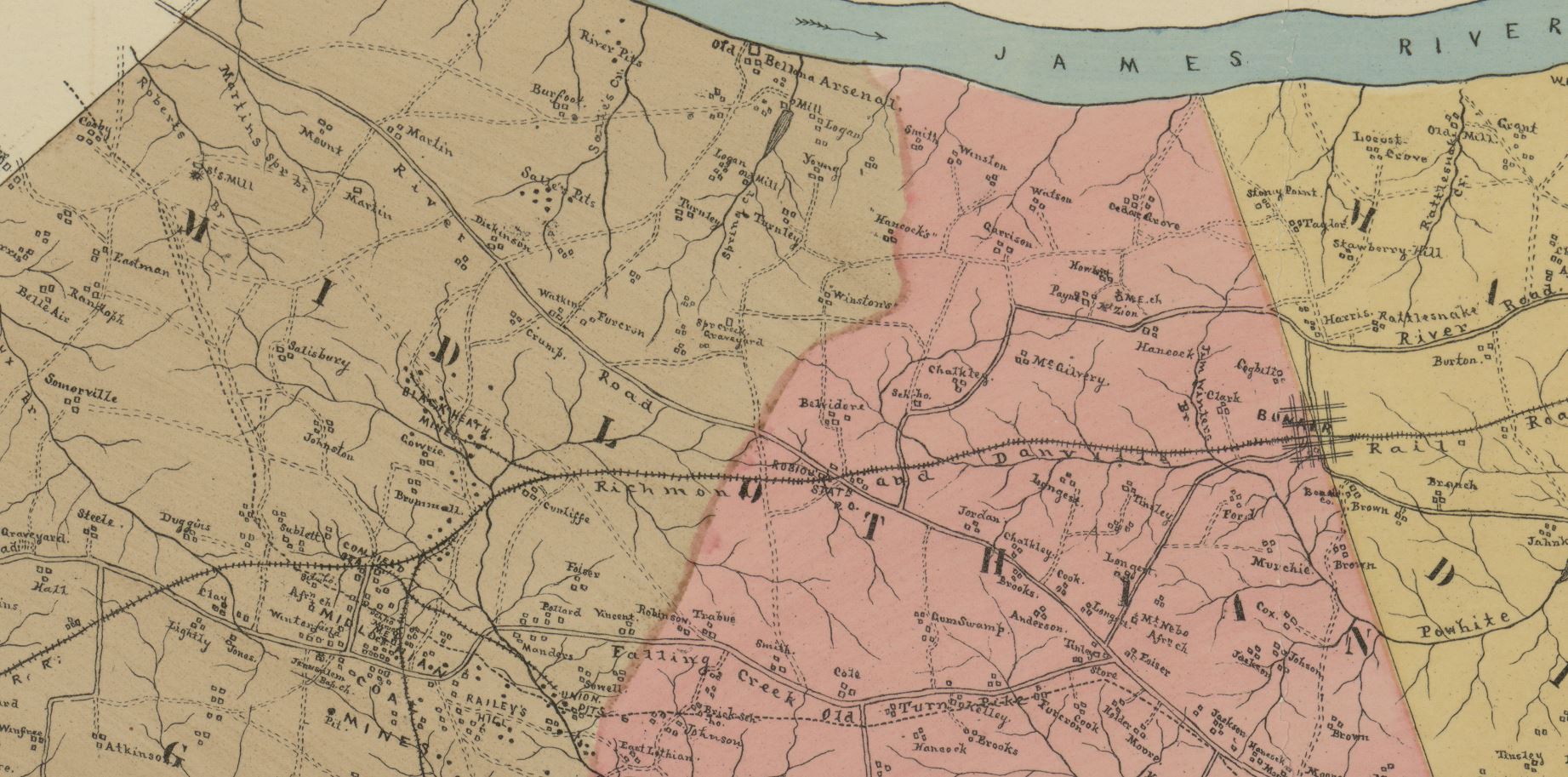
Bellona Arsenal
The name says everything about intent. Bellona, the Roman goddess of war, fierce sister of Mars, lent her name to a weapons foundry carved into the Virginia countryside fourteen miles west of Richmond. Established in 1810 on the south shore of the James River by U.S. Attorney General William Wirt and Army Major John Clarke, the Bellona Foundry began life casting weapons for the young republic's War Department. Within six years the federal government built an arsenal next door to store the growing stockpile of cannon. For the next half-century, through peace and civil war, these buildings above the fall line of the James would shape iron into instruments of destruction for whichever government held the land.
The Foundry on the Fall Line
Major Clarke chose the site well. The fall line of the James River provided water power and a natural boundary between the navigable tidewater and the rugged Piedmont above. The foundry hummed with the work of casting cannon barrels, and by 1816 the Army erected Bellona Arsenal immediately to the west, a formal military post with stone walls enclosing eight buildings arranged around a central quadrangle. The main arsenal building stood three stories tall at the north end, flanked by officers' quarters and workshops, with a barracks anchoring the south side. A powder magazine with walls five and a half feet thick sat prudently to the west, surrounded by its own stone barrier to contain any accidental blast. The arsenal repaired small arms and stored cannon through 1832, when the garrison was pulled back to Fort Monroe. A single ordnance sergeant stayed behind as caretaker of this growing collection of iron and gunpowder.
From Silkworms to Secession
By 1837 the War Department declared Bellona Arsenal surplus. The irony was thick: a temple to the goddess of war temporarily became a silkworm farm when Thomas Randolph leased the empty buildings. When Major Clarke died in 1844, oversight of the foundry passed to Dr. Junius L. Archer, who purchased the entire arsenal complex from the federal government in 1856 for the remarkably modest sum of $2,650. That bargain would soon pay dividends of a different sort. As sectional tensions erupted into the Civil War, Archer leased both the arsenal and the foundry to the Confederate States and stayed on as superintendent. Bellona Arsenal ranked second only to the much larger Tredegar Iron Works in Richmond as a producer of Confederate armaments, its furnaces once again pouring molten metal into cannon molds, this time aimed at the nation that had built the place.
Stone Walls and Silence
The end came quickly after the war. By 1872 the owners demolished the barracks, officers' quarters, and one workshop. Only three of the original eight quadrangle buildings and the powder magazine survived. The property was sold in 1877 and changed hands several times, each new owner finding less use for buildings designed to store and repair weapons. In 1942 Merle C. Luck purchased what remained and began the unlikely work of converting former military workshops into residences. The brick buildings, each two stories with hipped roofs and interior end chimneys, still stand along State Route 673 near Midlothian. The roofless powder magazine endures too, its five-and-a-half-foot walls open to the sky, holding nothing but weather and memory.
A Road Called Old Gun
Bellona Arsenal was added to the National Register of Historic Places on May 6, 1971, securing its place in the official record of American heritage. But the neighborhood had already written its own tribute. The road that runs through the Robious area of Chesterfield County, where the arsenal and foundry once thundered, is called Old Gun Road. Residents drive it daily, most unaware they are tracing a path once worn by wagons heavy with cannon. The surviving workshop buildings, documented by the Historic American Buildings Survey, offer a rare glimpse of early American military architecture. Their segmental arched openings and central entrances speak to a time when the nation's weapons were forged not in sprawling industrial complexes but in compact riverside outposts named after ancient gods.
From the Air
Located at 37.554N, 77.617W along the south shore of the James River in Chesterfield County, Virginia, approximately 14 miles west of downtown Richmond. Best viewed at 2,000-3,000 feet AGL. The James River fall line is visible as a transition from tidal to rocky riverbed. Nearest airports: Richmond International (KRIC) 18 nm east, Chesterfield County Airport (KFCI) 7 nm south. Look for the river's south bank near Midlothian; the surviving structures sit off State Route 673.