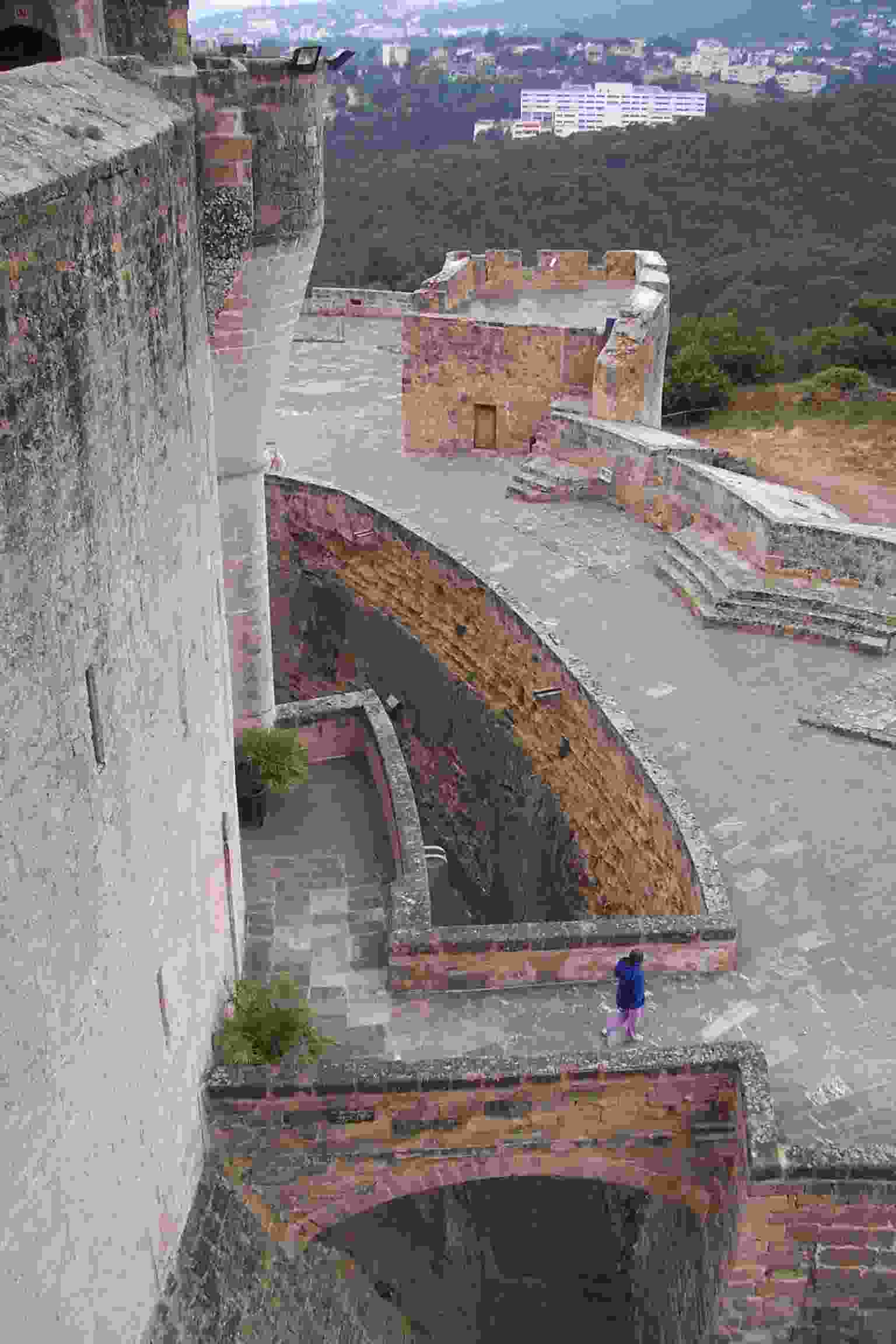
Bellver Castle
Most medieval castles are angular things -- squares, rectangles, the occasional irregular polygon dictated by the terrain. Bellver Castle is a circle. Built between 1300 and 1311 on a forested hill three kilometers west of Palma de Mallorca, it is one of the few circular castles in all of Europe, its round walls and cylindrical towers giving it a form that looks more like a crown placed on the hilltop than a conventional fortress. The name comes from the Catalan for "beautiful view," and from its ramparts the entire bay of Palma unfolds below.
A Palace in the Round
King James II of Majorca commissioned the castle as a royal residence, and the architect Pere Salva -- who also worked on the Royal Palace of La Almudaina in Palma -- designed a structure that married palace comfort with military function. The plan is elegant in its geometry: a circular outer wall encloses a circular inner courtyard, with three minor towers attached to the wall and a larger donjon connected by a high bridge spanning the moat. The courtyard, with a well at its center fed by a cistern below, is ringed by two stories of Gothic semi-circular arches. The castle carries clear Islamic influences in its double arches, a reminder that Majorca had been under Muslim rule until just decades before construction began. Rock quarried from the very hill on which the castle sits formed its walls -- a practical choice that has, over the centuries, led to the appearance of cracks in the structure.
A Prison of Illustrious Inmates
Bellver's history as a prison began almost as soon as it was built. After King James III of Mallorca died at the Battle of Llucmajor in 1349, his queen, Violante of Vilaragut, and her stepchildren were confined within its circular walls. The pattern held for centuries. During the War of the Spanish Succession, the castle held supporters of both sides at different moments -- first partisans of Philip of Anjou, then, after the Bourbon victory, Maulets who had backed the Habsburg claimant. Its most famous prisoner was Gaspar Melchor de Jovellanos, the Enlightenment minister and writer, imprisoned from 1802 to 1808. Jovellanos used his confinement productively: he wrote the first detailed description of the castle and commissioned its earliest architectural drawings. In the 20th century, the prison held republican and Catalanist leaders, including Alexandre Jaume and Emili Darder, the former a parliamentarian, the latter the mayor of Palma. Both were later executed.
Tested but Rarely Taken
As a fortification, Bellver proved remarkably resilient. It withstood two sieges during the Middle Ages: the first in 1343, when Peter IV of Aragon campaigned to absorb the Majorcan kingdom back into the Crown of Aragon, and the second in 1391, during a violent anti-Semitic peasant uprising. In its entire history, the castle fell to an enemy only once -- in 1521, during the Majorcan phase of the Revolt of the Brotherhoods, when an assault finally breached its defenses. The introduction of artillery eventually rendered the original battlements and barbican obsolete, and they were replaced by loopholes better suited to gunpowder warfare. But the basic circular form endured, its geometry offering defenders a rare advantage: no blind spots, no corners where attackers could shelter from fire.
The Circle Endures
In 1931, the Spanish Second Republic transferred Bellver Castle to the city of Palma, along with the pine forest that surrounds it. It became a museum the following year and was restored again in 1976 to house the city's history collection. Today the circular courtyard hosts concerts, cultural events, and civic ceremonies. On the Sunday after Easter, Palma's citizens gather in the surrounding forest for the celebration of the Diumenge de l'Angel, a tradition that transforms the former fortress into a picnic ground. From the sea, from the city, from the air, the castle's unmistakable round profile stands against the sky -- a shape that has defined Palma's western skyline for more than seven hundred years.
From the Air
Located at 39.56N, 2.62E on a wooded hilltop 3 km west of central Palma de Mallorca. The castle's distinctive circular form is clearly visible from the air, surrounded by pine forest. Best viewed at 1,500-3,000 feet. Palma de Mallorca Airport (LEPA) is approximately 10 km to the east. The Bay of Palma and the city waterfront are excellent visual references.