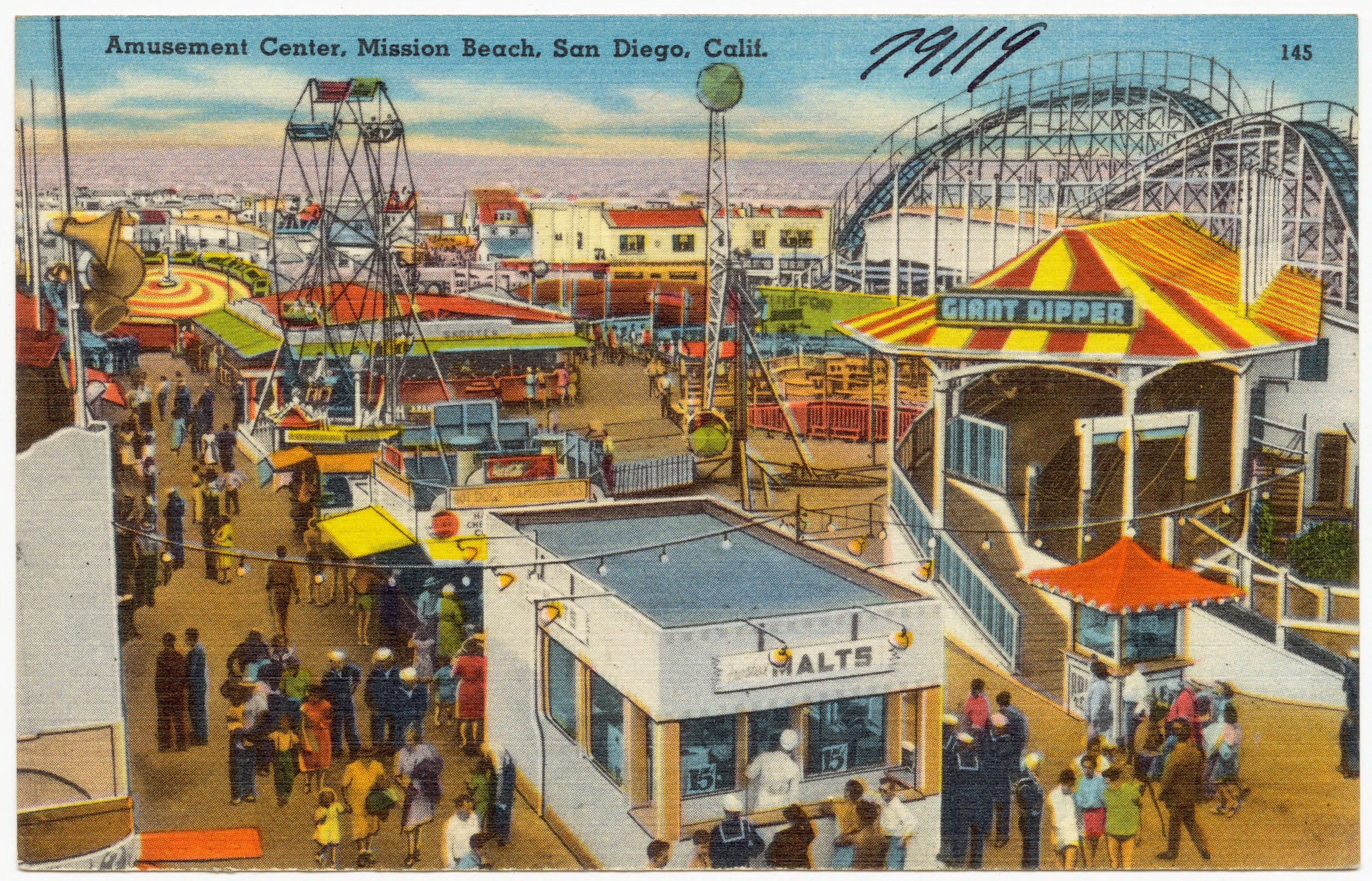
Belmont Park (San Diego)
Belmont Park opened on July 4, 1925, as Mission Beach Amusement Center — a seaside carnival on San Diego Bay built by sugar baron John D. Spreckels, with a wooden roller coaster that still runs a century later and a saltwater pool that was once the largest in the world.
The Fourth of July, 1925
John D. Spreckels had already made his mark on San Diego in a dozen ways — hotels, newspapers, streetcars, real estate — when he decided to build an amusement park on the oceanfront strip of Mission Beach. The Mission Beach Amusement Center opened on Independence Day, 1925, with rides, games, a dance hall, and a roller coaster that was among the largest wooden coasters in the American West.
The Giant Dipper, as the coaster came to be known, was designed and built by Frank Prior and Frederick Church, the Venice, California coaster design firm Prior & Church. It cost $50,000 and took approximately 45 days to construct. From the first day it ran, the Giant Dipper was the park's signature attraction — a wooden structure of hills and valleys that clattered and swooped above the beach, audible blocks away.
The Largest Saltwater Pool
Spreckels didn't stop at the roller coaster. He also built The Plunge, a vast indoor swimming pool that was, at the time of its opening, the largest heated saltwater indoor pool in the world. The Plunge could hold enormous crowds — it was designed not just as a place to swim but as a civic spectacle, a demonstration that San Diego had the resources and ambition to build things on a grand scale.
The saltwater that filled The Plunge was pumped in from the Pacific. San Diego sits on one of the most beautiful bays on the West Coast, and the idea of swimming in genuine ocean water, filtered and heated in a massive indoor pool steps from the beach, was a genuine novelty in the 1920s.
Over the decades, The Plunge was converted to freshwater, closed, threatened with demolition, and eventually renovated. It still operates today, no longer the world's largest but still functioning as a community swimming facility within the park.
Decline, Salvation, and Rock and Roll
By the 1970s, Belmont Park had declined along with many mid-century American amusement parks. The park closed in 1976, and the Giant Dipper — by then listed on the National Register of Historic Places — faced demolition. A local preservation campaign saved it. The coaster was restored and reopened in 1990, and the surrounding park was redeveloped as a smaller mixed commercial and entertainment complex.
Belmont Park has accumulated a small but genuine pop culture footprint. The pop-punk band Blink-182 filmed the video for their song 'M+M's' at the park, and the Giant Dipper has appeared in other films and television productions. The juxtaposition of a working century-old wooden roller coaster with the Pacific Ocean behind it creates a visual that is hard to replicate.
What Endures
Mission Beach in the twenty-first century is dense with vacation rentals, restaurants, and the constant churn of San Diego tourism. The boardwalk along the beach draws cyclists, rollerbladers, families, and visitors from across the country. Belmont Park sits in the middle of this as it always has — anchored to the same spot it occupied in 1925, still running the same wooden roller coaster.
The Giant Dipper is now a century old, give or take. It has outlasted the company that built it, the city that doubted it, and several waves of modernization that might have replaced it with something shinier. What you see when you look at it is the same configuration of wood and steel that went up in 45 days in 1925 — a machine that still runs on the same physics it always did, next to the same ocean.
From the Air
Belmont Park sits on the oceanfront at Mission Beach, approximately 4 miles northwest of KSAN (San Diego International Airport). On departure heading northwest or on approach from the ocean, the wooden superstructure of the Giant Dipper is visible on the narrow strip of land between Mission Bay to the east and the Pacific Ocean to the west. The park is identifiable from the distinctive silhouette of the roller coaster against the water.