Beloyarsk, Yamalo-Nenets Autonomous Okrug
Of the roughly 2,000 people living in Beloyarsk, more than 400 still name a Nenets language as their mother tongue rather than Russian. That linguistic stubbornness matters. Perched at nearly 67 degrees north in the Yamalo-Nenets Autonomous Okrug, this village was founded not by indigenous choice but by Soviet decree in 1951, when a collective farm bearing Stalin's name was imposed on the tundra. Seven decades later, the farm is largely gone, the Soviet Union is gone, and the Nenets are still here, still herding reindeer, still teaching their children the words their grandparents used.
Born from a Decree
Beloyarsk began as a Soviet collective farm in 1951, part of Moscow's drive to organize the nomadic Nenets people into settled, productive units. By 1953 the settlement had its own village council. The collective farm was the sole employer at first, but residents quickly diversified into fishing and hunting reindeer for both meat and fur. In 1961 the farm merged with another downriver operation to form the larger Baidaratsky state farm, whose finances one man, Babin Nikolay Andreevich, managed for thirty-five years straight, from 1958 to 1993. After the Soviet collapse, all state farms in the village except one were closed and privatized by 1997. The surviving enterprise is a reindeer breeding operation that in 2024 employed 115 people and generated about 144 million rubles in revenue. Despite its modest scale, the farm has accumulated 46 arbitration cases since its founding, a reminder that even in the Arctic, paperwork multiplies.
Guarding the Tundra's Faith
Religion arrived late and contentiously in Beloyarsk. After decades of enforced Soviet secularism, the post-1991 spiritual vacuum drew competing missionary efforts among the Nenets. By 2018, many residents had developed sharp resistance to outside religious groups. Tatiana Vagramenko, a Protestant minister from the village, put it bluntly: "Nowadays there are many missions that want to come here, but we don't let them. Because they do only harm." She described actively blocking unfamiliar sects from reaching the tundra communities, preferring to report them to local authorities rather than permit evangelization. The stance reveals something deeper than theological disagreement. For a people whose identity survived collectivization and linguistic pressure, the impulse to control who enters their spiritual life is another form of self-preservation.
A Hospital on the Permafrost
In 2015, a hospital rose on 2,500 square meters of Beloyarsk's frozen ground. The facility brought a polyclinic, a 16-bed hospital with modern two-patient wards, a maternity ward, a tuberculosis unit, X-ray and laboratory facilities, and specialty offices ranging from pediatrics to physiotherapy, all serving up to 50 patients per shift. For a village above the Arctic Circle, where the nearest significant town is Aksarka and winter roads close unpredictably, having local surgical and diagnostic capacity transforms survival odds. A post office followed in 2025, along with a fire department run by EMERCOM, Russia's emergency ministry. The village government itself occupies just 123 square meters, a bureaucracy small enough to fit inside a modest apartment.
Teaching the Old Words to Young Ears
Beloyarsk's primary school, Brusnichka, opened in 2012 across a two-story building with capacity for 120 children aged two to seven, most from indigenous northern families. The campus includes art studios, choreography rooms, speech therapy spaces, and dedicated native language instruction areas. The secondary school, a boarding institution founded in 1998, enrolls 616 students, 280 of whom live on campus. In 2022, the United Nations' International Decade of Indigenous Languages initiative visited the boarding school to help establish courses in Tundra Nenets, Northern Khanty, and Komi. Teachers from Beloyarsk and neighboring Aksarka worked alongside UN educators using storytelling, indigenous doll-making, and competitions to draw students into languages that census data shows are slipping away. Of Beloyarsk's 1,848 residents counted in 2020, only 490 demonstrated Nenets language proficiency, a number lower than the 750 who claimed Nenets ethnicity. Each classroom session fights that gap.
Numbers on the Edge
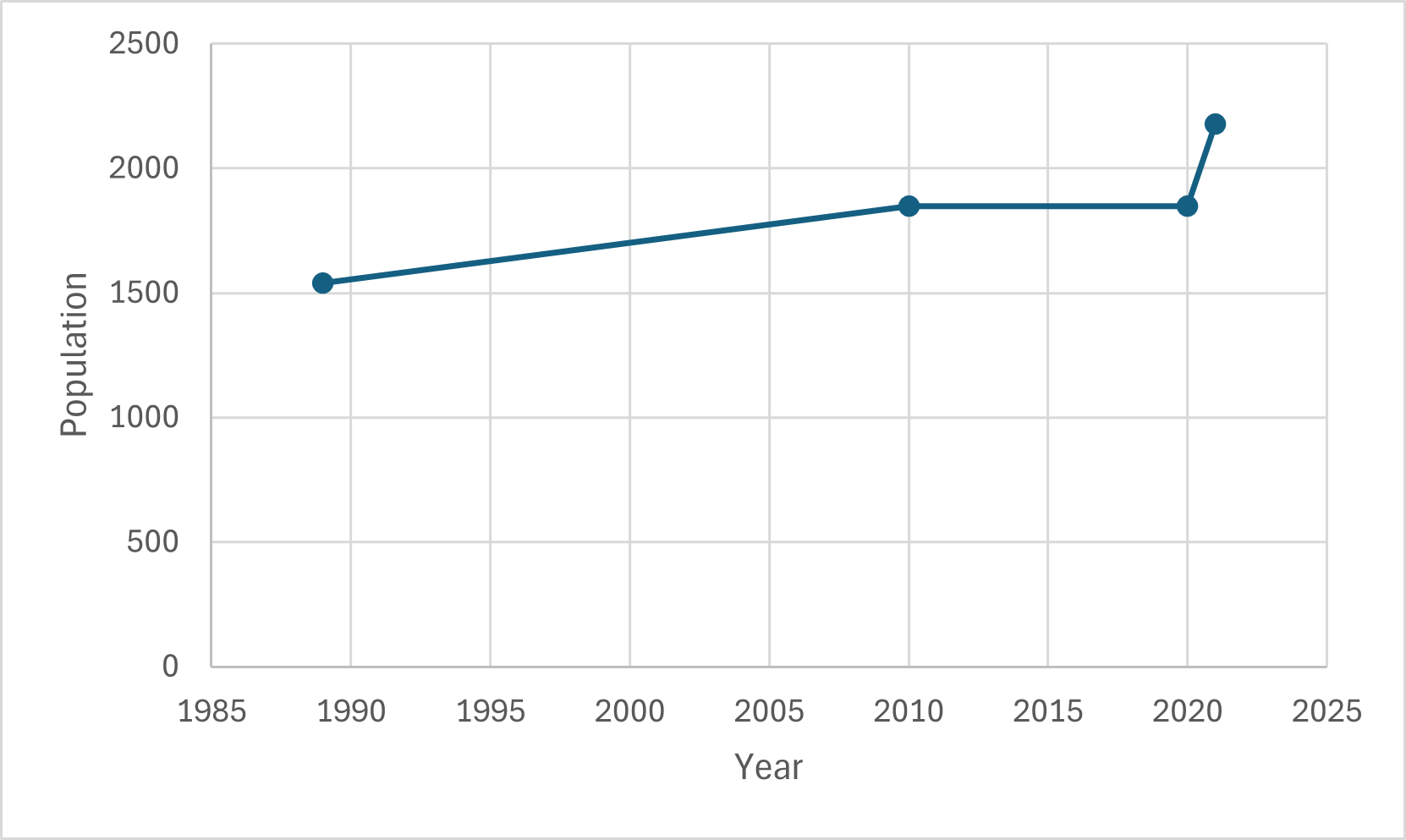
Beloyarsk's population tells its own quiet story. In 1989 the village counted 1,539 residents. By 2010 the number had risen to 1,859, then barely moved over the next decade, settling at 1,848 in 2020, a net loss of just two people in ten years. Then, abruptly, the population jumped to 2,178 in 2021. Whether that surge reflects better counting, migration, or natural increase, the village remains a tiny settlement in an enormous landscape. A 2021 veterinary study of local reindeer found moderate levels of dioxins, cadmium, and mercury in their organs, pollutants that drift north from industrial Russia and accumulate in the Arctic food chain. The Nenets eat what the reindeer eat, indirectly. In Beloyarsk, survival has always meant adapting to whatever the wider world sends across the tundra.
From the Air
Located at 66.87°N, 68.16°E in the Priuralsky District of Yamalo-Nenets Autonomous Okrug. The village sits along a river in flat tundra terrain, visible from altitude as a small cluster of buildings amid featureless white or green landscape depending on season. Nearest significant airstrip is at Salekhard (USDD), approximately 100 km to the northwest. Winter roads connect to Aksarka. Expect subarctic conditions with extended darkness in winter and midnight sun in summer. Recommended viewing altitude: 3,000-5,000 feet AGL.