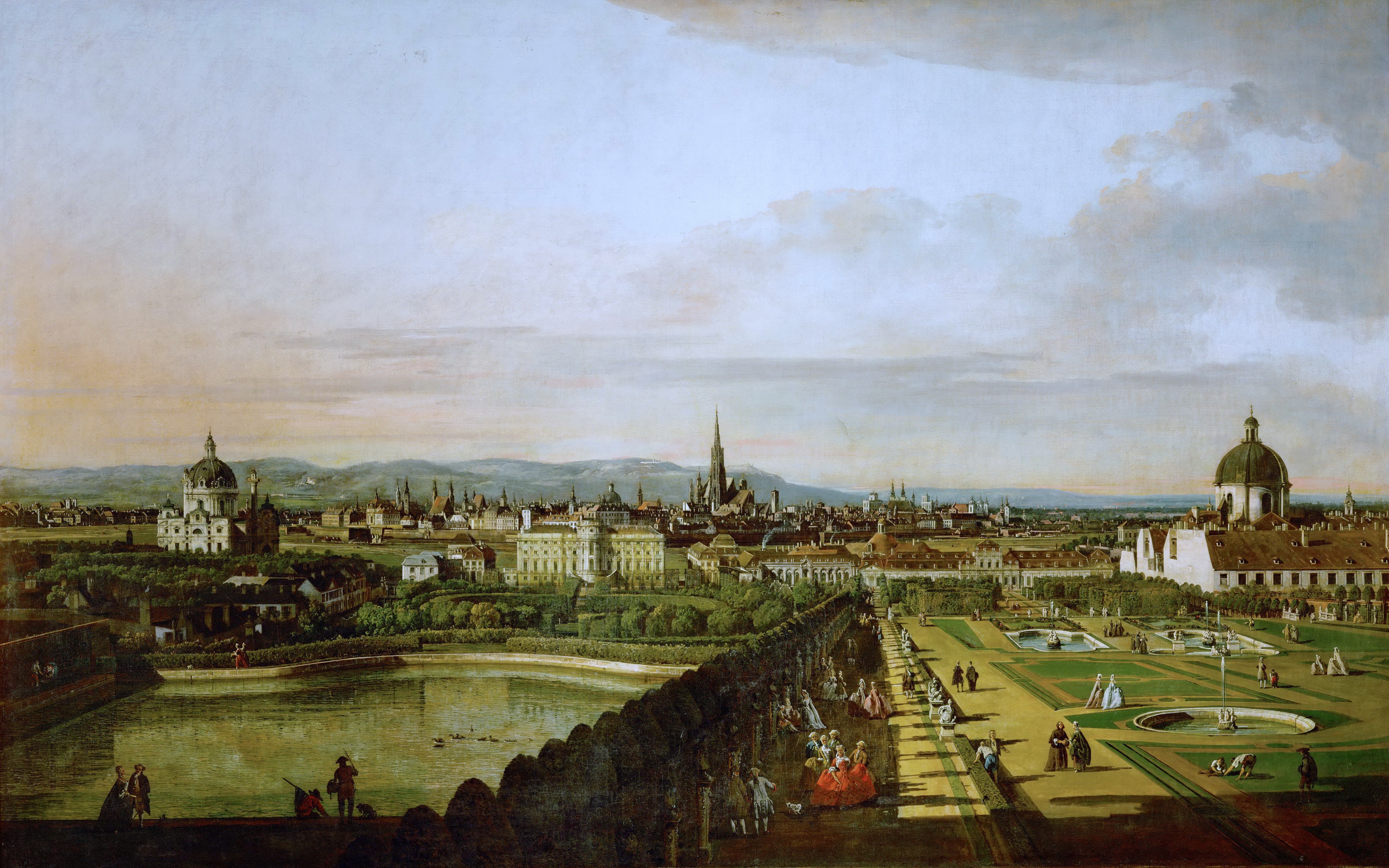
The Belvedere: A General's Trophy Case Turned Art Shrine
Prince Eugene of Savoy was born French, raised Italian, rejected by Louis XIV's court, and became the greatest military commander the Habsburg Empire ever produced. When he wanted a summer palace on the outskirts of Vienna, he did not settle for modesty. Between 1697 and 1723, his architect Johann Lukas von Hildebrandt built two palaces connected by a terraced garden on a gentle slope south of the Rennweg, the old road to Hungary. The Lower Belvedere came first, intimate and refined. The Upper Belvedere followed, monumental and triumphant, with a Marble Hall whose ceiling fresco by Carlo Carlone glorified the prince's military victories. Eugene had defeated the Ottomans, humbled the French, and reshaped the map of Europe. He built the Belvedere to make sure no one forgot it.
The Soldier Who Built in Stone
Eugene first purchased the land in November 1697, one year after beginning work on his city palace, the Stadtpalais. The site was undeveloped - ideal for the kind of grand landscape project that European aristocrats increasingly favored. He chose Hildebrandt over Johann Bernhard Fischer von Erlach, the more famous architect who had designed his city palace, perhaps because Hildebrandt had trained in both architecture and military engineering and understood how to build structures that commanded terrain. Hildebrandt had studied civil engineering in Rome under Carlo Fontana before entering imperial service. The two men had met during a military campaign in Piedmont, and Eugene trusted him implicitly. Hildebrandt would go on to design some of the finest Baroque buildings in Central Europe, including the Kinsky Palace and the Schwarzenberg Palace, but the Belvedere remained his masterpiece - a complex that functions simultaneously as a garden, a gallery, and a statement of aristocratic power.
Two Palaces, One Ascending Line
The Lower Belvedere, completed first, served as Eugene's summer residence. It is an elegant, horizontal building designed for comfort and entertaining, with an orangery and stables that now house contemporary art exhibitions. The Upper Belvedere is something else entirely. Begun in 1717 and finished in 1723, it crowns the hill at the garden's upper end, its copper-green roof and sculpted facade visible from across Vienna. Construction progressed so quickly that by October 1719 Eugene could receive the Turkish ambassador Ibrahim Pasha there - a pointed piece of symbolism, hosting the representative of the empire he had spent his career defeating. The Sala Terrena on the ground floor nearly collapsed from structural problems; Hildebrandt had to install a vaulted ceiling supported by four Atlas pillars in the winter of 1732-33, giving the room its current dramatic appearance. The Marble Hall above, with Carlone's ceiling fresco and Gaetano Fanti's illusionistic quadratura painting, remains one of the great Baroque interiors in Europe.
From Private Palace to Public Gallery
Eugene died in 1736 without an heir, and the Belvedere passed through several hands before the Habsburg court acquired both palaces. Maria Theresa moved part of the imperial art collection into the Upper Belvedere in the mid-eighteenth century, beginning its transformation from private residence to public museum. The complex played a role in one of the twentieth century's defining moments: on May 15, 1955, the Austrian State Treaty was signed in the Upper Belvedere's Marble Hall, officially ending the Allied occupation of Austria and restoring the country's sovereignty. Foreign ministers from the United States, Soviet Union, United Kingdom, and France signed the document on the same balcony where Leopold Figl then held the treaty aloft for the cheering crowd below - one of the most iconic images in postwar Austrian history. Today the Belvedere museum houses the Austrian Gallery, with works spanning from the Middle Ages to the present.
Klimt's Golden Embrace
The painting that draws more visitors than any other hangs in a room on the upper floor: Gustav Klimt's The Kiss, completed between 1907 and 1908. The image of two figures wrapped in a golden embrace, kneeling on a flower-covered cliff edge, has become one of the most reproduced artworks in history. Klimt painted it during his so-called Golden Phase, using gold leaf in a technique inspired by Byzantine mosaics he had seen in Ravenna. The Belvedere also holds Klimt's portraits of Judith and Adele Bloch-Bauer, along with major works by Egon Schiele and Oskar Kokoschka. The collection traces the arc of Austrian art from medieval altarpieces through the Baroque to the radical experiments of the Vienna Secession and Austrian Expressionism. But it is Klimt's gold that most visitors come for - a fitting irony in a palace built by a general, where the most powerful thing on display is a painting about tenderness.
The Garden Between
The terraced garden connecting the two palaces is a Baroque landscape designed to be read as a progression - from the intimate lower level to the monumental upper. Symmetrical parterres, clipped hedges, fountains, and a cascade of pools ascend the gentle slope. Sphinx sculptures flank the paths, their enigmatic faces gazing across trimmed lawns. The garden was planned as an integral part of the architectural experience: walking from the Lower Belvedere uphill to the Upper, the visitor moves through a narrative of increasing grandeur, arriving at the hilltop palace to discover, turning around, one of the finest views of Vienna's skyline, with the spire of St. Stephen's Cathedral rising above the old city. In summer, the reflecting pools mirror the Upper Belvedere's facade. In winter, snow silences the fountains and the garden becomes a white corridor between two palaces. Eugene designed the Belvedere as a total work of art, and three centuries later, the garden still holds that composition together.
From the Air
The Belvedere complex (48.19N, 16.38E) is located in Vienna's 3rd district, southeast of the city center. From the air, the two palaces and their formal garden are clearly visible as a symmetrical Baroque composition on a gentle south-facing slope. The Upper Belvedere's distinctive green copper roof is a useful landmark. The complex sits between the Sudbahnhof rail corridor and the Rennweg. Vienna International Airport (LOWW) is 15 km to the southeast. At 3,000-5,000 feet, the Belvedere garden axis points directly toward the spire of St. Stephen's Cathedral in the old city, providing a clear visual line between the two landmarks.