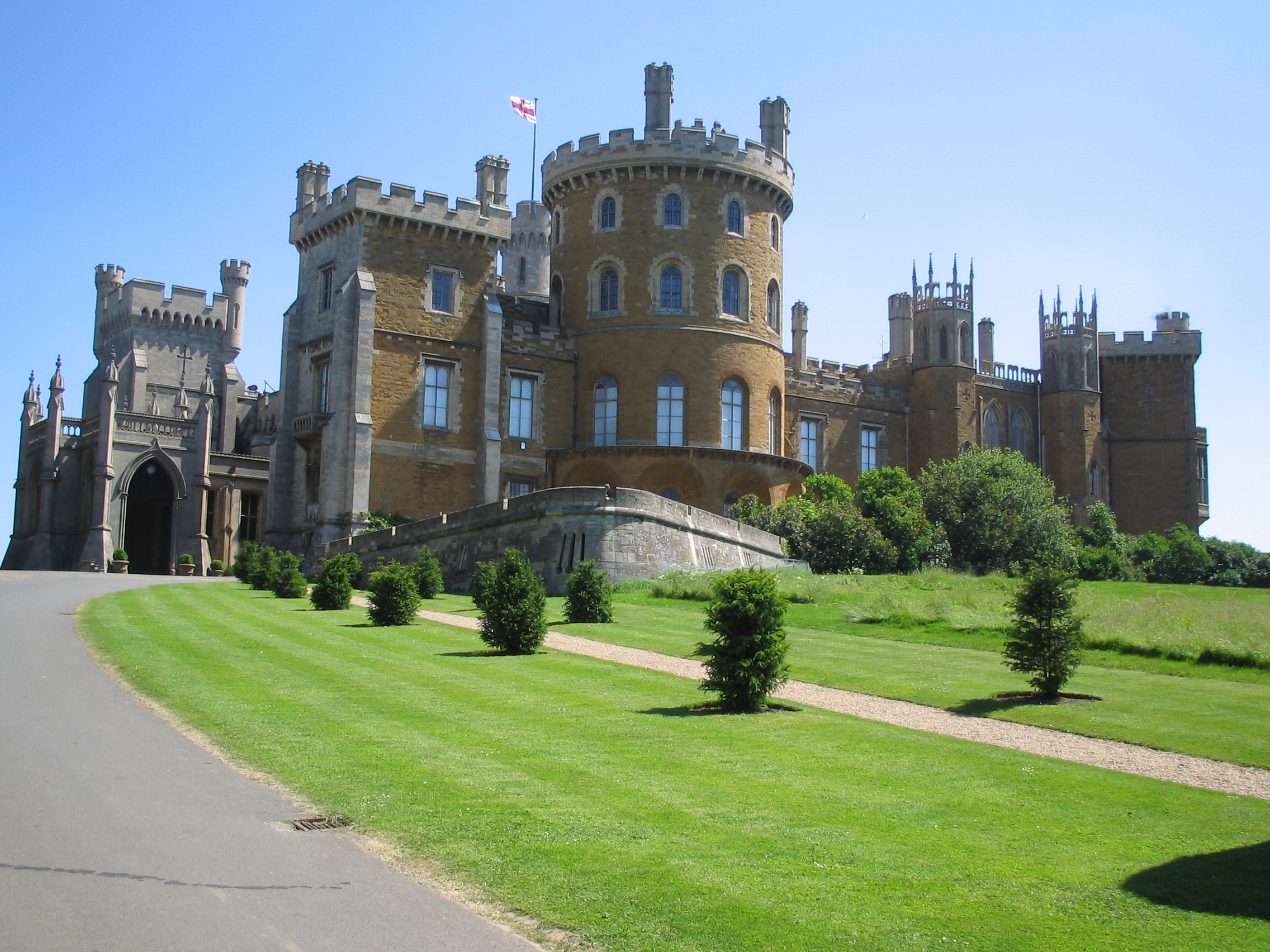
Belvoir Castle
It is pronounced 'Beaver.' The name Belvoir -- Norman French for 'beautiful view' -- arrived with William the Conqueror's followers in the 11th century, but the Anglo-Saxons who lived here could not wrap their tongues around it. A thousand years later, the mispronunciation endures, a small linguistic rebellion that has outlasted the Norman castle itself, the Tudor manor that replaced it, and the two subsequent rebuildings that followed. The castle that stands today on its Leicestershire hilltop is the fourth structure on the site, a 19th-century mock-medieval confection whose central tower echoes Windsor. It is also the place where, in the 1840s, a duchess grew hungry between meals and inadvertently invented one of England's most enduring social rituals.
The Witches and the Earl's Sons
A Norman fortification first rose on this hilltop within the wapentake of Framland, built on land belonging to Robert de Todeni as recorded in the Domesday Book of 1086. The antiquarian John Leland noted that 'the Castle stands on the very nape of a high hill, steep up each way, partly by nature, partly by the working of men's hands.' By 1464 the Norman castle was in ruins. Thomas Manners, 1st Earl of Rutland, began building a Tudor manor house in 1528, using stone salvaged from the dissolved Croxton Abbey and Belvoir Priory. It was in this Tudor house that one of the most disturbing episodes in Belvoir's history unfolded. In the early 17th century, three servants -- Joan, Margaret, and Phillipa Flower -- were accused of murdering the 6th Earl of Rutland's two young sons through witchcraft. Joan Flower died in prison. Margaret and Phillipa were hanged. The case of the Witches of Belvoir became one of the most notorious witchcraft trials in English history, a story of grief, suspicion, and the fatal consequences of accusation in a society that believed the devil walked among them.
Destruction and Reinvention
The Tudor manor served as a Royalist stronghold during the English Civil War, with King Charles I spending a night there on his way into Lincolnshire. Parliamentarian forces eventually took and slighted the castle, leaving it damaged but not destroyed. It was rebuilt by the late 1660s, only for a catastrophic fire in the early 19th century to destroy the house once more. The loss included paintings by Titian, Rubens, van Dyck, and Reynolds. Undeterred, the Manners family rebuilt again at a cost of 82,000 pounds. The architect Sir James Thornton designed the present castle, completed by 1832, as a romantic pastiche of medieval architecture. The result looks nothing like what the Normans built, but it fulfills the promise of the name: from its hilltop, the views across the Vale of Belvoir to the northwest remain genuinely beautiful. The 15,000-acre estate surrounding the castle became the heartland of English fox-hunting country, home to the Belvoir Hunt, established in 1750 and still kennelled southeast of the castle.
Afternoon Tea and a Misguided Hack
Belvoir's most lasting contribution to British culture began with a rumbling stomach. In the 1840s, Anna, Duchess of Bedford, was visiting the castle when she noticed the long, empty stretch between a light luncheon and dinner at eight o'clock. She ordered tea -- usually Darjeeling -- with cakes and sandwiches to bridge the gap, and found the combination so agreeable that she began inviting friends to share it. The habit spread through aristocratic households and then into the middle classes, becoming the institution of afternoon tea. The castle today remains the private home of the Manners family, now headed by the 11th Duke of Rutland, though it opens to the public for tours of its lavish state rooms: the Elizabeth Saloon, the Regent's Gallery, and a Roman-inspired State Dining Room. Film crews have made regular use of its photogenic interiors, from The Da Vinci Code to The Crown. In 2010, the castle's website was hacked by an Algerian group who inserted anti-Semitic texts in Arabic -- they had confused Belvoir Castle in Leicestershire with Belvoir Fortress in Israel. The name, it seems, remains a source of confusion in more ways than one.
From the Air
Belvoir Castle sits at 52.89°N, 0.78°W on a prominent hilltop in the extreme northern corner of Leicestershire, overlooking the Vale of Belvoir. The 19th-century mock-medieval castle with its central tower is visible from lower altitudes against the surrounding farmland. The nearest airports include Nottingham City (Tollerton) and RAF Cranwell to the northeast.