Bemidji, Minnesota
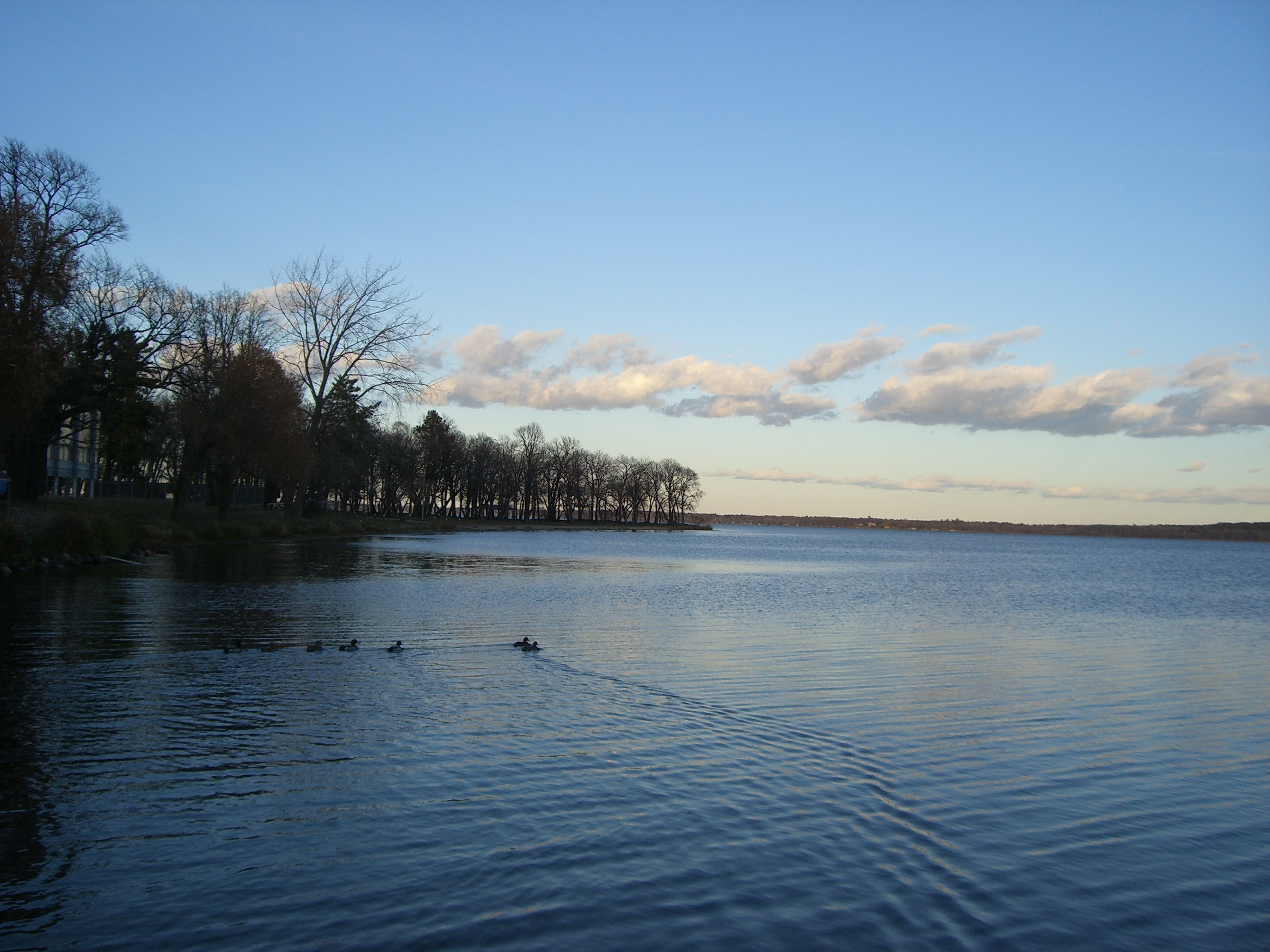
The early white settlers got the name wrong. When Shay-now-ish-kung, an Ojibwe leader who became the first permanent settler of what is now Bemidji in 1882, told newcomers what the lake was called, they thought he was introducing himself. The lake's Ojibwe name, Bemidjigumaug, means "river or route flowing crosswise," describing how the Mississippi River flows directly through it. The settlers called him Chief Bemidji and named the town after their own misunderstanding. It is a fitting origin story for a place that has spent more than a century turning confusion into character, misfortune into mythology, and tall tales into tourist attractions.
Where the Mississippi Crosses Itself
Bemidji sits on the southwest shore of Lake Bemidji in northern Minnesota, less than fifty miles downstream from the headwaters of the Mississippi River at Lake Itasca. The river enters the lake from the west and exits to the east, a geographic quirk the Ojibwe recognized centuries ago. About fifty Leech Lake Ojibwe lived along the south shore before the 1880s. Freeman and Besty Doud claimed 160 acres as the town's first homesteaders, and the settlement grew around sawmills and trading posts along the riverbanks. By 1896 Bemidji was incorporated. By 1898 railroads arrived, and by 1900 the population had reached 2,000. The town had three publishing companies before it had paved streets.
Timber Barons and Lumberjack Camps
The great pine forests surrounding Bemidji drew timber cruisers as early as the 1870s, scouting land for the wood industry barons: Thomas Barlow Walker, the Pillsbury brothers, Henry Akeley, and Frederick Weyerhaeuser. Walker's Red River Lumber Company of Crookston claimed nearly half of Beltrami County's timber. Logging camps numbered thirteen at their peak, each a small community where lumberjacks worked the winter cutting and the summer sawmilling. Between 1907 and 1910, drought and forest fires swept northern Minnesota. On July 19, 1914, a major sawmill burned, devastating the town's primary industry. Yet Bemidji adapted. During the Great Depression, the town profited by provisioning Civilian Conservation Corps camps. When soldiers returned from World War II, the lumber business boomed again as America built homes for its veterans.
The Giant on the Lakeshore
In the depths of the Great Depression, the Rotarians of Bemidji commissioned a statue. The figure was Paul Bunyan, the folkloric lumberjack whose Northwoods origins local author Art Lee had helped cement. Beside Paul stood Babe the Blue Ox. The statues were unveiled on January 15, 1937, to launch a Winter Carnival that drew more than 10,000 visitors to a town with a fraction of that population. By the early 1950s, Eastman Kodak proclaimed the pair the second most photographed sculptures in America, surpassed only by Mount Rushmore. Today they still stand along the shore of Lake Bemidji beside the Tourist Information Center, where a giant guest book holds decades of visitor signatures and a fireplace built from 900 stones, each collected from a different U.S. state, Canadian province, or Minnesota national park.
Hockey, Curling, and Cold
Bemidji's hemiboreal climate delivers long, severe winters, and the town has embraced the cold with a vengeance. Lake Bemidji freezes over around November 26 on average and does not thaw until late April. Bemidji State University built a hockey dynasty in the 1980s and 1990s, reaching the Division II title game eight straight years and winning five championships. The Bemidji Curling Club produced Olympic curlers in back-to-back cycles: skip Pete Fenson won a bronze medal with the U.S. men's team at the 2006 Winter Olympics in Turin, and Natalie Nicholson played lead on the U.S. women's curling team at the 2010 Winter Olympics in Vancouver. In January 2019, Bemidji hosted Hockey Day Minnesota, with outdoor games played on rinks beside the Sanford Center while the Minnesota Wild joined in.
A Northern Crossroads
Bemidji today serves as the regional hub for more than 200,000 people across eleven counties, two reservations, and the Sovereign Nation of Red Lake. The Concordia Language Villages nearby host immersive conversational programs in languages from French to Korean, and the Bemidji Symphony Orchestra has been performing since 1938. The town sits near Chippewa National Forest, Itasca State Park, and Lake Bemidji State Park, with 400 lakes in the surrounding area. Television viewers may know the name from the FX series Fargo, whose first season was set in and around Bemidji, though it was filmed in Calgary. The real Bemidji needs no fictional embellishment. A town built on misunderstanding, sustained by timber, and celebrated for a statue of a man who never existed has a story stranger than anything television could invent.
From the Air
Located at 47.47N, 94.88W on the southwest shore of Lake Bemidji in northern Minnesota. The lake and the Mississippi River flowing through it are clearly visible from altitude. Bemidji Regional Airport (KBJI) sits about 3 miles northwest of town. Itasca State Park and the headwaters of the Mississippi are roughly 30 miles to the southwest. The surrounding terrain is flat to gently rolling boreal forest dotted with hundreds of lakes. U.S. Highway 2 and U.S. Highway 71 intersect in town.