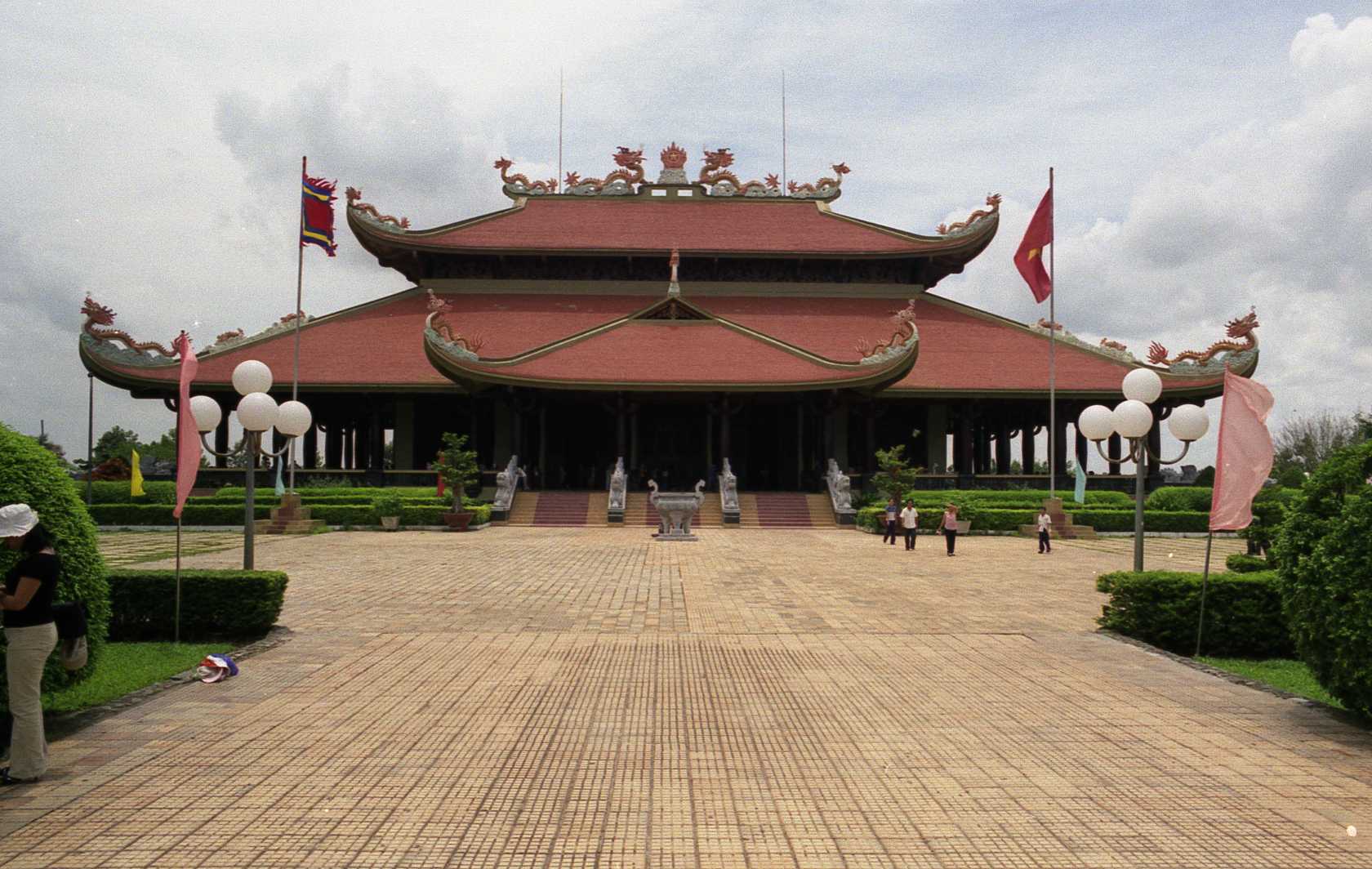
Ben Duoc Memorial Temple
Forty-four thousand, five hundred and twenty names. Each one carved in gilded letters on granite tablets that line the walls of a U-shaped temple in the Vietnamese countryside. Visitors come here not as tourists but as seekers, scanning the walls for a father, a grandmother, a comrade whose burial place they never learned. The management board keeps records and can sometimes tell them where the bones rest. This is the Ben Duoc Memorial Temple, built at the edge of the Cu Chi tunnels northwest of Ho Chi Minh City, where the ground itself is a monument to what war costs.
Where the Tunnels End
The temple sits on seven hectares of land in the Ben Duoc hamlet of Phu My Hung commune, at the terminus of the famous Cu Chi tunnel network. During the Vietnam War, this stretch of Binh Duong province belonged to what both sides called the Iron Triangle -- Tam Giac Sat -- a stronghold of resistance that American forces could neither hold nor pacify. The tunnels that honeycombed the laterite soil here sheltered fighters, hospitals, and command centers for years. When the war ended, the landscape bore its scars: craters pocked the earth, and vegetation had been stripped by defoliants. It was on this wounded ground that Ho Chi Minh City's Communist Party Committee chose to build a place of remembrance. On December 19, 1975, the first stage of the memorial was inaugurated, and that date became the annual day of gratitude to the dead.
Stone from the Marble Mountains
Construction of the temple proper began on May 19, 1993 -- the 103rd anniversary of Ho Chi Minh's birth. The builders drew on Vietnamese architectural tradition while working in modern materials. Visitors enter through a Tam Quan gateway, its round pillars and curved roofline evoking a village entrance, yin-and-yang tiles crowning the structure. On the pillars, parallel verses by the poet Bao Dinh Giang speak of devotion to the homeland. Beyond the gate stands the inscription house, a square structure sheltering a stone tablet three meters high and weighing over three tons. Artisans carved it from a single eighteen-ton block of stone quarried at Ngu Hanh Son, the Marble Mountains near Da Nang. The inscription, titled "Eternally Remember," was written by poet Vien Phuong and selected from a contest that drew 217 entries from 29 provinces and cities.
The Names on the Walls
Inside the main temple, the architecture serves a single purpose: to hold the names. The U-shaped worship hall centers on an altar of the nation, with a statue of Ho Chi Minh beneath an inscription reading "For the country, forget ourselves. Eternally remember." Incense tables flanking the center honor ancestors and unknown soldiers. But it is the walls that hold the weight. Along the left, the names of Party members who died; along the right, the names of fallen soldiers from the armed forces. The 44,520 names include Vietnamese Heroic Mothers, decorated heroes, and those officially recognized as revolutionary martyrs -- among them 9,322 from provinces and cities beyond Ho Chi Minh City. People visit individually and in groups, tracing their fingers across the gilded characters, searching for someone they lost. The temple staff maintain detailed records and can often provide information about burial locations.
Nine Floors, Nine Chapters
A nine-story tower rises 39 meters above the complex, its walls decorated with scenes depicting the life and resistance of the Cu Chi people. From the uppermost floor, visitors can survey the landscape of the former revolutionary base, including portions of the Iron Triangle that entered the history books. Below the temple, a basement holds nine exhibition spaces, each devoted to a different chapter of the Saigon-Cho Lon region's wartime experience. The first covers French colonial resistance. The second recreates the August 1945 uprising. Others chronicle guerrilla warfare in Cu Chi, the Tet Offensive of 1968, and the Ho Chi Minh Campaign of spring 1975. Sand tables, sculptures, stage models, and large-format paintings bring these events into three dimensions, turning chronology into something visitors can walk through rather than merely read.
Flowers Where Craters Were
Perhaps the most quietly powerful transformation at Ben Duoc is the landscape itself. Where bomb craters once scarred the earth, a flower garden now blooms year-round, planted with specimens donated by craftsmen and organizations from across Vietnam. National and provincial leaders have added their own trees to the garden fronting the temple. Behind the temple, facing the Saigon River, stands a granite monument sixteen meters tall and weighing 243 tons. Shaped like a teardrop, it features a lotus flower cradled by a hand -- an image drawn from Vietnamese folk poetry that connects the national flower to the memory of Ho Chi Minh. Carved into the monument's surface are scenes spanning Vietnamese history from the legendary founding by the Hung kings to reunification on April 30, 1975. The teardrop faces the river, as though grief itself were watching the water carry the past downstream.
From the Air
Located at 11.146N, 106.459E in Cu Chi district, approximately 50 km northwest of Ho Chi Minh City center. The temple compound is visible from moderate altitude as a cleared 7-hectare site with a prominent 39-meter tower, surrounded by gardens near the Saigon River. The nearby Cu Chi tunnels tourist area provides an additional landmark. Tan Son Nhat International Airport (VVTS) lies approximately 45 km to the southeast. The terrain is flat lowland with scattered rubber plantations.