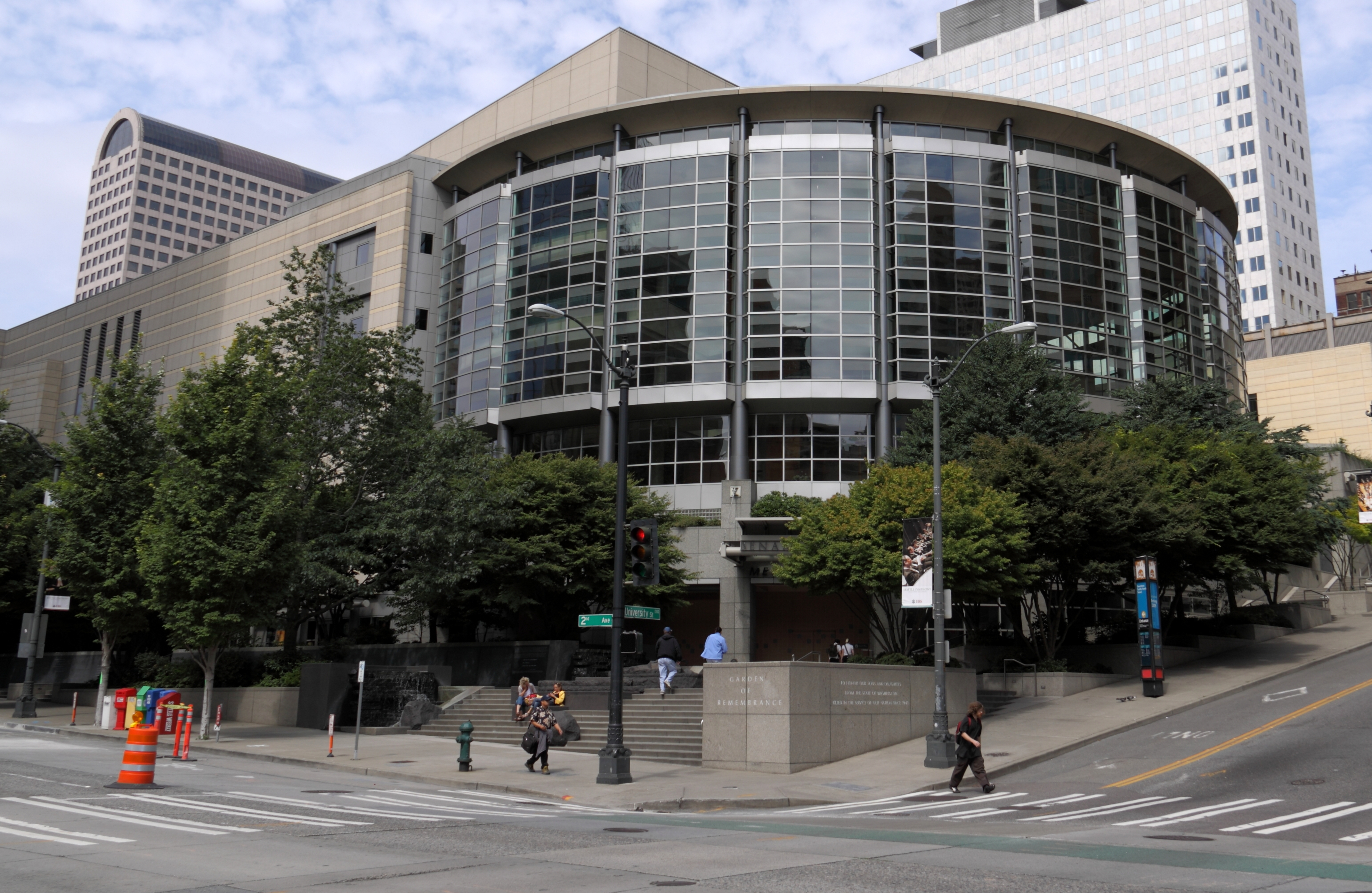
Benaroya Hall
Somewhere beneath the stage of Seattle's premier concert hall, freight trains rumble through the Great Northern Tunnel. The audience never hears them. When Benaroya Hall opened in September 1998, acoustician Cyril Harris had solved one of the most unusual engineering challenges in concert hall design: how to make a building that sits directly above an active rail corridor, and next to a transit tunnel, feel as silent as a sealed vault. His solution was elegant and extreme -- the entire performance hall floats on rubber isolation pads, decoupled from the outer shell of the building. The same technology that keeps train noise out of Brahms also happens to make the structure earthquake-resistant.
A Philanthropist's Gift
The hall carries the name of Jack Benaroya, the Seattle philanthropist whose $15.8 million donation launched the fundraising campaign for the $120 million project. His was the first and largest contribution, a statement of faith in a city that was still finding its cultural footing in the late 1990s. LMN Architects, a Seattle firm, designed the building to occupy an entire city block in the heart of downtown. Their work earned the National Honor Award from the American Institute of Architects in 2001, with structural engineering by Magnusson Klemencic Associates. Inside, the S. Mark Taper Foundation Auditorium seats 2,500 for full orchestral performances, while the more intimate Illsley Ball Nordstrom Recital Hall accommodates 536 for chamber music and solo recitals.
Glass, Light, and Chihuly
Walking into Benaroya Hall, the music begins before anyone picks up an instrument. The lobby is dominated by Crystal Cascade, a monumental glass sculpture by Dale Chihuly, the Tacoma-born artist whose blown-glass forms have become synonymous with the Pacific Northwest. Chihuly's work is one of several glass art installations throughout the building, transforming what could have been a conventional concert hall lobby into something closer to a gallery. The effect is deliberate -- Benaroya was designed not just as a place to hear the Seattle Symphony, but as a civic landmark that rewards the eye as much as the ear. Since its opening, the hall has helped double the Seattle Symphony's budget and the number of performances it stages each season.
Where Macklemore Meets Mozart
Since 2007, Benaroya has blurred the line between classical institution and popular music venue through its pops program. The roster of artists who have performed with the Seattle Symphony reads like a cross-section of the city's musical identity: Brandi Carlile, Macklemore, Sir Mix-A-Lot, Nancy Wilson of Heart, and the rock band Thunderpussy have all shared the stage with a full orchestra. These collaborations are not a sideshow. Nonclassical performances -- pop collaborations, live film scores, and video game music concerts -- account for roughly 30 percent of the Symphony's revenue and regularly draw audiences who might never attend a traditional classical program. It is a model that other orchestras around the country have studied and emulated.
Woven Into the City
Benaroya Hall does not simply sit in downtown Seattle; it is threaded into the city's infrastructure. The Great Northern Tunnel passes directly beneath it. The Downtown Seattle Transit Tunnel runs alongside it, with Symphony station -- renamed in August 2024 to honor the Seattle Symphony -- integrated directly into the building. Concertgoers step off a light rail train and walk straight into the lobby. This physical connection to the transit network reflects the hall's broader ambition: to be not a temple set apart from daily life, but a living room at the city's center, where the sound of a 2,500-seat orchestra rises just a few dozen feet above the steel rails that have carried cargo through Seattle for over a century.
From the Air
Benaroya Hall sits at 47.608°N, 122.337°W in downtown Seattle, occupying a full city block between 2nd and 3rd Avenues. From the air, look for the glass-and-steel structure just south of Pike Place Market and west of the downtown transit corridor. The nearest general aviation airport is Boeing Field/King County International (KBFI), approximately 4 nautical miles to the south. Seattle-Tacoma International Airport (KSEA) lies about 11 nautical miles to the south. Recommended viewing altitude: 2,000-3,000 feet AGL for downtown context.