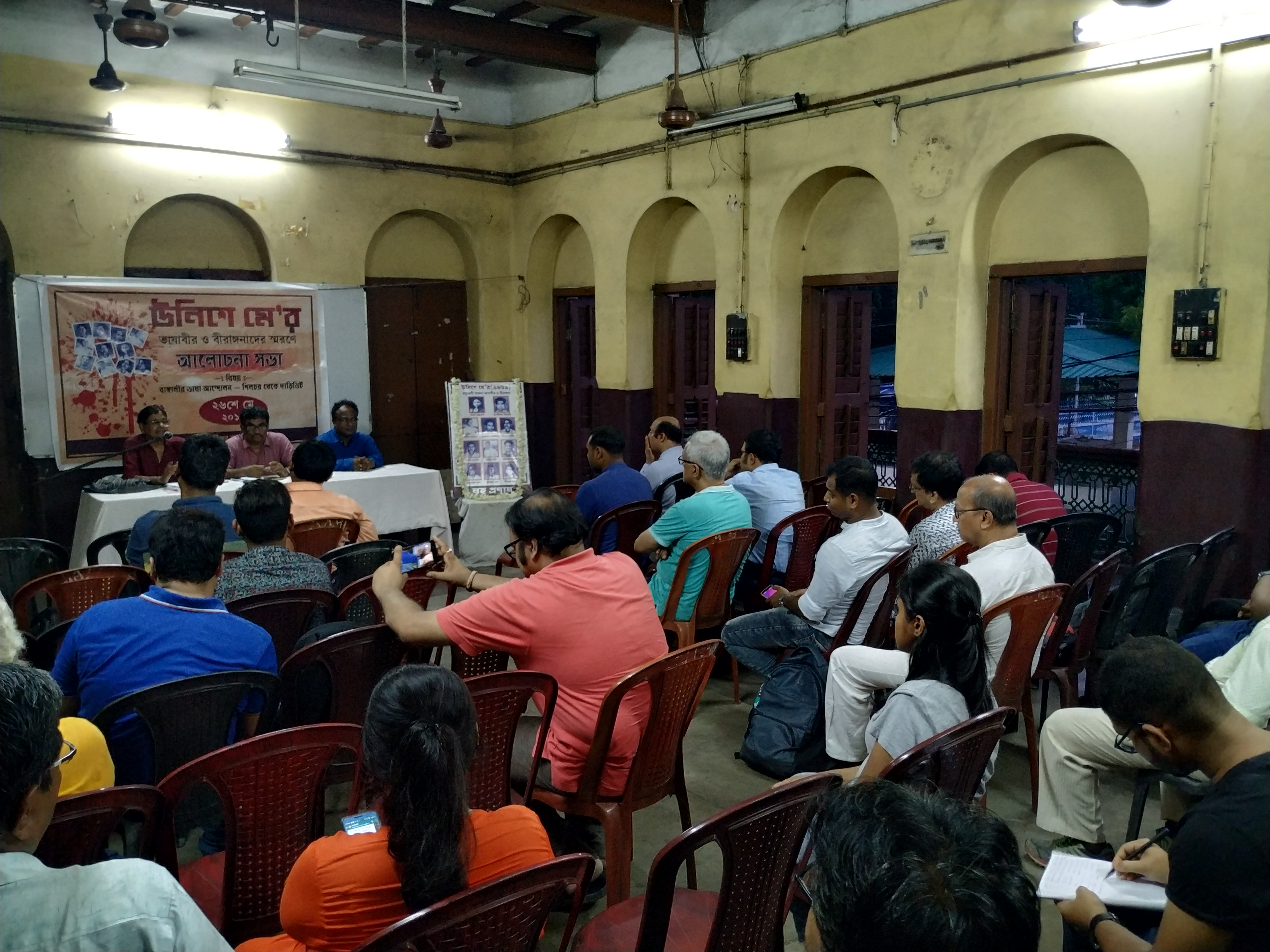
Bengali Language Movement (Barak Valley)
Not a single ticket was sold for the 5:40 a.m. train. On 19 May 1961, Silchar railway station fell silent -- not from emptiness, but from purpose. Thousands of Bengali-speaking protesters had gathered along the tracks in a dawn-to-dusk hartal, a total work stoppage meant to force a simple demand: the right to use their mother tongue. By afternoon, Assam police and the paramilitary Assam Rifles would open fire on those unarmed demonstrators. Eleven people died that day and in the weeks that followed, making the Barak Valley language movement one of the few struggles in world history where people sacrificed their lives not for territory or political power, but for the right to speak and learn in their own language.
A Valley Divided by Decree
The Barak Valley sits in southern Assam, a lush lowland where the Barak River winds between tea gardens and rice paddies. In 1961, roughly 80 percent of the valley's population spoke Bengali, a mix of Hindu and Muslim communities who had lived there for generations. But the valley belonged administratively to Assam, a state whose Brahmaputra Valley majority spoke Assamese. When Chief Minister Bimala Prasad Chaliha pushed a bill through the Legislative Assembly on 24 October 1960 making Assamese the sole official language, it effectively erased Bengali from schools, courts, and government offices in the Barak Valley. Legislator Ranendra Mohan Das protested that the bill imposed the language of one-third of the population upon the other two-thirds. His objection was overruled.
Two Hundred Miles on Foot
Resistance coalesced around the Karimganj-based Bengali language council, the Parishad. In April 1961, its leaders set out on a padayatra -- a walking march -- through the Barak Valley countryside. For two weeks, the Satyagrahis covered over 200 miles on foot, moving through village after village around Silchar and Karimganj, explaining what the new law meant for Bengali-speaking families: children taught in a language they did not speak, legal proceedings conducted in words they could not understand. The march ended in Silchar on 2 May. Parishad leader Rathindranath Sen issued an ultimatum: if Bengali was not granted official status by 13 April 1961, a complete hartal would shut down the valley on 19 May. On 12 May, soldiers of the Assam Rifles, the Madras Regiment, and the Central Reserve Police staged a flag march through Silchar. On 18 May, police arrested three movement leaders, including Sen himself.
Blood on the Tracks
The hartal began at dawn on 19 May across Silchar, Karimganj, and Hailakandi. Picketers stood peacefully at railway stations, government offices, and courts. The morning passed without incident. Then, around 2:30 in the afternoon, a Bedford truck carrying nine arrested protesters from Katigorah drove past the Tarapur railway station. Seeing their fellow activists in custody, the crowd surged onto the tracks in protest. The truck driver and his police escorts fled; moments later, someone set the abandoned vehicle alight. What happened next tore through the community. The Assam Rifles opened fire. Nine people fell dead at or near the station. Two more would die of their wounds in the following days. Among the eleven were Kanailal Niyogi, Kamala Bhattacharya, Sachindra Chandra Pal, and Sunil Sarkar -- ordinary people whose names would become permanent fixtures of the valley's memory. Dozens more were beaten with lathis and bayonets, and at least 30 were hospitalized with bullet wounds. Some carried the disfigurement for the rest of their lives.
The Language That Would Not Be Silenced
The killings forced the Assam government to reverse course. Bengali was granted official status in the Barak Valley's three districts of Cachar, Karimganj, and Hailakandi. Section 5 of Assam Act XVIII, 1961, enshrined the protection explicitly: Bengali would be used for all administrative and official purposes up to and including the district level. The victory came at a cost that echoes across borders. The Barak Valley massacre is often compared to the 1952 Bengali language movement in Dhaka, where Pakistani police shot and killed students demanding Bengali as a national language -- an event that eventually inspired UNESCO's International Mother Language Day. In 2013, when the Assam government issued a circular pushing Assamese in all districts, protests in the Barak Valley forced another reversal within months.
Eleven Names, Remembered Every May
The Shahid Minar, a martyrs' memorial, stands in Silchar today, containing the ashes of those who died. Every 19 May, the valley observes Bhasha Shahid Divas -- Language Martyrs' Day. Rallies wind through the streets, cultural programs fill the evening, and flower garlands drape the busts of the eleven. In 2011, a bronze bust of Kamala Bhattacharya was unveiled at the Chhotelal Seth Institute. The movement's legacy extends beyond memorials. It established a principle that linguistic minorities within Indian states have a right to official recognition -- a principle tested repeatedly as India's linguistic map continues to shift. For the Bengali-speaking communities of the Barak Valley, the names of those eleven dead are not history. They are a living argument that language is not merely a tool of communication but a matter of identity worth defending.
From the Air
Located at 24.82°N, 92.81°E in the Barak Valley of southern Assam, northeast India. The area is a flat river valley surrounded by low hills, visible as green lowland terrain from altitude. Nearest significant airport is Silchar Airport (VEKU). Kumbhirgram Air Force Station is nearby. The Barak River provides a good visual reference winding through the valley. Best viewed at 8,000-12,000 feet for valley context.