Bennekom
Walk down the main street of Bennekom on the evening of May 4th and you will hear nothing. No cars. No conversations. A few hundred residents move on foot toward a small park at the south end of the village, past the medieval Old Church and the shuttered shops, and at the monument they stop. The Dutch national anthem rises. Two minutes of silence follow. Then everyone goes home. They have been doing this every year since 1945, when the village they were returning to was barely a village at all - a strip of evacuated houses cleared by the German army for fields of fire, with their windmill blown apart and a hundred German soldiers buried in the cemetery.
The Bishop and the Saint
The story of Bennekom really begins with a young noble named Meinwerk, born around 975 at Renkum just down the road, and the plague that nearly killed him after he became Bishop of Paderborn in 1009. He survived. He believed Saint Alexander - a Roman martyr whose bones had been carried up to Germany in 851 - had healed him, and he built churches in gratitude. One of them probably rose on land his mother Adela of Renkum already owned at Bennekom: the Old Church, whose tuffstone foundations and 11th-century mortar came to light during the 2006 restoration. It is the oldest church in the municipality of Ede, and the only Saint Alexander dedication in the Netherlands. Around it, the streets still bend the way medieval cart tracks bent.
Castles in the Marsh
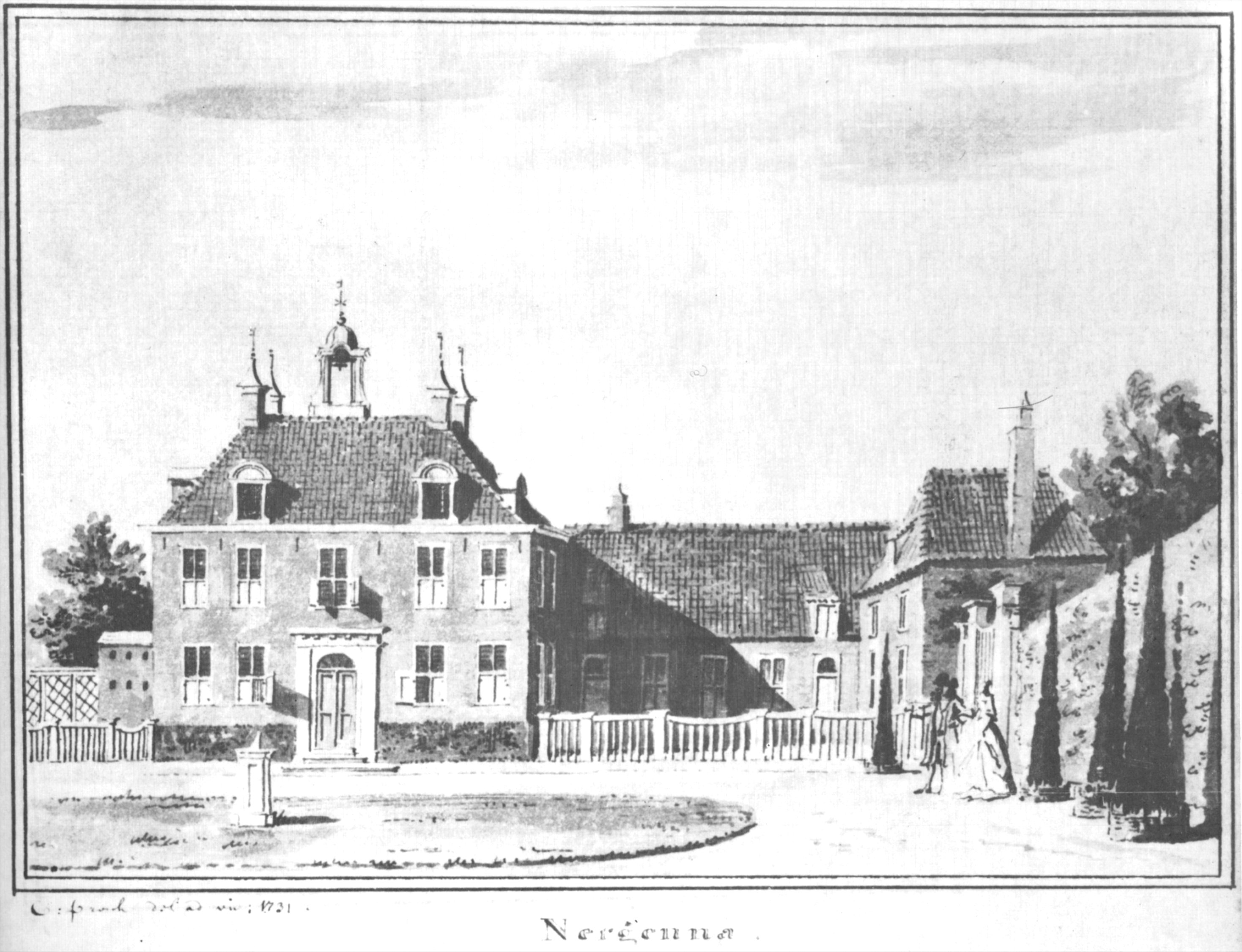
The land here was harder to cross than it looks. West of the village stretches the Binnenveld - a flat strip of clay and drained peat that marks the path a glacier scraped during the last Ice Age. The marshes were not properly drained until the 13th century, and before that the only safe crossings ran past four fortified farmsteads: Harslo, Nergena, Hoekelum, and the Ham. They guarded the wet borderland where the Duchy of Guelderland and the Bishopric of Utrecht periodically went to war. The castles are mostly gone now. Hoekelum survives as a moated country house. Of Harslo, only the gatehouse remains, standing alone in a field like a forgotten sentence. The hamlet of De Kraats still sits on the remnants of dunes blown there at the end of the Ice Age - higher ground for the people who refused to live in mud.
Sperrgebiet
On 21 October 1944, the village was emptied. After Operation Market Garden failed at Arnhem and the Allies dug in south of the Rhine, Bennekom found itself on the wrong side of the new front line, and the German army declared it Sperrgebiet - forbidden territory. Residents had to leave. Only enslaved laborers, forced to build defenses, remained. German engineers demolished houses on the village edge to clear sightlines. Allied artillery shelled what was left. On 23 November, the windmill on the edge of town went up in a column of smoke and flame when the munitions stored inside it detonated, killing roughly a hundred German troops and flattening nearby properties. A stray V-1 rocket added its own crater later. For nearly seven months, Bennekom was a place without people.
The Five Names in the Park
On the night of 8 March 1945, RAF aircraft dropped weapons near Lunteren for the Dutch resistance. Seventeen members of the underground were captured. Two weeks later they were executed - four from Bennekom at Amersfoort, one at Loosdrecht. Their names were Maarten H. Lugthart, Jan Mekking, Peter Roseboom, Lambertus van Elst, and Hylke van Vliet. Most were ordinary men in their twenties. Canadian troops liberated the empty village on 17 April 1945, and that summer Canadian soldiers helped erect a small monument to the five. The park around it was renamed Bart van Elst Park. The procession on May 4th still walks toward those five names, and toward the others - the civilians killed by stray shellfire, the Jewish neighbors who did not come home from Sobibor and Auschwitz, the resistance members shot in fields no one marks.
The Village Now
Today Bennekom is comfortable, slightly expensive, and full of cyclists. About 5,876 households fill its streets. Many residents commute to Wageningen University and its agricultural research institutes, or to Ede, or down the A12 toward Holland. The Old Church bell still rings at noon - an echo of the pre-Reformation Angelus, kept going by the civil municipality since Napoleonic times when church towers were nationalized. The steam tramway that once ran through the village center to Wageningen stopped running in the 1960s. The hospital became Baron van Wassenaarpark. Children climb at Hoekelum on Ascension Day for the gymkhana. Most days the village is unremarkable in the way that quiet European villages are unremarkable: schools, two grocery markets, seven churches reflecting various shades of Dutch Calvinism, a soccer club. Only on May 4th does it stop and remember what it once was.
From the Air
Bennekom sits at 52.00 N, 5.68 E in the southwestern Veluwe, between Wageningen on the Lower Rhine and Ede to the north. From cruising altitude the parish reads as a small grey cluster on the edge of forested moraine, with the A12 motorway running just north of the village and the canalized Grift to the west marking the boundary with Utrecht province. Nearest major airports: Eindhoven (EHEH) about 65 km south, Düsseldorf (EDDL) 120 km southeast, Amsterdam Schiphol (EHAM) 80 km northwest. Best viewed at 2,000-4,000 ft in clear weather, where the Old Church tower, the wooded estate of Hoekelum north of the A12, and the rectangular block of pine and birch forest east of the village become distinct.