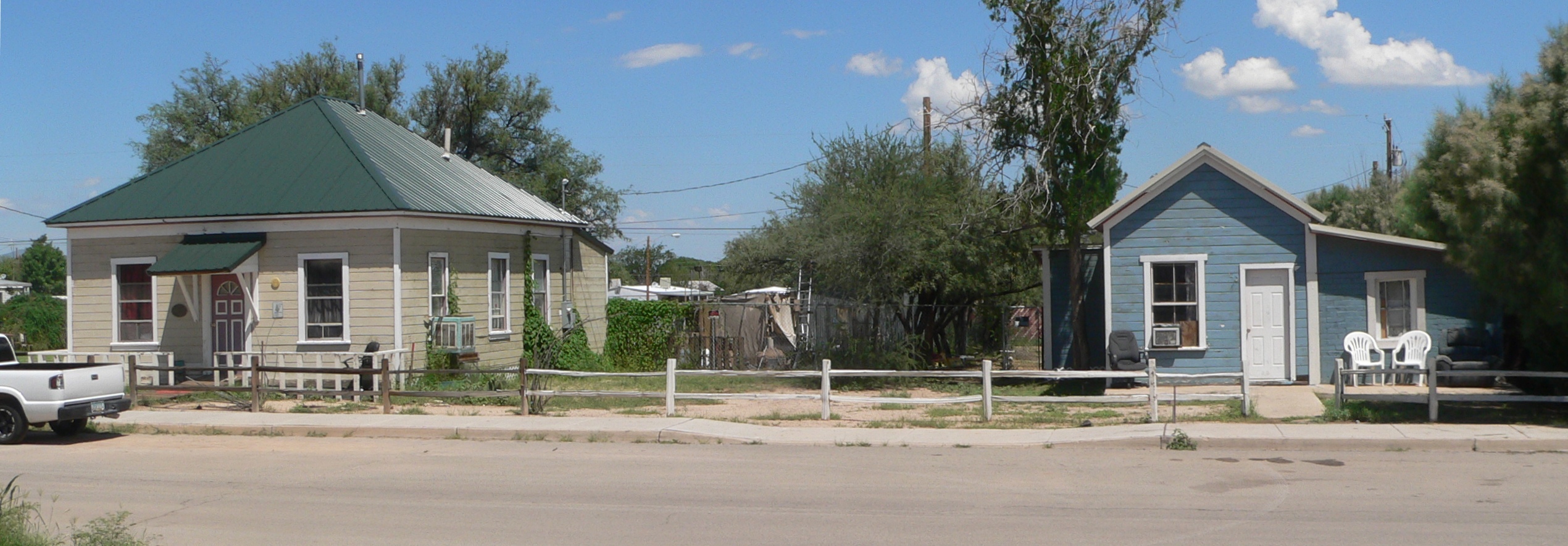
Benson Railroad Historic District
Before it was a town, it was a stagecoach station called Ohnesorgen, a lonely waypoint in the Arizona desert. Then the Southern Pacific railroad arrived in 1880, and everything changed. Within fifteen years, Benson had become the only point in the entire territory where three independent railroad lines converged. Passengers heading for Tombstone's silver bonanza, copper ore from Bisbee's mines, freight from the Galiuro and Rincon mountain districts, all of it flowed through this unlikely hub. The workers who kept those trains running needed places to eat, sleep, and spend their wages. The eleven historic buildings that survive today tell the story of a railroad boom that transformed a stagecoach stop into a crossroads of the frontier Southwest.
Crossroads of Iron Rails
The Southern Pacific brought transcontinental connection in 1880, making Benson the gateway to southeastern Arizona. Suddenly the only way to reach Tombstone, then exploding with silver fever, was to take the train to Benson and hire a stagecoach for the final leg. Two more railroads followed. The New Mexico and Arizona Railroad arrived in 1882. Then in 1894, the Arizona Southeastern Railroad Company, owned by the Copper Queen Consolidated Mining Company in Bisbee, laid tracks specifically to ship ore to Benson for distribution elsewhere. The town's population quadrupled from 300 to 1,200 in thirty years. Hotels, saloons, restaurants, and worker housing sprouted around the depot, creating the commercial district that would later earn National Register recognition.
The Architecture of Ambition
The buildings that survive represent a catalog of frontier construction techniques. Five vernacular frame houses line East 3rd Street, built of dimension lumber with wood siding in the practical styles working families could afford: shotgun houses with their elongated floor plans, hall and parlor dwellings, L-shaped homes with additions tucked into corners. Board and batten siding, v-groove siding, shed-roofed porches with slender wooden columns, these were the materials and methods that housed railroad workers across the American West. The single vernacular adobe building, a carriage house in the alley east of the Arnold Hotel, represents the older Spanish colonial tradition that preceded the rails.
The Roadmaster's House
The Queen Anne style residence at 305 East 3rd Street belonged to the railroad's roadmaster, the man responsible for maintaining the track and right-of-way. Its jerkinhead roof with cross-gables, its veranda wrapping three-quarters of the house, its corbelled brick chimney, all announced a status several rungs above the shotgun houses down the street. The original picket fence still stands. Tongue and groove wood siding speaks to construction quality built to last. The roadmaster needed to live well. His job demanded constant vigilance over miles of desert track, and his home served as both residence and visible symbol of the railroad's investment in the community.
Colonial Dreams on the Frontier
Three Colonial Revival homes speak to aspirations beyond mere shelter. The house at 285 East 3rd Street holds a peculiar distinction: it features Arizona's largest known example of double-roofing, where a second roof was built entirely over the first to improve insulation. The Arnold Hotel at 253 East 3rd Street represents the grandest Colonial Revival statement in the district, a single-story redwood structure with a four-sided veranda integrated into its hipped roof. Redwood columns, redwood siding, tongue and groove redwood paneling inside, the builders imported California's finest lumber to create something lasting. The hotel served travelers changing trains, merchants visiting on business, and drummers selling wares throughout the territory.
When the Trains Stopped Coming
The decline came swiftly. In 1901, the Arizona Southeastern Railroad rerouted its traffic, bypassing Benson entirely. Nine years later, the Southern Pacific opened a direct line from Tucson to Nogales, removing another reason to stop. Benson went from three-line hub to single-line whistle stop in less than a decade. The economy contracted. Buildings fell into disrepair. But the district's very marginality preserved it. No one had money to tear down the old structures and build new ones. The shotgun houses, the roadmaster's Queen Anne residence, the Arnold Hotel with its redwood elegance, all survived precisely because prosperity never returned to sweep them away. Today eleven contributing structures stand along East 3rd Street, architectural fossils from the thirty-year railroad boom that once made Benson the crossroads of Arizona.
From the Air
Located at 31.97N, 110.29W in Benson, Arizona, elevation approximately 3,580 feet in the San Pedro River Valley. The historic district clusters near the former depot site on 3rd Street, visible from low approaches over the town center. Benson Municipal Airport (E95) lies 3 nm northwest with a 4,500-foot paved runway. Tucson International (TUS) sits 40 nm northwest for larger aircraft. The San Pedro River runs north-south through the valley, with the Rincon Mountains rising to the northwest and the Dragoons to the southeast, framing the natural transportation corridor that made Benson a railroad hub.