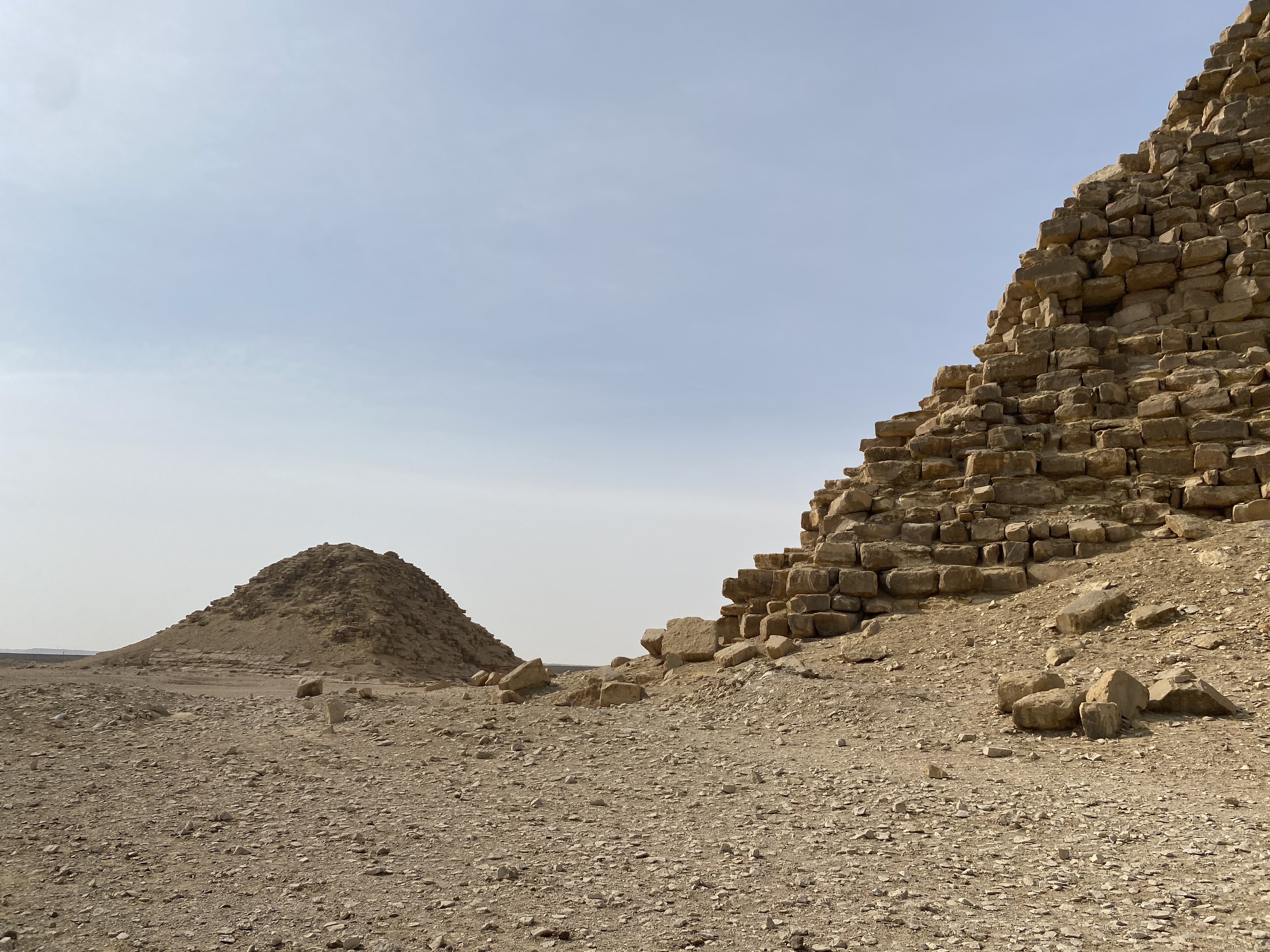
Bent Pyramid
Halfway up, the angle changes. From the desert floor, the lower walls of the Bent Pyramid climb at a steep 54 degrees, then abruptly shift to 43 degrees, giving the 4,600-year-old structure a kinked silhouette unlike any other pyramid in Egypt. Built by Pharaoh Sneferu during the Old Kingdom, approximately 40 kilometers south of Cairo at the royal necropolis of Dahshur, this was an experiment in real time, a monument where the builders changed their minds mid-construction and left the evidence for everyone to see. Its ancient name translates roughly as "The Southern Shining Pyramid," and in the low desert light, the name still fits: unlike nearly every other pyramid in Egypt, the Bent Pyramid retains most of its original polished Tura limestone casing, gleaming where the surfaces of its neighbors have been stripped bare.
Three Phases of an Idea
The pyramid passed through three distinct construction phases, each reflecting a different ambition. The first plan called for a base of 157 meters and a punishing inclination of roughly 58 degrees, which would have produced a structure around 125 meters tall. But such a steep angle had never been achieved at this scale, and the builders likely recognized early that it was unachievable. In the second phase, the base was widened to 188 meters and the angle reduced to 54 degrees, using inclined stone layers borrowed from the step-pyramid tradition. Had this angle been maintained to the apex, the pyramid would have stood over 129 meters, making it the third tallest ever built. Instead, at a height of 49 meters, the builders pivoted again. The third phase reduced the angle to 43 degrees and introduced horizontal masonry layers, the technique that would define every major pyramid built afterward. The resulting kink is unique in Egyptian architecture. The final structure stands 105 meters tall with a volume of roughly 1.44 million cubic meters.
Why the Bend?
Theories about the angle change have occupied Egyptologists for generations. In 1974, physicist Kurt Mendelssohn proposed that the builders changed course in reaction to the catastrophic collapse of the Meidum Pyramid, which was under construction simultaneously. Others point to stability concerns, noting damaged stones in the interior and unfinished sections. But there are no signs of structural deformation in the Bent Pyramid itself, complicating the instability theory. A more practical explanation involves ramp logistics: for geometric reasons, serving a pyramid steeper than about 52 degrees with construction ramps was likely impossible. The Bent Pyramid was the second of three pyramids Sneferu built during his long reign, and each one refined the lessons of its predecessor. His next project, the nearby Red Pyramid, was built at a consistent 43-degree angle from base to apex. His son Khufu, whom the Greeks called Cheops, took those lessons to their ultimate conclusion at Giza.
Passages and Hidden Chambers
The interior is as unusual as the exterior. Two entirely separate entrance systems lead to two distinct chamber complexes, an arrangement found in no other pyramid. The northern entrance, 12 meters above ground, opens into a 74-meter descending passage barely over a meter high, ending in a subterranean antechamber with a corbelled ceiling soaring nearly 13 meters overhead. A second entrance on the western face, at a height of 33 meters, descends through its own passage to an upper burial chamber whose corbelled roof rises over 16 meters. A rough connecting tunnel links the two systems. Ancient cedar beams still brace the upper chamber, their purpose debated: some scholars read them as emergency reinforcement against structural failure, while others argue they were part of the original funerary furniture. No sarcophagus was found in either chamber, and no burial was ever confirmed.
A Mountain in an Artificial Landscape
The Bent Pyramid did not stand alone. A 700-meter limestone causeway connected it to a valley temple to the northeast, an unusual structure with beveled edges and decorated pillar reliefs. Fifty-five meters to the south, a satellite pyramid, possibly built for Sneferu's wife Hetepheres or to house the pharaoh's ka, mirrors the main structure in miniature. Archaeologists have identified evidence that the entire plateau was artificially leveled, with quarried trenches on the western and southern flanks and traces of an ancient garden enclosure fed by a wadi channel connecting to a harbor. Researchers Alexanian and Arnold described the result as "an artificial mountain erected within an artificial landscape." In July 2019, Egypt opened the Bent Pyramid to tourism for the first time since 1965, allowing visitors into its 4,600-year-old chambers through the narrow northern tunnel.
From the Air
Located at 29.79N, 31.21E at Dahshur necropolis, approximately 40 km south of Cairo. The distinctive bent profile is visible from altitude; look for the kinked silhouette south of the Giza plateau. The nearby Red Pyramid and Black Pyramid are also visible. Best viewed at 3,000-6,000 ft AGL. Nearest airport is Cairo International (HECA). The Giza pyramids lie approximately 15 km to the north.