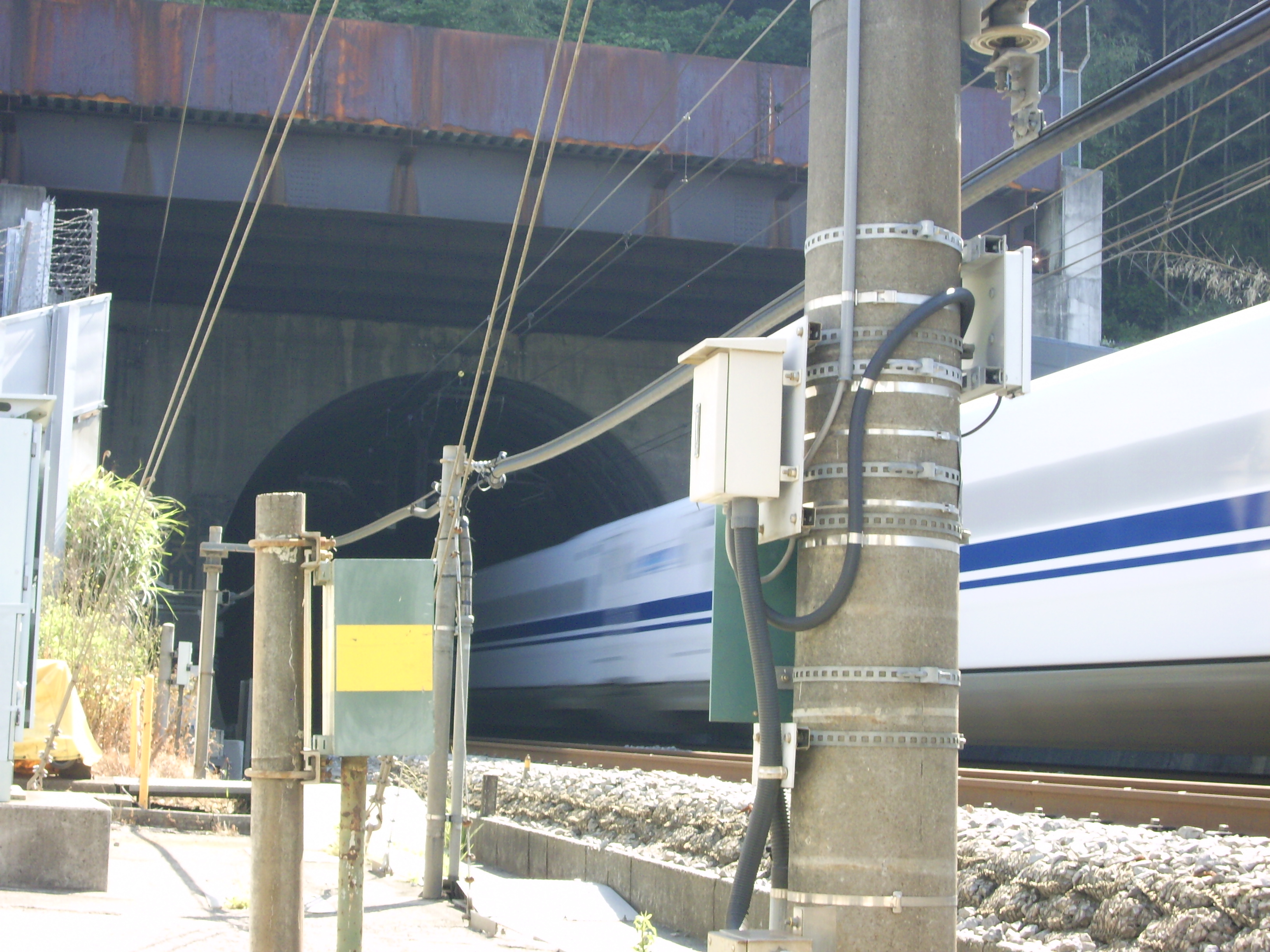
Bentenyama Tunnel
Before the world's first bullet train could carry a single passenger, it had to prove itself underground. The Bentenyama Tunnel, a 1.316-kilometer bore through the Oiso hills of Kanagawa Prefecture, was completed in 1962 -- two full years before the Tokaido Shinkansen opened for service. It sat within the Kamonomiya test section, a 32-kilometer stretch between Odawara and Ayase where prototype trains shattered speed records and engineers ironed out the physics of moving people at velocities no railway had ever sustained. Today, Shinkansen trains flash through Bentenyama in seconds. But this tunnel was one of the places where the bullet train was born.
The Proving Ground
The Kamonomiya model track, as engineers called it, opened in June 1962 as the critical test bed for Shinkansen technology. Over two years, prototype trains logged a remarkable 250,000 kilometers on this section alone. On October 27, 1962, a test consist designated 'set B' reached 190 km/h, breaking the previous Japanese rail speed record. Four days later, on October 31, the same set pushed past 200 km/h for the first time -- a psychological barrier that proved high-speed rail was not merely theoretical but achievable. The Bentenyama Tunnel, sitting along this stretch near the Kozu area of the Oiso hill land, was part of every one of those test runs. Every record-setting sprint passed through its 1.3 kilometers of concrete and rock.
Layers of Sand and Stone
The geology beneath Bentenyama tells its own story. The tunnel cuts through the southwestern edge of the Oiso hill land, a region characterized by diluvium-tertiary formations -- ancient layers of compacted soil dating back tens of thousands of years. Alongside the tunnel's path, the hill is composed of alternating beds of sand gravel and tuffaceous mudstone, volcanic sediment compressed over geological ages. For the engineers of the early 1960s, boring through this layered sandwich of soft and hard material was a significant challenge. The tunnel had to withstand not only the passage of trains at unprecedented speeds but also the seismic activity common to this stretch of the Japanese coast, where tectonic plates grind beneath the surface.
A Dream Decades in the Making
Japan's bullet train did not spring from nothing in 1959, when construction formally began. The idea traced back to the Dangan Ressha project of 1939, a wartime plan to build a high-speed wide-gauge railway along the Tokaido corridor. The government acquired land and began boring tunnels before the Pacific War consumed all available resources and the project was shelved. Three tunnels from that era were later incorporated into the Tokaido Shinkansen route. The Bentenyama Tunnel itself was built fresh for the new line in 1962, but it inherited the vision of those earlier planners. When the Diet approved the modern Shinkansen project in December 1958, allocating 194.8 billion yen for construction, chief engineer Hideo Shima and Japanese National Railways president Shinji Sogo were fulfilling a dream that had survived wartime defeat and postwar reconstruction.
Seconds of Passage, Decades of Service
When the Tokaido Shinkansen opened on October 1, 1964, nine days before the Tokyo Olympics, it connected Tokyo and Osaka in four hours. The Hikari express and the all-stops Kodama began their runs along a route that remains one of the busiest rail corridors on Earth. The Bentenyama Tunnel, operated today by Central Japan Railway Company, sits between Shin-Yokohama and Odawara stations along this route. A modern Nozomi train, traveling at up to 285 km/h, passes through its 1.3 kilometers in roughly 17 seconds. Passengers barely register the brief dimming of light from their windows. Yet this unassuming stretch of tunnel near the Kanagawa coast represents one of the most consequential leaps in transportation engineering of the 20th century -- the place where speed stopped being a fantasy and became a timetable.
From the Air
Located at 35.294N, 139.213E in the Oiso hill land of Kanagawa Prefecture, near the Kozu area southwest of Odawara. The tunnel is not directly visible from the air, but the Tokaido Shinkansen line is a prominent linear feature cutting through the hills between Shin-Yokohama and Odawara. Look for the rail corridor running parallel to the coast along Sagami Bay. Nearest major airport: Tokyo Haneda (RJTT), approximately 55 km northeast. Odawara Castle and the Hakone mountain range provide visual landmarks to the west. Best viewed at lower altitudes where the rail line can be distinguished from surrounding infrastructure.