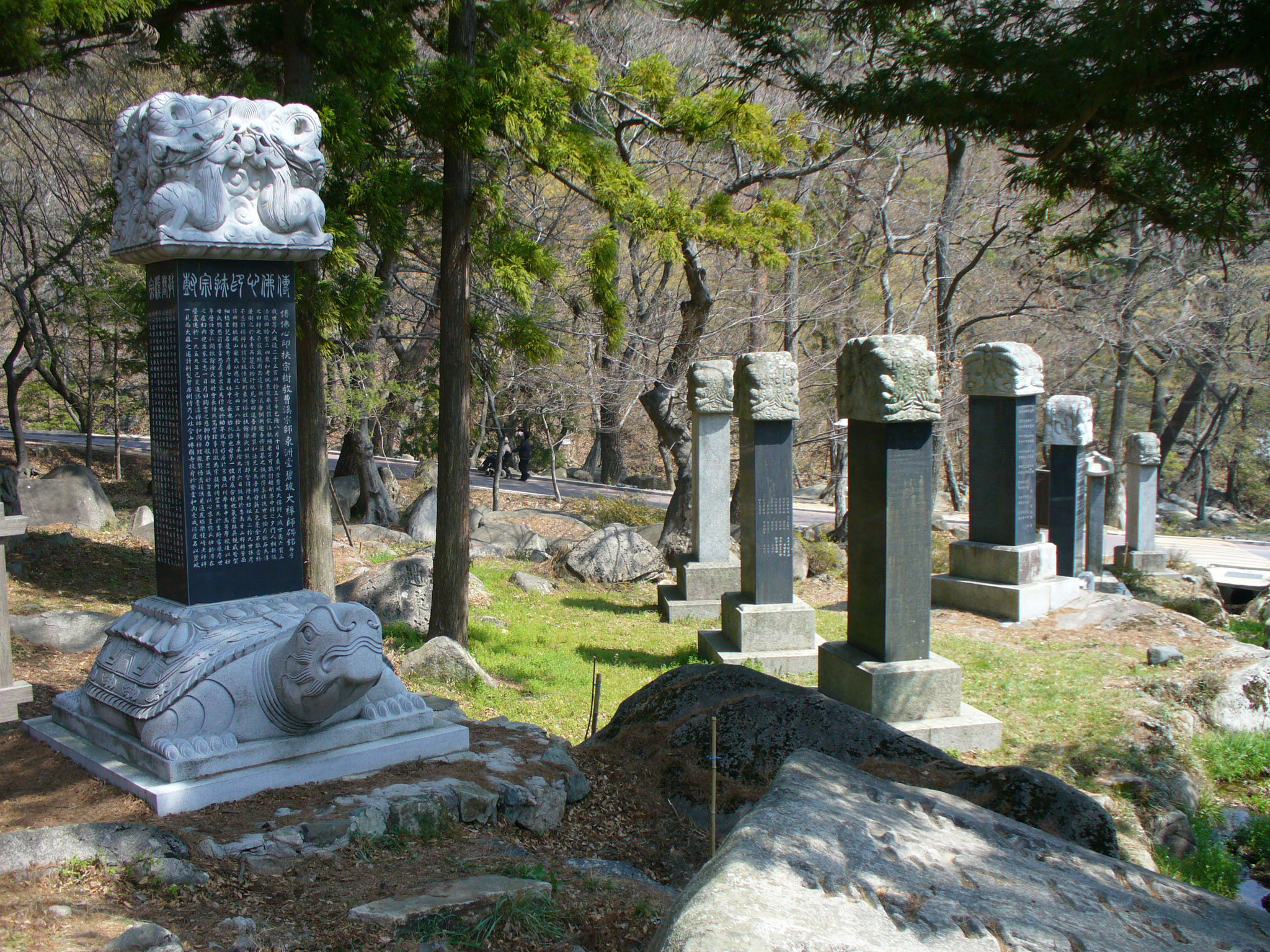
Beomeosa
Somewhere near the peak of Mount Geumjeongsan, a pool of water sits inside a boulder. According to legend, a golden fish descended from Brahma Heaven to live in this pool, and the water has never run dry since. The temple built on the mountain's slopes in 678 AD took its name from that fish: Beomeosa, the Temple of the Nirvana Fish. Thirteen centuries later, monks still chant in its halls, wisteria still blooms purple across its grounds, and the golden fish -- if you believe the story -- still swims.
The Nirvana Fish
The name Beomeosa encodes its own mythology. The first syllable means Nirvana, the second means fish, the third means temple. The official translation offered by the temple itself -- 'Temple of Gold Fish from Brahma Heaven' -- captures the celestial dimension of the legend. The pool called Geumsaem, the Golden Spring, still exists near the summit of Geumjeongsan. Whether or not it contains a divine fish is a matter of faith, but the mountain's name echoes the same story: Geumjeongsan means 'Mountain of the Golden Well.' Every name on this mountainside points upward.
Stone, Fire, and Renewal
Beomeosa was established in 678 during the Silla period as one of ten major temples of the Avatamsaka School. Its Three Story Stone Pagoda and a stone lamp date to this era -- survivors of everything that followed. In 1592, Japanese forces invaded Korea and burned the wooden buildings to the ground. What stands today began rising in 1613, when monks Myojeon and Haemin led the reconstruction; the main hall, Daeungjeon, was completed by 1614 and subsequently renovated in 1713, 1814, and 1871. The stone structures endured because stone endures. The wooden halls were rebuilt because faith demanded it. The cycle of destruction and restoration is not incidental to Beomeosa's story; it is the story. A temple is not its buildings. It is the decision to rebuild them.
Wisteria and Gatekeepers
Before reaching the temple compound, visitors pass through Iljumun, the One Pillar Gate -- so named because from the side it appears supported by a single pillar, symbolizing the one true path to enlightenment. The approach then threads through a mass of wild wisteria, over 6,500 plants designated as Natural Monument No. 176, that blooms a deep lavender in late spring. This grove has been called Deungungok for centuries. Beyond the wisteria, the temple complex unfolds across the mountainside: Daeungjeon at its center, eleven hermitages scattered through the surrounding forest, each with its own character. Wonhyoam was the residence of the famous Silla monk Wonhyo. Kyemyongam, the Rooster's Crow Hermitage, takes its name from two rocks shaped like chickens. Geumgangam is the Diamond Hermitage. The names suggest a community of places, each with its own personality, orbiting the central temple like smaller planets.
The Headquarters of Seon
Beomeosa is one of three major temples in southeast Korea, alongside Haeinsa and Tongdosa. Its particular distinction is its deep connection to Seon Buddhism -- the Korean tradition of meditation practice that shares roots with Japanese Zen and Chinese Chan. The temple has earned the title 'Great Headquarters Temple of Seon Buddhism,' and it serves today as a head temple of the Jogye Order, Korean Buddhism's largest denomination. The monks here have also gained attention for their martial arts tradition; the temple's fighting monks have practiced and taught their distinctive style for generations. Visitors can experience monastic life through the Templestay program, sleeping in the temple, eating Buddhist monk food, and following the daily rhythms of chanting and meditation.
A City Below, a Mountain Above
Beomeosa sits in Geumjeong District, technically within the city limits of Busan, South Korea's sprawling second city. The juxtaposition is striking. Busan's high-rises, beaches, and fish markets press against mountains that hold a seventh-century temple and the ruins of Geumjeong Fortress above it. Hikers who climb past the temple to the fortress gates find themselves looking down at container ships in the harbor and skyscrapers along Haeundae Beach. The mountain does not care about the city, and the temple does not acknowledge it. Inside the compound, the sounds are wind in wisteria, wooden prayer beads clicking, and the resonant strike of a temple bell. The golden fish, presumably, is still swimming.
From the Air
Coordinates: 35.28°N, 129.07°E on the slopes of Mount Geumjeongsan in northern Busan. The temple sits at elevation in a forested mountainside above the dense urban area. Nearest airport: RKPK (Gimhae International Airport, ~20 km west). Geumjeong Fortress ruins are visible on the ridgeline above. Best viewed at 2,000-4,000 ft to distinguish the temple complex from surrounding forest canopy.