Bequia
Alexander Hamilton's father died here, and nobody came to the funeral. James Hamilton moved from St. Croix to Bequia in 1774 under a British land grant program for indigent settlers, took up a plot along the shore of Southeast Bay, and stayed for sixteen years. His famous son sent money and letters begging him to visit or emigrate to the new United States. Neither man ever made the trip. The island that kept them apart is seven square miles of volcanic hillside in the Grenadines, fifteen kilometers south of Kingstown, and its name -- from the Arawak for "island of the clouds" -- suits a place that has always existed slightly out of reach.
A Harbor Worth Fighting Over
Admiralty Bay, on Bequia's west coast, was once the safest natural harbor in the Eastern Caribbean during hurricane season. Henry Morgan may have anchored there. Local legend holds that Blackbeard -- Edward Teach -- used Bequia as his base, and that Sir Francis Drake planned his attacks on Cartagena from these waters. What is certain is that the harbor's depth and shelter made the island a repair facility for ships at a time when the only other drydocks in the region were Nelson's Dockyard on Antigua and the Carlyle in Bridgetown, Barbados. Cedar trees on the island supplied timber for wooden shipbuilding, and the protected bay made hull repairs possible even during storm season. The Kalinago and Arawak peoples had used the island for fishing and farming long before Europeans arrived, but Bequia's harbors made it irresistible to every navy and pirate fleet that passed through the Grenadines.
Traded Between Empires
Bequia changed hands the way Caribbean islands did in the eighteenth century: through treaties signed in European capitals by men who had never seen the places they were giving away. The French settled first, establishing small plantations of indigo, cotton, and sugar worked by enslaved Africans brought through the Atlantic slave trade. The indigenous Kalinago population was gradually displaced or assimilated, a pattern repeated across the Lesser Antilles. During the Seven Years' War, French, Spanish, and Dutch fleets used Bequia for resupply while banning British ships. The 1763 Treaty of Paris redrew the Caribbean map: Saint Vincent and the Grenadines went to Britain in exchange for Guadeloupe, Martinique, and St. Lucia. In 1779, France seized Bequia back despite the treaty, only to lose it again soon after. Through all of this, the people who actually worked the land -- the enslaved Africans on the sugar plantations -- had no voice in any negotiation. Independence finally came in 1979.
The Last Whalers
Bequia is one of the few places on Earth where whaling is still permitted. The International Whaling Commission classifies the island's hunt as aboriginal whaling, and Bequians are allowed to catch up to four humpback whales per year using hand-thrown harpoons from small, open sailboats. The tradition was introduced by Yankee whalers in the nineteenth century and persists today, though the quota is rarely met and some years produce no catch at all. The hunt is controversial -- critics note that speedboats and harpoon guns sometimes replace the traditional methods -- but for the island it represents a living connection to a maritime heritage that shaped every family in Paget Farm and Port Elizabeth. The population of roughly 5,300, a mixture of African, Scottish, and Kalinago descent, still measures its calendar partly by the sea.
Floats, Regattas, and Turtle Sanctuaries
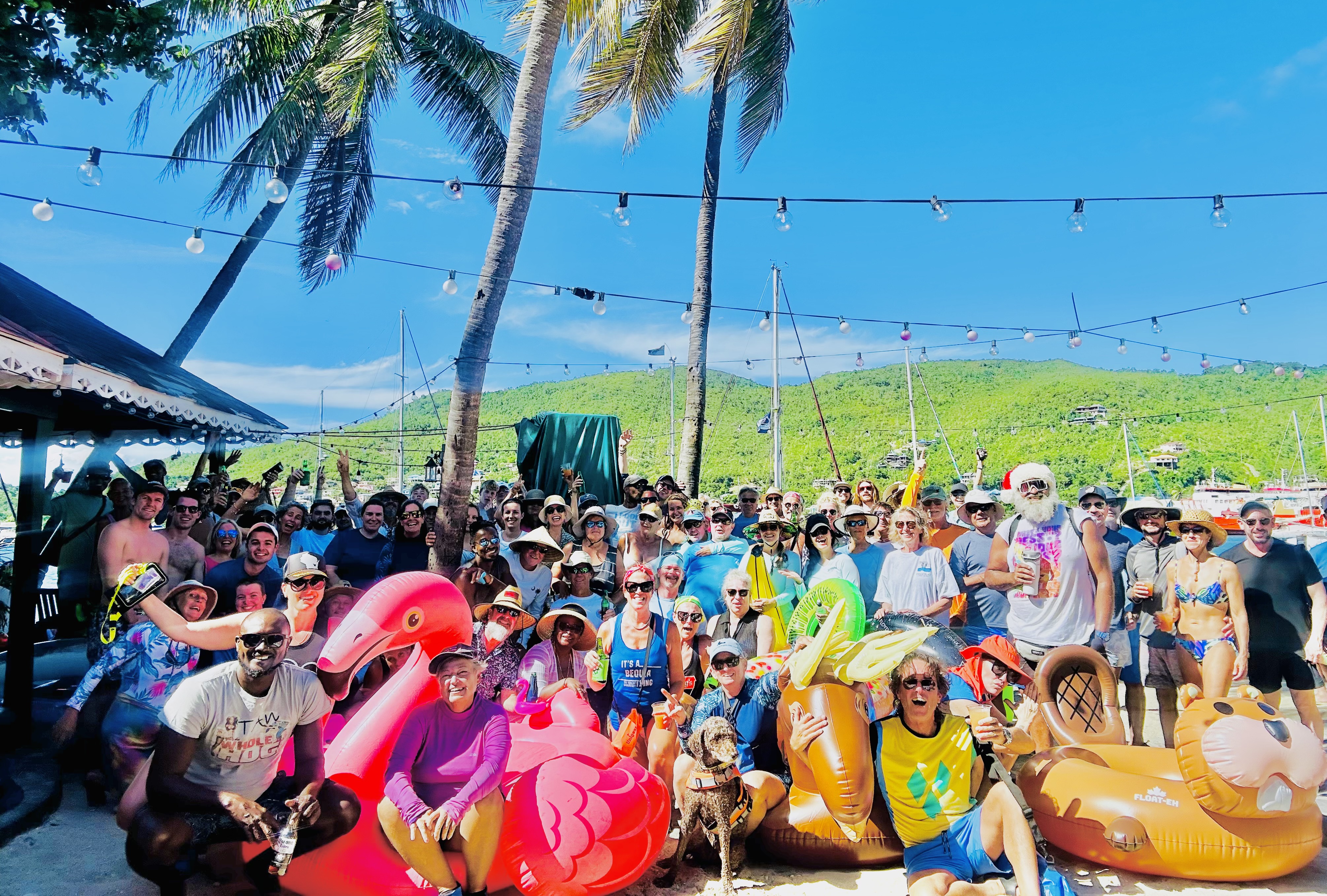
Modern Bequia draws cruising yachts, expats, and divers to 28 identified dive sites where hawksbill turtles, moray eels, and lobsters move through wrecks and shallow caves. The Easter Regatta and Music Fest is the island's biggest annual event, but a newer tradition has captured something essential about Bequia's character. Since 2010, on New Year's Day, nearly a hundred people gather at the Frangipani and Whaleboner bars in the early afternoon, nursing hangovers from the night before, and set out across the bay on any unmotorized device that floats -- pool lilos, inner tubes, improvised rafts. At Park Bay, the Old Hegg Turtle Sanctuary protects hawksbill sea turtles. Princess Margaret visited in the 1950s from nearby Mustique and had a beach renamed in her honor, though locals still call it Tony Gibbons. The island has always had its own names for things.
From the Air
Bequia is located at 13.02N, 61.23W, approximately 9 nautical miles south of Saint Vincent. The island measures 7 square miles and is the second-largest in the Grenadines. J.F. Mitchell Airport (TVSB) serves the island from Paget Farm on the southwest coast. Admiralty Bay on the west coast is the prominent harbor feature, easily visible from altitude with numerous yachts at anchor. The island's hills are lower than Saint Vincent's peaks, making it distinct from the air. Mustique (TVSM) is about 7 nautical miles to the south. E.T. Joshua Airport (TVSA) on Saint Vincent is the nearest commercial airport. Approach from the west for the best view of Port Elizabeth and the harbor.