Berbera
In 1801, a merchant named Ibrahim Punkar wrote to the Governor of Bombay describing a coastal city with five or six armed towers, where Somali traders adhering to the Shafi'i school of Sunni Islam exchanged goods from Harar, Gondar, and Shewa for cloth, rice, and tobacco arriving from Gujarat and Muscat. Dates and tin came from Mocha, Jeddah, and Al Mukalla. The city was Berbera, and it had been doing this kind of business for at least two thousand years. Perched on the southern shore of the Gulf of Aden with the only sheltered natural harbor on the entire coast, Berbera has served every power that ever wanted to control the Red Sea approaches — and outlasted them all.
The Ancient Port of Malao
Berbera's trading history reaches back to classical antiquity. The city is believed to be the ancient port of Malao, described in the first-century Periplus of the Erythraean Sea as lying 800 stadia beyond the city of the Avalites. Somali sailors navigated these waters in the beden, a traditional maritime vessel, connecting their coast to a trade network that included Phoenicia, Ptolemaic Egypt, Ancient Greece, Parthian Persia, the Sabaean kingdom, Nabataea, and the Roman Empire. The Periplus describes exports of myrrh, frankincense, and cinnamon flowing north and east, while manufactured goods flowed south. The 13th-century Arab geographer Abu al-Fida recorded Berbera as a significant port, and by the medieval period the city had become a major hub for the Ifat, Adal, and Isaaq sultanates. Porcelain fragments and coins unearthed at sites along the Somali coast confirm trade connections reaching as far as China.
Empires at the Harbor
Berbera's strategic value made it a prize worth fighting over. In 1516, the Portuguese fleet under Lopo Soares de Albergaria sacked the city, part of a broader campaign to dominate Indian Ocean trade routes. Ottoman admiral Selman Reis arrived not long after, extending Istanbul's reach into the Horn of Africa. The Somali inhabitants, far from passive, organized their own defense: when a British vessel called the Mary Anne attempted to dock in 1825, the Habr Awal clan attacked, killing two crew members and burning the ship. The Royal Navy responded with a blockade that strangled Berbera's trade until 1827, when the Battle of Berbera forced the Habr Awal to pay an indemnity of 15,000 Spanish dollars. Between 1884 and 1886, Britain signed treaties with the northern Somali clans and established a protectorate. Berbera served as its capital until 1941, when administration shifted to Hargeisa. Despite possessing the only sheltered harbor on the Gulf of Aden's southern coast, the city watched its administrative importance drain inland.
Superpower Playground
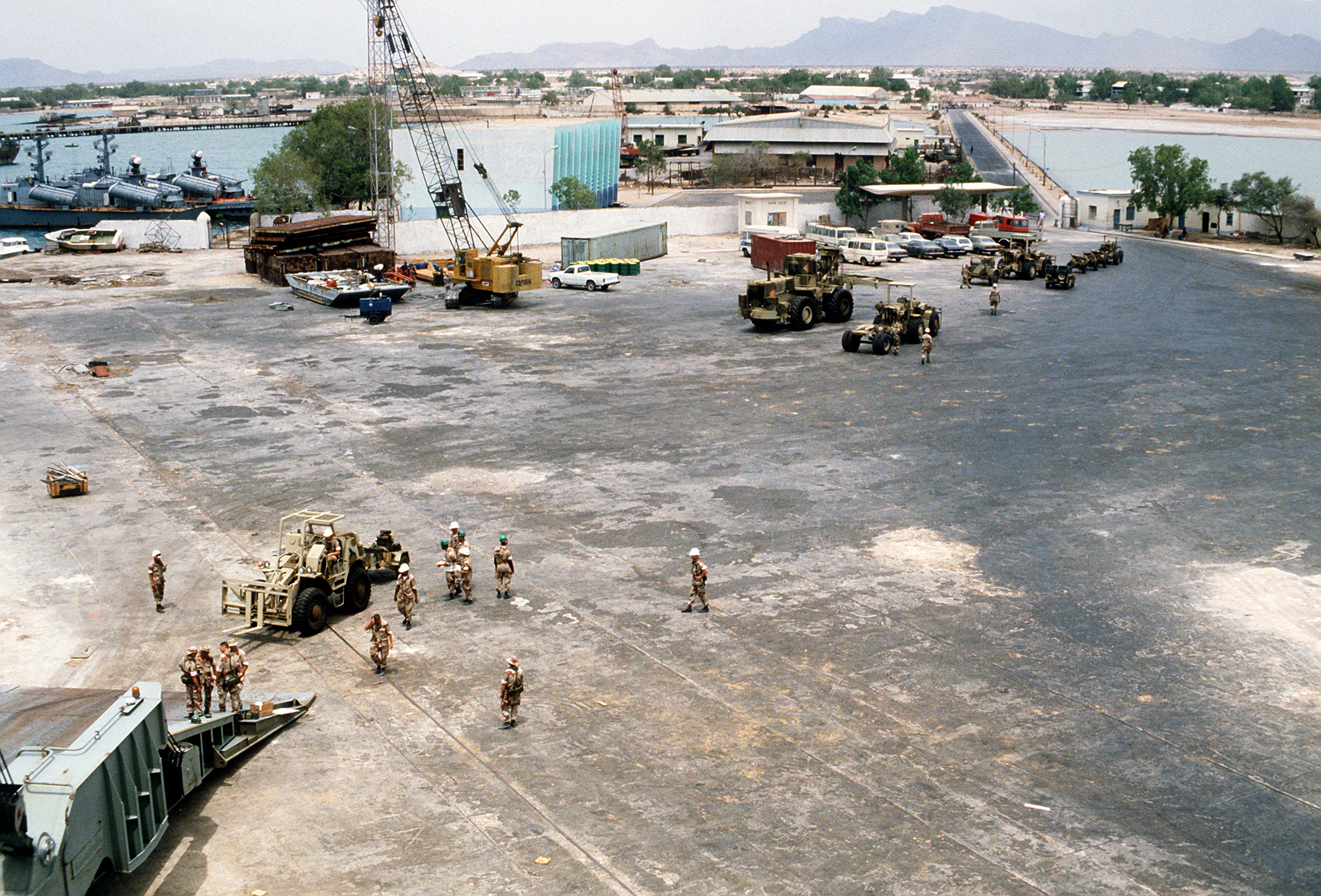
The Cold War gave Berbera a new chapter. After Somalia's independence in 1960, the Soviet Union signed an agreement in 1962 to develop the port's facilities, later significantly upgrading them in 1969 under Siad Barre's government. Soviet naval vessels and personnel operated from Berbera throughout the 1970s, making it one of Moscow's most important footholds on the African continent. When Barre broke with the Soviets after the Ogaden War of 1977-78, the Americans moved in. The United States expanded Berbera's seaport for military use, securing access to a facility that could service the Rapid Deployment Force protecting Western interests in the Persian Gulf. For a brief, strange period, Berbera — a city of fishermen and traders on an arid coast — found itself at the intersection of global superpower rivalry, its harbor hosting the warships of first one ideology, then the other.
The Port Reborn
Today Berbera is reinventing itself once more. In 2016, the Somaliland government signed a 30-year concession with DP World, the Dubai-based logistics giant, to develop and operate the port. A new container terminal opened as part of a $442 million investment, positioning Berbera as a competitor to Djibouti's port for handling goods destined for the Ethiopian hinterland. Ethiopia, landlocked since Eritrea's independence in 1993, has been actively seeking alternative trade routes, and a 2024 agreement exploring access through Berbera underscored the port's renewed strategic importance. Popular beaches like Bathela and Batalale have earned Berbera the local nickname "Beach City," but the economy remains centered on the port. Livestock, frankincense, myrrh, and hides flow outward, as they have for centuries, though now they travel in containers rather than the holds of dhows. Berbera's harbor, the same sheltered anchorage that attracted Phoenician traders and Roman merchants, remains its defining asset.
From the Air
Berbera sits at 10.44°N, 45.01°E on the Gulf of Aden coast. From altitude, the city is visible as a coastal settlement with a prominent harbor and port infrastructure along a semi-arid shoreline. Berbera Airport (HCMI) has one of the longest runways in Africa at approximately 4,140 meters, originally extended for potential NASA Space Shuttle emergency landings. The airport is located south of the city center. The Gulf of Aden stretches north toward Yemen, with the coastline running east-west. Hot, arid conditions prevail, with summer temperatures regularly exceeding 40°C.