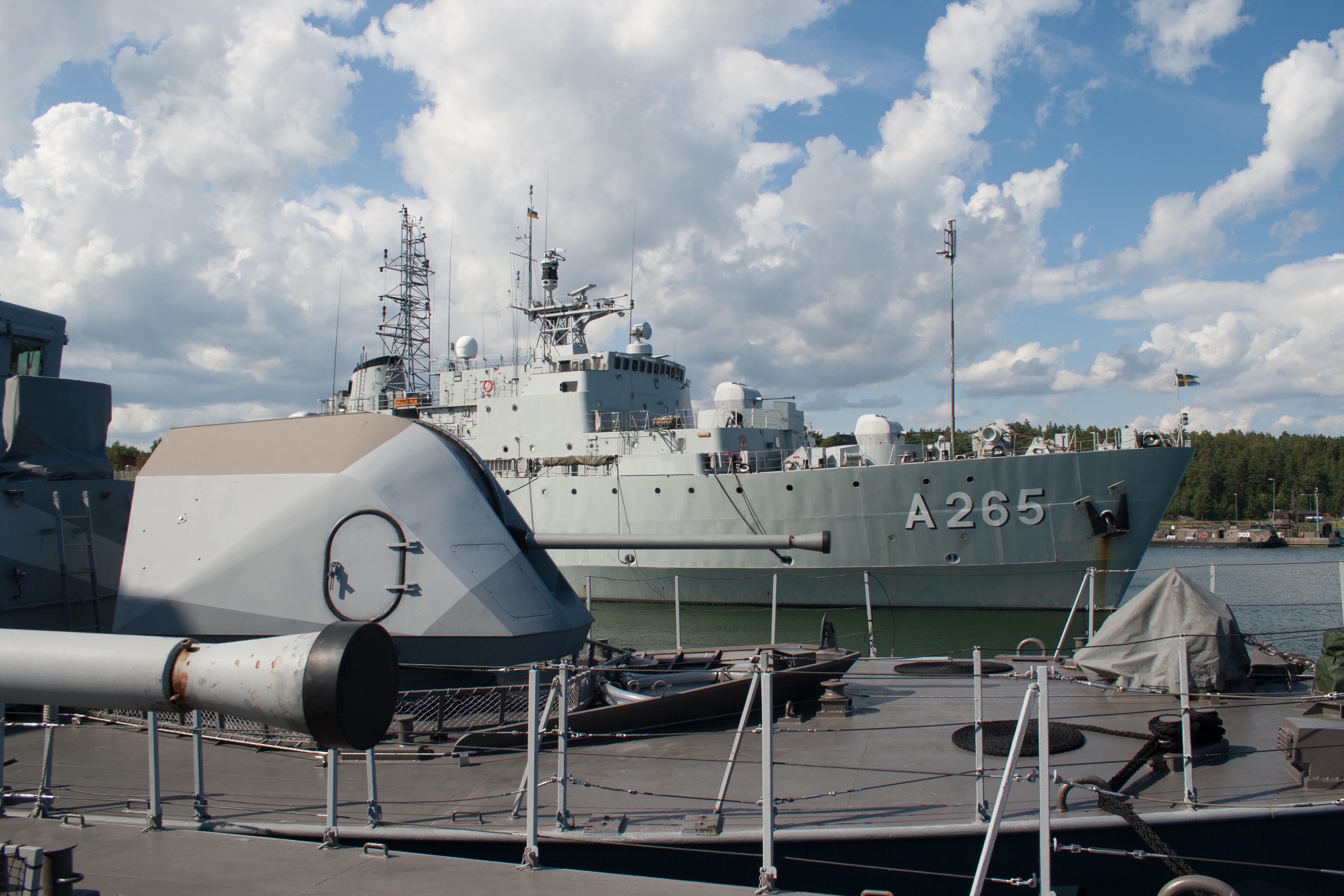
Berga Naval Base
The shooting warnings used to be read aloud in church. In the late 1800s, parishioners in the scattered communities around Hårsfjärden would hear their pastors announce upcoming naval exercises, a weekly reminder that their quiet fjard had become something else entirely. Today, Berga Naval Base sprawls across the same rocky shoreline where Swedish sailors first practiced coastal warfare over a century ago, its gray warships moored against a backdrop of dense pine forests and granite outcrops that define the Stockholm archipelago.
From Target Practice to Forward Base
The Swedish Navy discovered Hårsfjärden's potential in 1904, when the sheltered waters between the islands of Vitsgarn and Märsgarn became home to the Coastal Fleet's combat and signal schools. What began as a modest target depot grew steadily as Sweden navigated the turbulent waters of European politics. By World War I, the depot had transformed into a forward operating base for the entire mobilized navy. Decommissioned ships were towed into the fjard and sunk as targets while heavy artillery thundered across the water. The exercises intensified year by year, and bridges, workshops, and facilities spread across the surrounding islands.
The Castle and the Cold War
When World War II erupted, Swedish strategists faced a difficult reality: the naval base at Stockholm sat exposed on the inner waterways. Hårsfjärden became the navy's southern anchor, ringed by minefields, coastal batteries, and air defenses. Seaplane and submarine facilities rose along the bay between Vitsgarn and Märsgarn. In 1944, the Riksdag made a decisive move, purchasing Berga Castle from the estate of landowner Helge Ax:son Johnson for 2.635 million Swedish kronor. The acquisition included over 1,000 hectares of land and a strip of water 3.5 kilometers long. The hunting grounds became training areas, and in 1946, the first wave of naval families moved in. Crown Prince Gustaf Adolf himself inaugurated the Non-Commissioned Officers' School that October.
Training Sweden's Maritime Warriors
Berga's mission has always centered on turning civilians into sailors. The training schools relocated from Skeppsholmen in central Stockholm, bringing with them programs for chief mates, machinists, and coastal artillerymen. By 1949, specialized facilities for torpedo and submarine training had risen along the shore, including the legendary submarine trainer Valrossen. For decades, conscripts and career officers alike learned seamanship in these waters, mastering the intricate navigation required to operate among the thousands of islands that guard Sweden's eastern coast. The skills honed here proved essential during the Cold War, when the archipelago served as Sweden's first line of defense.
Modern Defenders of the Archipelago
Following the Defence Act of 2004, Berga underwent transformation once again. Today the base hosts the 4th Naval Warfare Flotilla, which returned in autumn 2008, along with the 1st Marine Regiment and the Södertörn Group of the Home Guard. The waters where target ships once sank now serve as training grounds for Sweden's modern amphibious forces, specialists in the unique warfare demanded by the Baltic's island-studded coastline. The naval schools that once dominated Berga have consolidated into the Swedish Naval Warfare Centre at Karlskrona, but the base remains active, its mission evolved but unchanged in essence: preparing Sweden's sailors for whatever lies beyond the archipelago's horizon.
From the Air
Located at 59.08°N, 18.14°E in Hårsfjärden, approximately 20 kilometers south of central Stockholm. The base is visible from 3,000-5,000 feet, identifiable by naval vessels moored along the shoreline and the contrast between military installations and surrounding forest. Nearby airports include Stockholm Bromma (ESSB, 25nm northwest) and Stockholm Arlanda (ESSA, 40nm north). Best viewed in clear weather when the archipelago's intricate pattern of islands is visible.