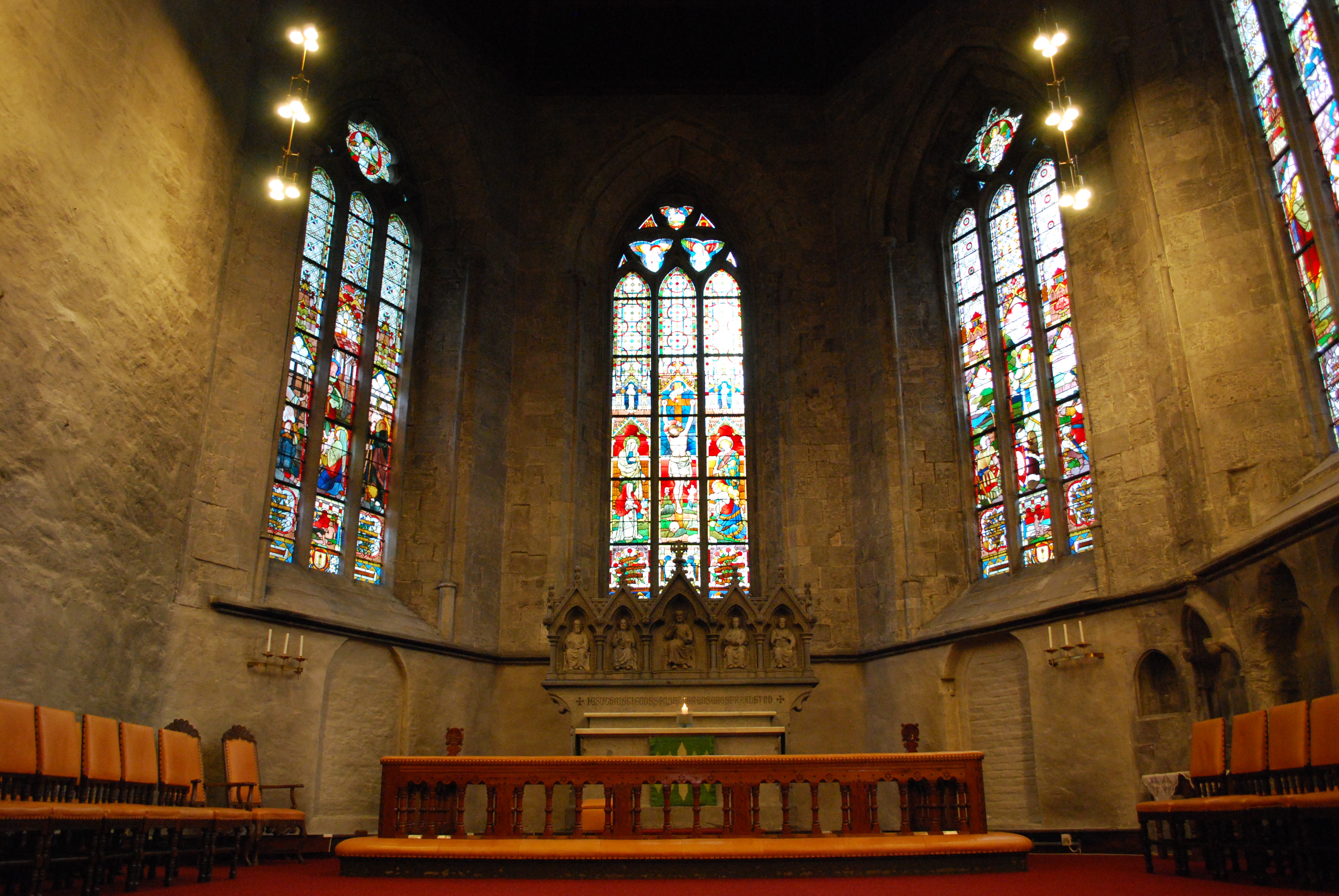
Bergen Cathedral
There is a cannonball lodged in the stone tower of Bergen Cathedral. It has been there since August 2, 1665, when English and Dutch warships exchanged fire across the harbor during the Battle of Vågen. Nobody has removed it. The cathedral, dedicated to Saint Olaf, first appears in historical records from 1181 -- a date recorded because a peasant chief named Jon Kutiza attacked King Sverre in Bergen and the king's men fled inside for shelter. Since then, this building has burned down and been rebuilt so many times that its survival feels less like preservation and more like stubbornness.
Built, Burned, Built Again
The first stone church on this site was a Romanesque long church, though little is known about it beyond its basic dimensions. It burned in 1248 during a city-wide fire, and a new stone church rose on the same foundations, incorporating parts of the surviving north wall. Fire struck again in 1270, with King Magnus Lagabote financing repairs. In 1463, another blaze gutted the structure, and it sat partially ruined for nearly a century. The Reformation brought new purpose: in 1537, the church was designated Bergen's cathedral, replacing the old Christ Church at Holmen, which had been demolished six years earlier. Bergen's first Protestant bishop, Gjeble Pedersson, finally completed the reconstruction before his death in 1557.
A Church Caught in Crossfire
Fires in 1623 and 1640 reshaped the cathedral once more, giving it its current general appearance -- the old nave steeple torn down, the west tower raised in its place. Then came the Battle of Vågen in 1665, when the harbor outside became a theater of war between English and Dutch fleets during the Second Anglo-Dutch War. A stray cannonball struck the cathedral tower and remains embedded there to this day, visible to anyone who looks closely enough. The 1702 city-wide fire brought yet another extensive renovation. Through it all, the cathedral endured -- not unchanged, but unbroken.
Where Democracy Began
In 1814, Bergen Cathedral served a purpose its medieval builders could never have imagined. Along with more than 300 other parish churches across Norway, it became a polling station for the country's first national elections -- the vote for the Norwegian Constituent Assembly that would write the Constitution of Norway. Each church parish served as a constituency, electing representatives called electors who gathered at the county level to choose delegates for the historic assembly at Eidsvoll Manor. In a nation finding its political voice after centuries of Danish rule, this cathedral was one of the rooms where Norwegian democracy was born.
Restoring the Medieval Soul
By the 1880s, the cathedral's interior had accumulated layers of Rococo decoration that obscured its medieval origins. Architects Christian Christie and Peter Andreas Blix led a renovation that stripped away the later ornamentation and restored the church to something closer to its original medieval appearance. The restoration was as much a statement about Norwegian identity as it was about architectural taste -- part of the broader movement of romantic nationalism that celebrated the country's independent medieval heritage. Today the cathedral seats about 600 people and hosts regular musical concerts, its stone walls resonating with sound as they have for over eight centuries.
From the Air
Located at 60.39N, 5.33E in central Bergen, near the harbor waterfront. Bergen Airport Flesland (ENBR) is 18km south. The cathedral is identifiable from the air by its prominent west tower, situated in the city center between the Vågen harbor and the surrounding hillsides. Best viewed at 1,500-2,500 feet. The Bryggen wharf and Bergenhus Fortress are nearby landmarks. Expect oceanic weather with frequent cloud cover.