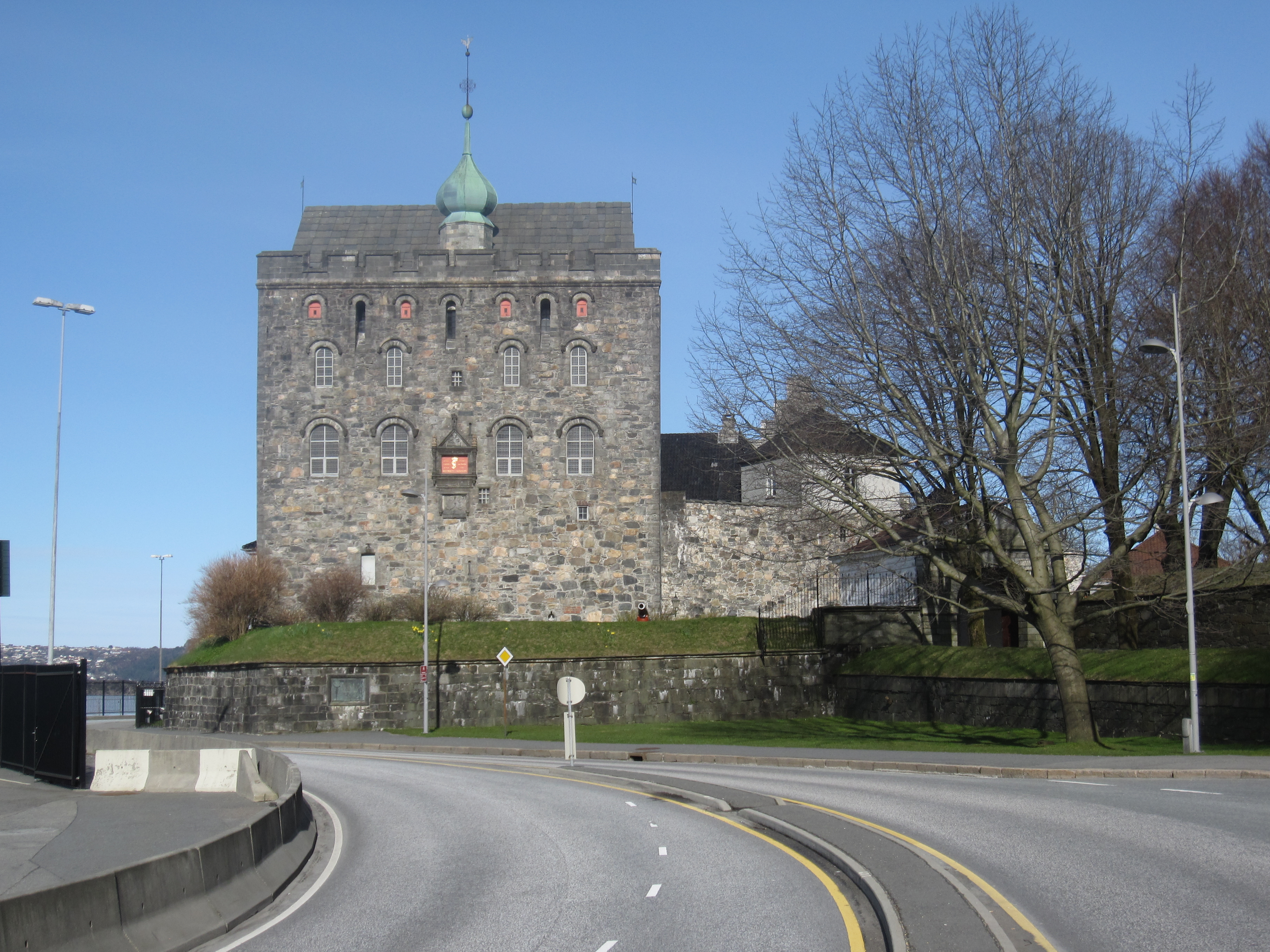
Bergenhus Fortress
In 1840, someone proved that the massive stone building inside Bergenhus Fortress was actually the 700-year-old feast hall of King Hakon Hakonsson. The discovery electrified a nation in the process of rediscovering its medieval identity. Henrik Ibsen wrote a poem in the hall's honor. Henrik Wergeland gave it a name: Haakons Hall. The building had spent centuries as a storage warehouse, its original purpose forgotten during four hundred years of Danish rule. Bergenhus sits at the mouth of Bergen harbor, one of Norway's oldest and best-preserved stone fortifications, with structures dating to the 1240s and a history that spans royal coronations, pirate sieges, Hanseatic trade, and Nazi occupation.
When Bergen Was the Capital
In medieval times, the area now occupied by Bergenhus was called Holmen, and it was the center of Norwegian power. Excavations have uncovered foundations believed to date before 1100, possibly erected by King Olav Kyrre. Until 1299, Bergen served as Norway's capital, making Holmen the seat of its rulers. The site held not just the royal residence but also a cathedral -- Christ Church, begun around 1100 -- several other churches, the bishop's residence, and a Dominican monastery. Christ Church contained the shrine of Saint Sunniva, Bergen's patron saint, and served as the venue for royal coronations and weddings. At least six kings were buried there. Stone walls first enclosed the compound in the 1240s, and the royal hall was built around 1260.
The Hall and the Tower
Hakon's Hall is the largest secular medieval building in Norway. No written records of its construction survive, but according to Hakon Hakonsson's saga, it did not exist at the king's coronation in 1247 yet was in use for the wedding of King Magnus Hakonsson and the Danish princess Ingebjorg Eriksdatter on September 11, 1261. Built in Gothic style, the hall's resemblance to English structures of the period suggests it may have been designed by architects from the court of Henry III of England, with whom Hakon maintained friendly relations. Nearby stands the Rosenkrantz Tower, its oldest core dating to the 1270s, when King Magnus the Lawmender built a defensive tower with a royal apartment on the top floor. In the 1560s, Scottish stonemasons expanded it for Governor Erik Rosenkrantz, adding dungeons below and cannon positions above.
Pirates, Decay, and Rediscovery
When King Eirik Magnusson died in 1299, Bergen lost its status as the main royal residence. The personal union with Denmark from 1380 to 1814 meant the fortress gradually decayed. In 1429, the Victual Brothers -- Baltic pirates -- captured and burned the complex. A new stone portal from the mid-15th century shows it was rebuilt, but by then Holmen had been stripped of its churches and converted into a purely military installation. The name Bergenhus came into use. Christ Church was demolished between 1526 and 1531; today a memorial stone marks where its altar once stood. By the 18th century, Hakon's Hall had become a warehouse, its royal past erased from living memory until 19th-century romantic nationalism reclaimed it as a symbol of Norwegian independence.
Fire, War, and Resurrection
The hall was finally restored in the 1890s and decorated in the 1910s with frescoes depicting scenes from Hakon Hakonsson's saga and stained glass windows. Then, on April 20, 1944, disaster struck. During World War II, the German navy had commandeered Bergenhus for its headquarters, and an explosion caused the hall's wooden roof to catch fire and burn. The flames destroyed all the decorations from the first restoration. A second restoration took place in the 1950s, and the hall reopened on September 11, 1961 -- the 700th anniversary of its first recorded use. The fortress today is administered by the Royal Norwegian Navy, which stations about 150 military personnel there. Hakon's Hall and Rosenkrantz Tower are open to the public, decorated now with tapestries rather than frescoes, and the central area called Koengen serves as a concert venue.
From the Air
Located at 60.40N, 5.32E at the entrance to Bergen harbor (Vågen). Bergen Airport Flesland (ENBR) is 18km south. From the air, Bergenhus is clearly visible as the stone fortification complex at the northern end of Vågen harbor, with Hakon's Hall and Rosenkrantz Tower as prominent structures. The fortress grounds are on the waterfront, adjacent to the Bryggen wharf UNESCO site. Best viewed at 1,500-2,500 feet. Expect frequent cloud cover and rain.