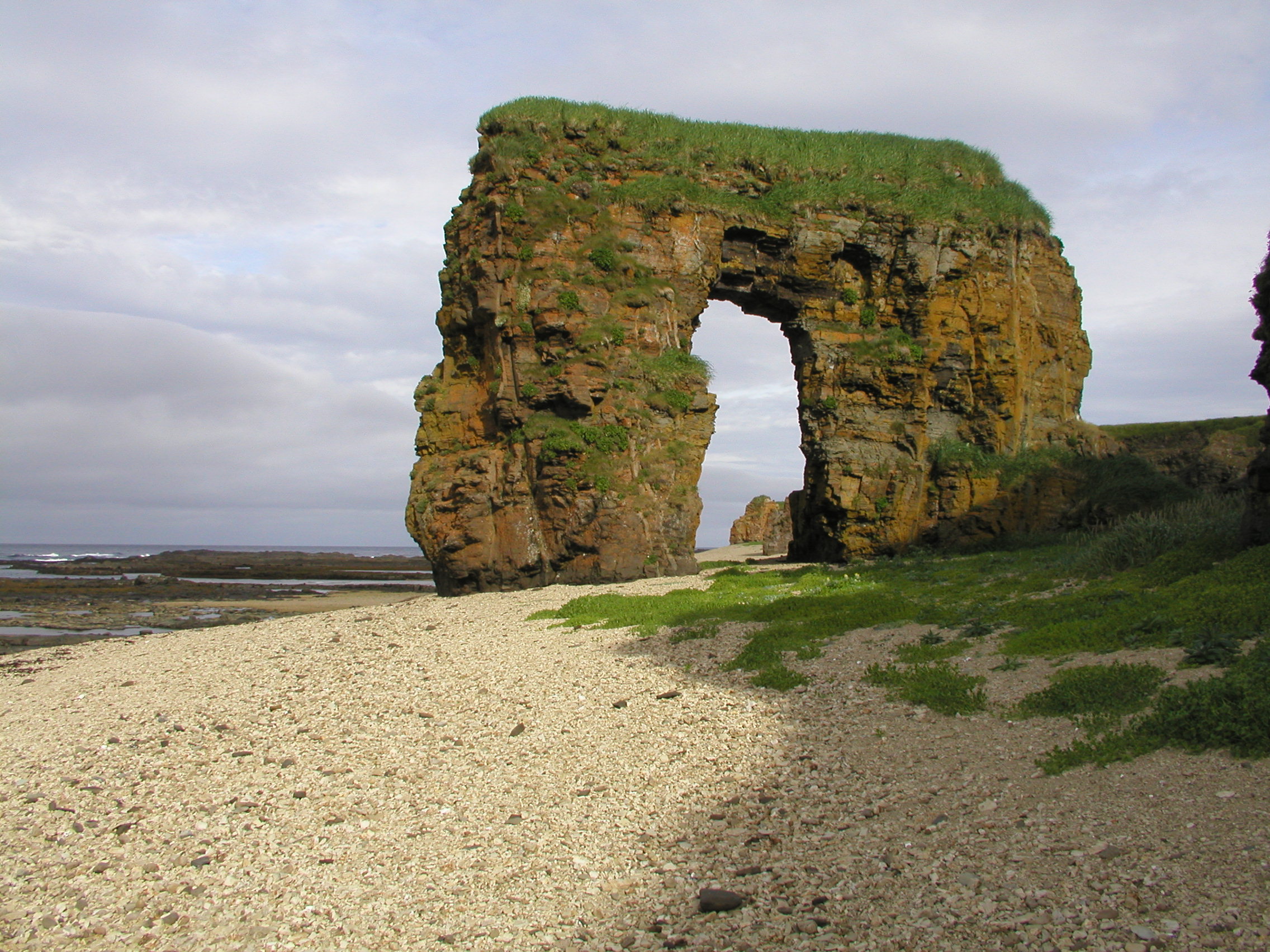
Bering Island
Vitus Bering never meant to find this island. In 1741, the Danish-born commander was sailing the St. Peter home to Kamchatka after an expedition that had charted mainland Alaska and the Aleutian chain for the Russian Navy. Storms shattered his ship. Scurvy was killing his crew. When land appeared through the fog, Bering's men dragged themselves ashore on a treeless, windswept island they had never seen before. Twenty-eight of them, including Bering himself, would die there. The island that bears his name is still one of the most isolated inhabited places on Earth, a place where fog rolls in from the Aleutian Low and the sun averages less than three hours a day.
Shipwreck and Survival
The survivors of the St. Peter were stranded on Bering Island for ten months. They killed seals and seabirds to eat, sheltered in makeshift dwellings against the relentless wind, and watched their commander die on December 19, 1741. Among them was Georg Wilhelm Steller, a German-born naturalist whose scientific curiosity refused to yield to the misery around him. Steller convinced his reluctant companions to eat seaweed, which cured their scurvy. Then he set about exploring the island and cataloging its wildlife with a thoroughness that would define his legacy. He described an enormous, docile marine mammal grazing on the kelp beds surrounding the island -- Steller's sea cow, a creature so gentle and so large it could not flee the hunters who would soon follow. The survivors eventually built a small boat from the wreckage of the St. Peter and sailed back to Petropavlovsk in 1742, carrying sea otter furs and preserved meat that would change the island's fate.
The Naturalist's Tragedy
Steller returned to the Russian mainland and devoted himself to publishing his findings, ultimately producing De Bestiis Marinis -- On the Beasts of the Sea -- a foundational text in marine biology. But his sympathies for the indigenous peoples of Kamchatka drew the suspicion of colonial authorities. Accused of fomenting rebellion, Steller was imprisoned and ordered to return to St. Petersburg. He died en route in 1746, at the age of 37, never reaching the capital. His diaries were published posthumously to great scientific acclaim. The island's highest point, rising to 2,464 feet, now carries his name -- a modest monument to a man whose brief life produced lasting contributions to natural history and whose compassion for native peoples was treated as a crime.
The Extinction Wave
The furs Steller's companions brought back to Kamchatka launched a rush. In 1743, Emilian Basov landed on Bering Island to hunt sea otters, beginning a wave of exploitation that would island-hop across the Bering Sea to the Aleutians and ultimately to Alaska. The promyshlenniki -- Russian fur traders -- stripped the islands of their marine mammals with devastating efficiency. Steller's sea cow, the gentle giant he had described with such care, was hunted to extinction by 1768, barely a quarter-century after Steller first saw it. Sea otters were nearly gone from Bering Island by 1854. The ecological destruction that began with Basov's landing would reshape the biology of the entire North Pacific, extinguishing species that had evolved over millions of years in a matter of decades.
Transplanted Lives
In 1825, the Russian-American Company transferred Aleut families from Atka Island to Bering Island to serve as hunters. Another group of Aleut and mixed-race settlers arrived the following year, establishing the first permanent human settlement on an island that had known no year-round residents. By 1827, the population stood at 110 -- 17 Russians, 45 Aleuts, and 48 people of mixed heritage. The community grew slowly, reaching over 300 by 1879. After Russia sold Alaska and the Aleutian Islands to the United States in 1867, Bering Island fell under the jurisdiction of Petropavlovsk-Kamchatsky, and the Aleut community found itself cut off from its ancestral homeland by an international border drawn through waters they had navigated for generations.
Fog, Wind, and Persistence
Today, Bering Island and its surrounding waters form the Komandorsky Zapovednik, a biosphere reserve where sea otters have finally stabilized after centuries of hunting and Steller sea lions still haul out on the rocky beaches each summer. The island's subarctic climate is brutal but moderated by the ocean -- winters run milder than on the Kamchatka mainland, though the persistent fog from the Aleutian Low and the cold Oyashio Current keep sunshine to a miserable average of about 2.8 hours per day. The settlement of Nikolskoye, the only village, endures in one of the most remote inhabited corners of Russia. Bering's grave is still there, marked on the treeless hillside above the shore where his crew dragged themselves from the surf nearly three centuries ago.
From the Air
Located at 55.00N, 166.25E in the western Bering Sea. Bering Island is the largest of the Commander (Komandorski) Islands, visible from altitude as a treeless landmass surrounded by open ocean. Nearest significant airfield is Petropavlovsk-Kamchatsky (UHPP), approximately 350 km west on the Kamchatka Peninsula. Shemya (PASY) in the western Aleutians lies approximately 500 km east. Expect persistent fog, low ceilings, high winds, and extreme weather variability. The island has a small airstrip near Nikolskoye but no instrument approaches. A useful visual waypoint for North Pacific navigation between Kamchatka and the Aleutians.