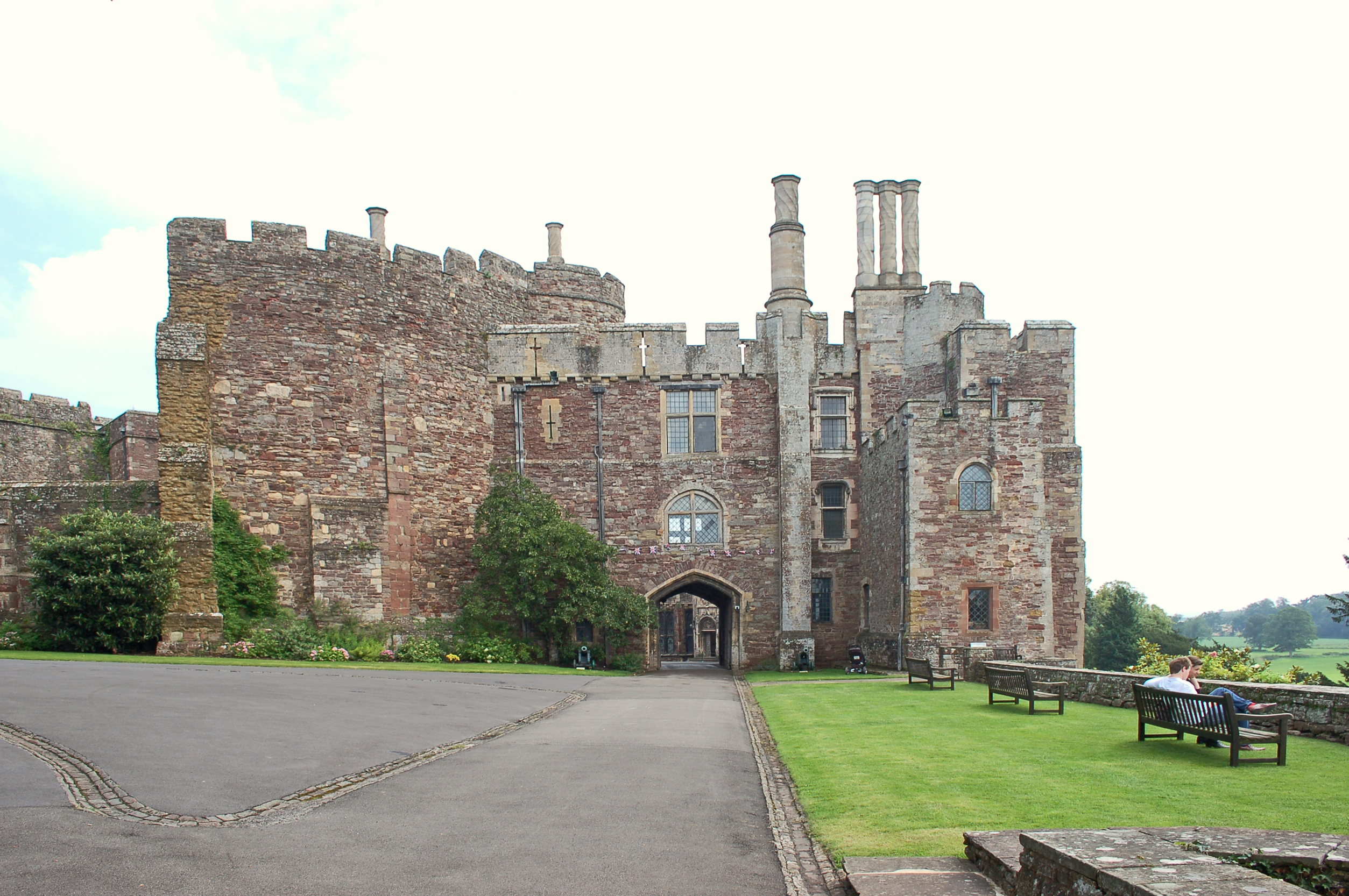
Berkeley Castle
The screams carried beyond the castle walls. According to Holinshed's Chronicles, the people of Berkeley town heard King Edward II cry out in the night as his murderers went about their work in September 1327. They prayed for his soul, understanding from the sound what was happening. Nearly seven centuries later, visitors to Berkeley Castle can still stand in the small chamber where the king is said to have been held, and where one of the most notorious murders in English history took place. The castle has belonged to the same family, more or less continuously, for almost nine hundred years, and it wears its dark history without apology.
A Norman Stronghold
The first castle at Berkeley was a motte-and-bailey fortification built around 1067 by William FitzOsbern, one of William the Conqueror's closest companions, shortly after the Norman invasion. It was positioned to command the low-lying country between the Cotswold escarpment and the Severn Estuary. Over the following centuries, the earth-and-timber structure was replaced in stone, and the castle evolved from a purely military installation into a fortified residence. The shell keep, built atop the original motte, and the inner gatehouse date from this transformation. Berkeley Castle is now the third-oldest continuously occupied castle in England, after the Tower of London and Windsor Castle, and the oldest still owned and occupied by the same family.
The Murder of a King
In 1327, the deposed Edward II was placed in the custody of Thomas de Berkeley and his brother-in-law Roger Mortimer, who had engineered the king's removal from power. Edward was imprisoned at Berkeley Castle, and on 21 September he was killed. The method described by later chroniclers -- a red-hot iron thrust into his body through a horn so as to leave no visible wound -- has been debated by historians for centuries. Some scholars argue Edward actually escaped and was replaced by another victim. Christopher Marlowe dramatized the murder in his 1594 play Edward II, and the story of the red-hot poker has endured in popular memory regardless of its accuracy. The body lay in state in the castle's Chapel of St John for a month before being escorted to Gloucester Abbey for burial.
Royal Visits and Civil War
Berkeley Castle's history extends far beyond its most infamous episode. Henry VIII and Anne Boleyn visited in August 1535. Elizabeth I came later in the century and played bowls on the castle's bowling green. A dispute over the castle's ownership between the Berkeley and Talbot families was so bitter it produced the Battle of Nibley Green in 1470, often cited as the last private battle fought in England. During the English Civil War, the castle was garrisoned by Royalist forces. In 1645, a Parliamentary army under Colonel Thomas Rainsborough besieged it, firing cannon from the roof of the adjacent parish church of St Mary the Virgin at point-blank range until the garrison surrendered.
Living History
What distinguishes Berkeley from most English castles is continuity. It contains an antique four-poster bed identified as the piece of furniture remaining longest in continuous use by the same family in Britain. The Great Hall still serves as a living room. The Chapel of St Mary, now called the Morning Room, retains its painted wooden vaulted ceiling and a biblical passage inscribed in Norman French. Since 1956, the castle has been open to visitors, and it has appeared in numerous film and television productions, from The Other Boleyn Girl to The Spanish Princess. When American actress Courteney Cox appeared on Who Do You Think You Are? in 2017, she learned she was a direct descendant of Thomas de Berkeley -- twenty-one generations removed from the man who held a king prisoner in these walls.
From the Air
Located at 51.689N, 2.457W in the town of Berkeley, Gloucestershire, between the Cotswold Hills and the Severn Estuary. The castle's round keep and curtain walls are visible among surrounding parkland. Nearest airports: Bristol (EGGD) approximately 15nm south, Gloucestershire Airport (EGBJ) approximately 15nm northeast. Best viewed from 1,500-2,500ft.