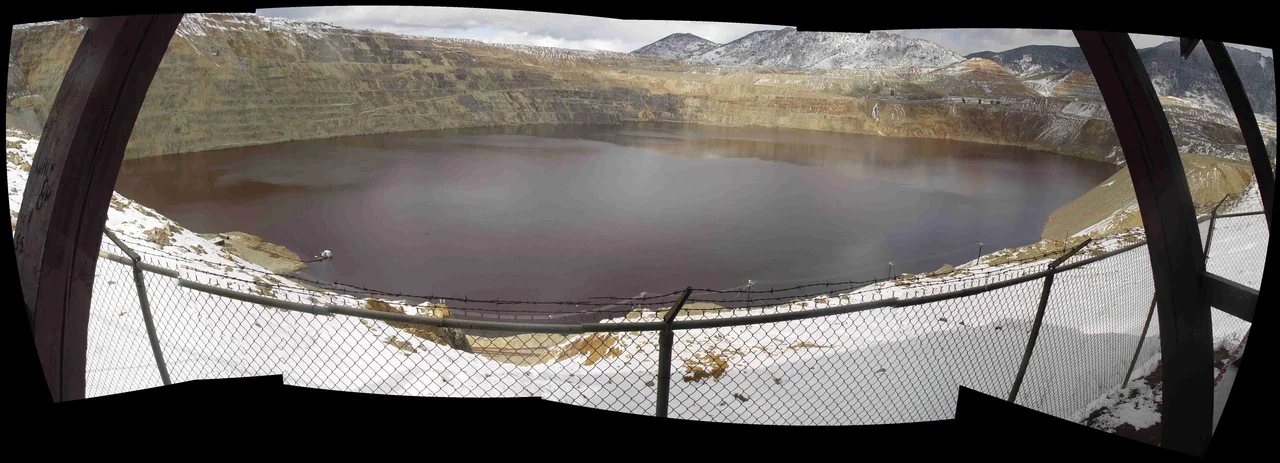

The Berkeley Pit
In Butte, Montana, there's a hole. Not just any hole - a mile-wide, 1,800-foot-deep pit that was once the world's largest open-pit copper mine. When the Atlantic Richfield Company stopped pumping in 1982, groundwater began to fill the pit. Over four decades, it's become a lake 1,000 feet deep containing approximately 50 billion gallons of water so toxic that birds die if they land on it. The water is highly acidic (pH 2.5), loaded with dissolved copper, iron, arsenic, cadmium, zinc, and sulfuric acid. In 1995, 342 migrating snow geese landed on the pit; by morning, all were dead, their insides corroded. The Berkeley Pit is one of the largest Superfund sites in America, a lake that grows two feet deeper each month, rising toward the day when it reaches the water table and threatens to contaminate the entire region.
The Mining
Butte was the 'Richest Hill on Earth,' a copper bonanza that electrified America. Underground mining began in the 1880s, producing copper for telegraph and power lines. By the 1950s, the underground operations were exhausted, but copper prices made open-pit mining profitable. The Anaconda Company began stripping away the surface in 1955, eventually swallowing entire neighborhoods - including the town of Meaderville - into a pit that grew to 7,000 feet long, 5,600 feet wide, and 1,800 feet deep. The mine operated until 1982, when falling copper prices and the cost of pumping water made it uneconomical. When the pumps stopped, the water rose.
The Lake
Groundwater flows into the pit from the surrounding rock, carrying with it the metals exposed by a century of mining. The water interacts with the sulfide minerals in the rock, creating sulfuric acid. Dissolved copper gives the water a vivid blue-green color that's almost beautiful from a distance. The pH is approximately 2.5 - as acidic as stomach acid. Heavy metals concentrate to levels toxic to any life. The lake rises about 2 feet per month as groundwater continues to pour in. A treatment facility pumps and processes some water, but the volume is overwhelming. The lake is now over 900 feet deep and contains approximately 50 billion gallons.
The Geese
On November 28, 1995, a late-season snowstorm forced a flock of migrating snow geese to land for the night. They chose the Berkeley Pit. By morning, 342 were dead - floating on the toxic water, their internal organs destroyed by the acidity. The incident made national news and forced a reckoning with the pit's dangers. The mining company installed 'hazing' systems - loud noises, flashing lights, and motorboats - to drive birds away before they land. The systems work imperfectly. Birds still land, still die. The snow geese became symbols of the pit's silent lethality.
The Crisis
The critical level is 5,410 feet above sea level - the height at which the pit water would begin flowing into the alluvial aquifer that supplies drinking water to Butte and the surrounding region. As of 2024, the water level is approaching 5,400 feet, rising steadily. The EPA and responsible parties have built treatment facilities to pump and process water, but the inflow exceeds the processing capacity. Solutions are expensive and temporary. The pit will never be clean; the question is whether it can be managed. If the water level isn't controlled, Butte's water supply - and potentially the entire Upper Clark Fork River basin - faces contamination.
Visiting the Berkeley Pit
The Berkeley Pit Viewing Stand is located at the east end of Park Street in Butte, Montana. The platform allows visitors to view the pit lake from above. Admission is charged; hours vary seasonally. Interpretive displays explain the mine's history and ongoing remediation. The World Museum of Mining, adjacent, provides broader context on Butte's copper heritage. Uptown Butte preserves historic mining-era architecture. Bert Mooney Airport has commercial service; Missoula International is 120 miles northwest. Visiting the pit is a sobering experience - the scale of the hole, the vivid color of the water, the knowledge of what it contains.
From the Air
Located at 46.02°N, 112.51°W in Butte, Montana. From altitude, the Berkeley Pit is unmistakable - a massive terraced hole filled with blue-green water, adjacent to the Butte urban area. The pit's geometric shape and vivid color contrast sharply with the surrounding landscape. The Anaconda Smelter Stack is visible 26 miles west. The Continental Divide forms the mountain backdrop. Bert Mooney Airport is just north of town. The pit's scale is impressive from the air - a mile wide, a quarter-mile deep, and growing.
Nearby Stories
- Cathedral of Saint Helena 41 km away
- Hamilton 74 km away
- Crail Ranch Buildings 82 km away
- Hauser Dam 85 km away
- Cook-Folsom-Peterson Expedition 90 km away
- Missoula 118 km away
- Montana State University 126 km away
- 1983 Borah Peak Earthquake 187 km away