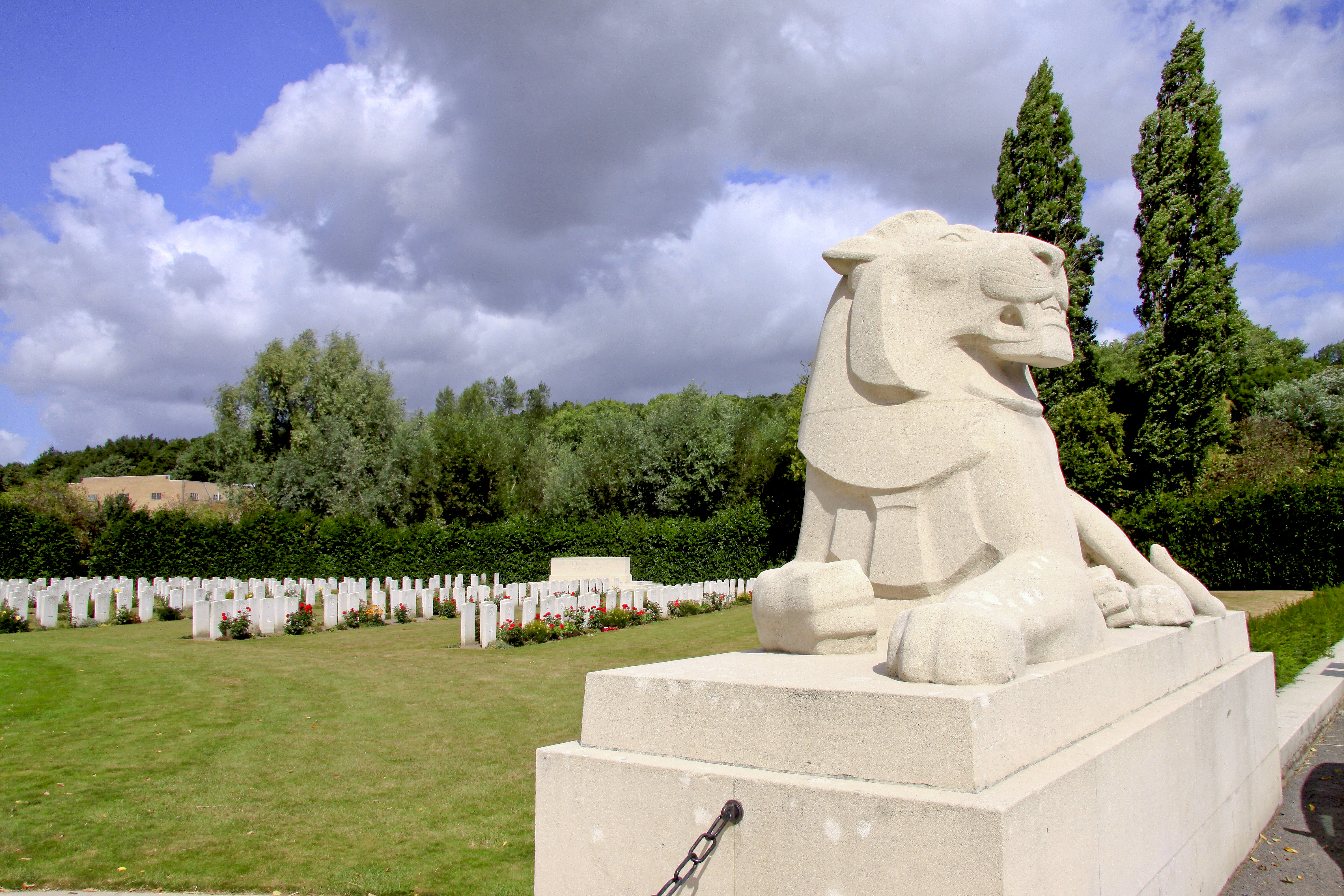
Berks Cemetery Extension
Across the road from a small cemetery the Royal Berkshires had begun in a quiet stretch of woodland, there was simply more ground. By June 1916, that fact mattered. Burials at Hyde Park Corner had outpaced the few rows the regiment had originally laid out, and so a second cemetery was opened opposite — the Berks Cemetery Extension. The road still runs between them. One side is small, walled, almost domestic. The other side, expanded in 1930 to absorb burials moved from a chateau cemetery that could not be kept in perpetuity, is broader and grander, with a colonnaded memorial whose tablets carry more than eleven thousand names.
A Quiet Sector
Ploegsteert Wood — known to the soldiers who served here as Plugstreet Wood — sat just south of the Ypres Salient, near enough to the front line to be dangerous and far enough back to feel almost survivable. After the fierce fighting of late 1914, the sector settled into the grim routine of trench warfare without any of the great set-piece battles that defined other parts of the line. Units were posted here to recover from worse places: the Somme, Passchendaele, Loos. They learned the ground, mounted trench raids, took their daily losses to snipers and shellfire, and rotated out. The cemetery filled up not in surges but slowly, week by week, the way it does where ordinary war is still going on.
The Memorial
The Ploegsteert Memorial to the Missing stands inside the cemetery's walls, an open rotunda flanked by two stone lions, designed by Harold Chalton Bradshaw — the same architect who shaped the Cambrai Memorial in France. It commemorates more than eleven thousand soldiers of the British and Empire forces who died in this corner of Flanders between 1914 and 1918 and have no known grave. They were the men who simply did not come back from a patrol, or whose bodies were lost to the mud, or who were killed in a shellburst that left nothing identifiable behind. The names are arranged by regiment and rank, panel after panel, the kind of accounting that has to be done because nothing else can be.
Borrowed Ground
Belgium gave the cemetery to Britain. After the Armistice, King Albert I formally assigned the cemetery grounds to the United Kingdom in perpetuity — a gift made across many sites in Flanders, in recognition of British and Empire sacrifices in the defence and liberation of his country. It is a strange kind of ownership: a few square hectares of one nation's farmland held forever by another, mown and tended by the Commonwealth War Graves Commission, the rose beds replanted each spring. In 1930 the extension was enlarged to receive graves from the Rosenberg Chateau Military Cemetery a kilometre away, which the CWGC had not been able to secure in perpetuity. The men buried there were dug up and reburied here, under the same headstones, in the same kind of ground.
Two Cemeteries, One Crossing
Stand on the road and look both ways. To the south sits Hyde Park Corner (Royal Berks), the small original cemetery — eighty-seven graves, set in a half-circle, named after a corner in London. To the north sits the Extension and its memorial, broader and more formal, the stone of remembrance and the cross of sacrifice on a wide lawn. The two grew from the same impulse but took different shapes. The Berkshire Regiment opened one. The architects of memory finished the other. Between them runs the Ploegsteert road, which the soldiers used to march to and from the line. On the first Friday of every month at seven in the evening, just down the road in the village, a ceremony is held at the memorial and the Last Post is sounded. It has been done since 1999. It is much less famous than the ceremony at the Menin Gate in Ypres, twelve kilometres north, and it is held for exactly the same reason.
Why It Stays Quiet
The Salient draws crowds — Tyne Cot, the Menin Gate, the In Flanders Fields Museum. Ploegsteert sits at the edge of the visitor route, far enough south that coach tours often skip it. People who come tend to come deliberately, looking for a particular name on the memorial panels, or for one of the graves moved here from Rosenberg Chateau, or simply for the strange quiet that the place keeps. Wear on the steps is light. The wood across the road is still a wood. Ploegsteert was where Winston Churchill commanded a battalion of the Royal Scots Fusiliers in 1916, between political careers, and where he was photographed in a steel helmet looking improbably young. He left. The eleven thousand named on the tablets did not.
From the Air
Located at 50.738 degrees north, 2.882 degrees east, in the village of Ploegsteert in Hainaut Province, on the Franco-Belgian border south of Ypres. The cemetery sits along the N365 road. Nearest major airport is Lille (LFQQ) about 25 km south; Brussels (EBBR) is 120 km east. The cemetery is on flat ground at the edge of Ploegsteert Wood — the white stones of the memorial rotunda are visible from low altitude.