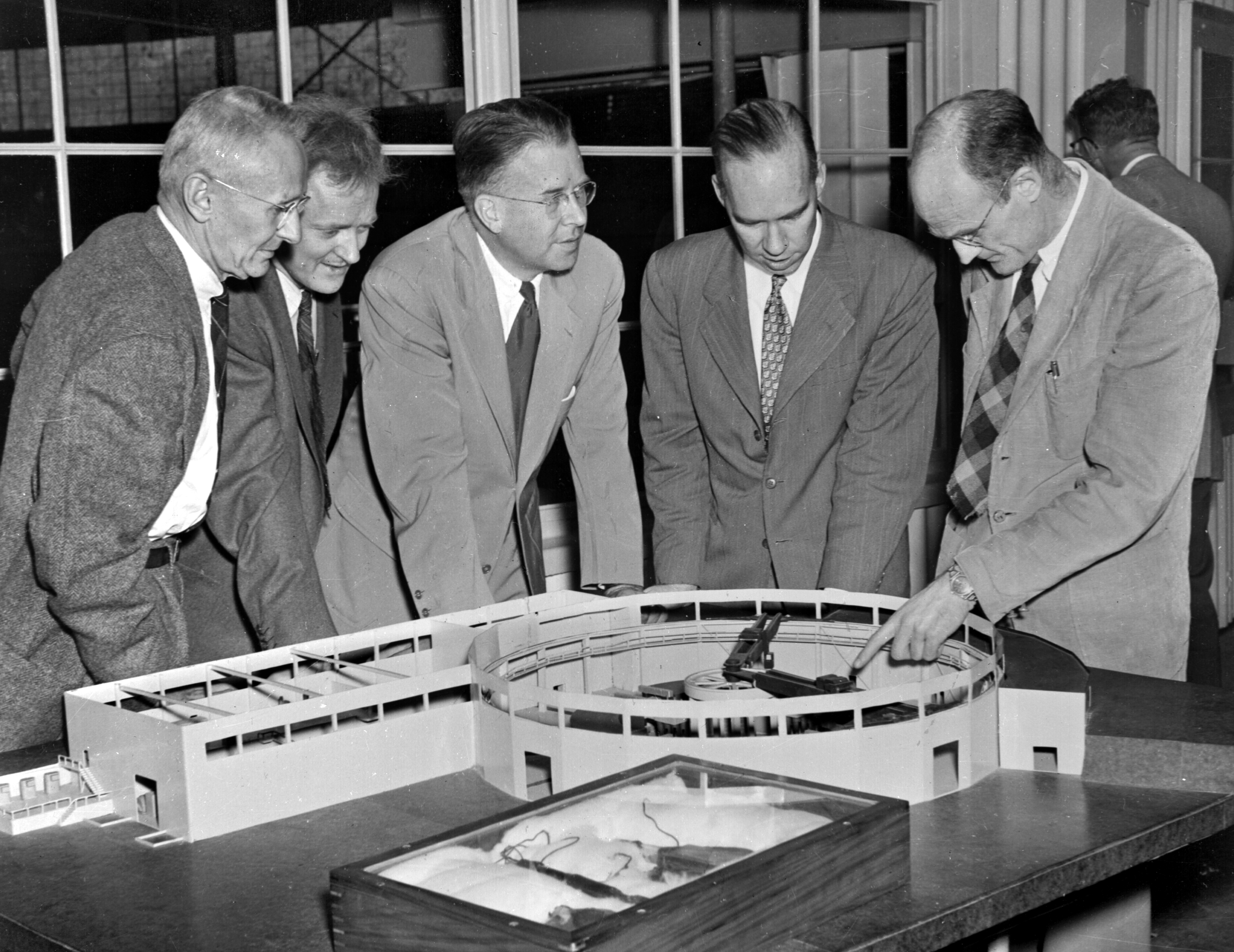
Bevatron
Every five seconds, the machine screamed. A rising, falling wail from a motor-generator system so powerful that everyone in Lawrence Berkeley National Laboratory could hear it cycling through its heartbeat of acceleration and release. The Bevatron began this rhythm in 1954 and kept it up for nearly four decades, a 10,000-ton iron-and-vacuum instrument designed to answer one of physics' most elegant questions: does every particle in the universe have a mirror image with the opposite charge? The answer, when it came in 1955, didn't just confirm a theory. It proved that antimatter was real.
Hunting the Mirror Particle
By the early 1950s, physicists had strong reasons to believe in antiparticles but limited evidence. The positron -- the anti-electron -- had been spotted in cloud chambers in the 1930s, and after World War II, cosmic ray experiments revealed positive and negative muons and pions. But the antiproton, the mirror of the proton itself, remained theoretical. Building a machine energetic enough to create one required brute force on an unprecedented scale. The name said it all: Bevatron, for 'billions of electron volts synchrotron.' Its designers calculated exactly how much energy was needed to conjure a proton's opposite from the collision of protons with a fixed target, then built the magnets and vacuum chambers to deliver it. The 10,000-ton iron magnet ring dwarfed anything that had come before. In 1955, Emilio Segre and Owen Chamberlain found what they were looking for. The antiproton existed. A year later, Bruce Cork, Glen Lambertson, Oreste Piccioni, and William Wenzel discovered the antineutron. Segre and Chamberlain received the Nobel Prize in Physics in 1959.
Bubbles and Franckensteins
The Bevatron's second act was equally transformative, though less celebrated. Beams of protons extracted from the accelerator struck targets to generate secondary beams of pions, strange particles, and other exotic debris. These particles were then sent through a liquid hydrogen bubble chamber, where their paths became visible as trails of tiny bubbles, each curve and spiral encoding information about mass, charge, and energy. Thousands of these 'events' were photographed, then measured on enormous devices nicknamed 'Franckensteins' after their inventor, Jack Franck. Human operators traced particle tracks by hand, punching coordinates onto IBM cards with a foot pedal. Early computers then reconstructed three-dimensional trajectories through magnetic fields. The process was part craftsmanship, part computation -- and it opened the floodgates. Hundreds of new particles and excited states poured out of the data. Luis Alvarez, who inspired and directed much of this bubble chamber program, received the Nobel Prize in Physics in 1968.
The Bevalac's Heavy Ion Years
In 1971, Albert Ghiorso saw an opportunity to give the aging accelerator new purpose. He conceived of joining the Bevatron to the SuperHILAC linear accelerator, creating a hybrid he named the Bevalac. Where the original machine had smashed protons into targets, the Bevalac could accelerate entire atomic nuclei -- carbon, iron, uranium -- to relativistic speeds. This opened an entirely new field of heavy-ion physics, allowing scientists to study what happens when chunks of nuclear matter collide at velocities approaching the speed of light. The applications reached beyond pure research: the Bevalac pioneered the use of heavy-ion beams for cancer treatment, directing charged particles with surgical precision to destroy tumors while sparing surrounding tissue. For two decades, the machine served this dual mission of frontier physics and medical innovation, until it was finally decommissioned in 1993.
Overtaken by Precision
The Bevatron's weakness was also its defining characteristic: sheer size. As a 'weak-focusing' synchrotron, it needed an enormous beam aperture, which demanded that colossal magnet. The next generation of accelerators adopted 'strong focusing,' which squeezed beams into much tighter spaces and made magnets far cheaper. CERN's Proton Synchrotron reached 30 GeV in 1959 with a fraction of the Bevatron's bulk. Brookhaven's Alternating Gradient Synchrotron followed in 1960. Today's Large Hadron Collider reaches energies nearly 11,000 times greater than the Bevatron's, yet confines its beams to a cross-section of about one millimeter. The old machine had been surpassed not by brawn but by elegance.
Rubble and Revelry
Demolition began in 2009. By early 2012, the 10,000-ton magnet, the vacuum chambers, the motor-generator that had wailed across the hillside for decades -- all of it was gone. The building that housed the Bevatron was reduced to rubble and cleared from the Berkeley Hills. What remains is harder to demolish: the proof that for every particle, an antiparticle exists; the bubble chamber photographs that revealed hundreds of new states of matter; the medical techniques born from heavy-ion beams. The site on the hill above the UC Berkeley campus is quiet now. The five-second scream has stopped. But the symmetry the Bevatron confirmed -- that the universe builds in mirror pairs -- is permanent.
From the Air
The Bevatron site (37.8774N, 122.251W) sits in the hills above the UC Berkeley campus within the Lawrence Berkeley National Laboratory complex. From 3,000-4,000 feet AGL, look for the cluster of LBNL buildings on the ridgeline above Berkeley. The Bevatron building itself was demolished by 2012, but the lab complex remains prominent. Oakland Metro (KOAK) is approximately 5nm south-southeast. Bay fog frequently obscures the western approach while the hills above remain in clear air.