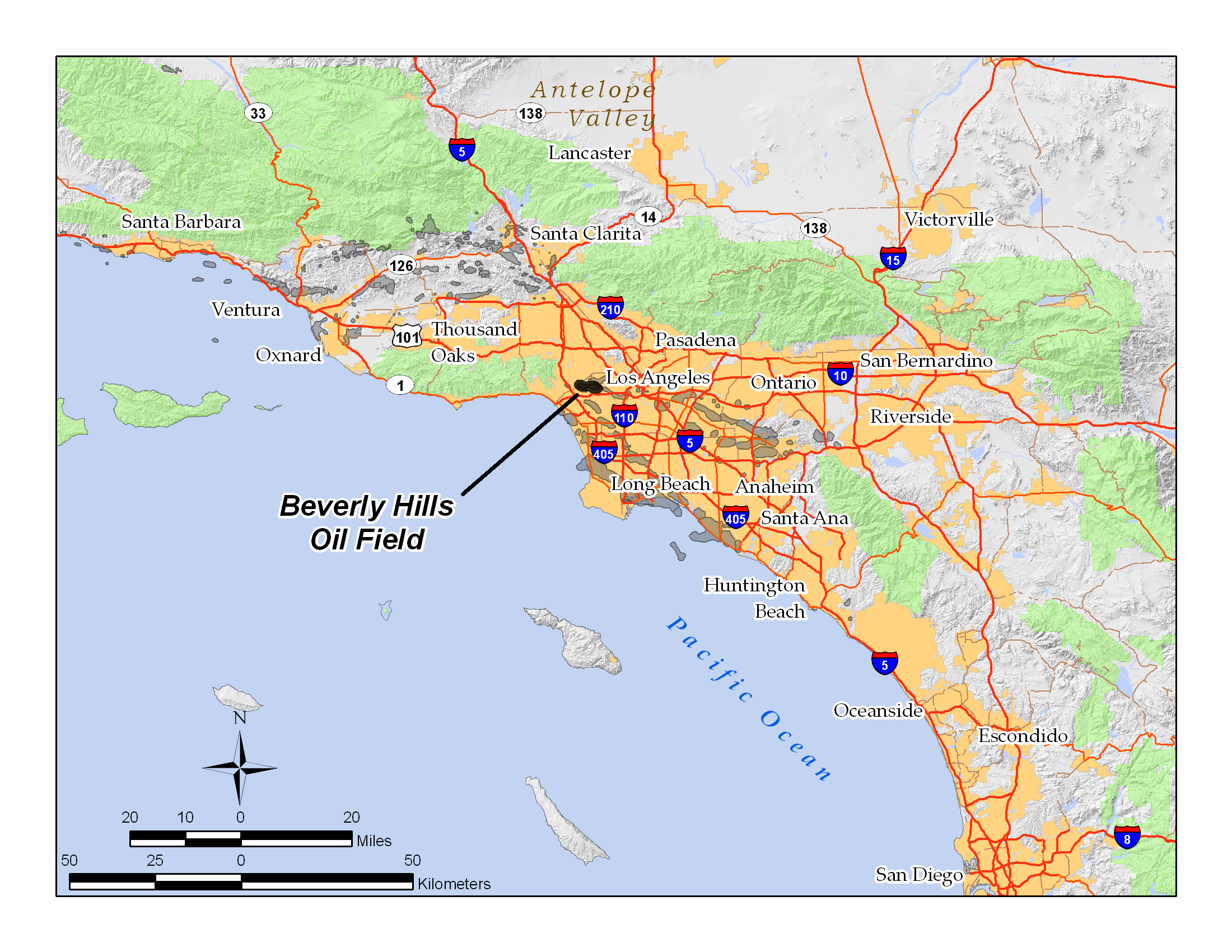
Beverly Hills Oil Field
Somewhere beneath the shops on Rodeo Drive, beneath the mansions on Sunset, beneath the Beverly Hills High School football field, the oil is still there. The Beverly Hills Oil Field stretches four miles long through one of the most expensive pieces of real estate on earth, and while the Bentleys idle above and tourists photograph the palm trees, 97 active oil wells continue their patient extraction work underground. The derricks are hidden in windowless buildings designed to look like anything other than what they are. The industry that made Southern California is still operating — it just learned to dress for the neighborhood.
The Discovery
W.W. Orcutt discovered oil in the Beverly Hills area in July 1900, before Beverly Hills existed as a city, before most of the surrounding area had been developed, when the land was still largely citrus groves and bean fields. The field proved to be substantial — geologists eventually estimated that approximately 600 million barrels of oil were originally in place beneath the surface. More than 150 million barrels have been extracted over the course of the 20th and 21st centuries. The field retains roughly 11 million barrels in accessible reserves, which helps explain why the industry has persisted here long after it became anomalous in its surroundings.
Four Islands of Concealment
Active oil production in Beverly Hills today takes place from four 'drilling islands' — clusters of wells housed in structures designed to be invisible in an upscale urban context. The buildings that contain them have no windows and are architecturally unremarkable: they could be warehouses, utility facilities, or the back-end infrastructure of any large commercial operation. One drilling island sits on the grounds of Beverly Hills High School, where it has operated alongside classrooms and sports fields for decades. Students at the high school have attended classes in what is, technically speaking, an active industrial facility for generations.
The Cancer Cluster Lawsuit
In 2003, a group of Beverly Hills High School alumni, many of whom had been diagnosed with cancer, filed lawsuits alleging that oil and gas operations on and near the school grounds had exposed them to toxic chemicals and caused their illnesses. The plaintiffs pointed to what they described as an unusually high cancer rate among graduates of the school. The lawsuits were dismissed between 2006 and 2007 after courts found insufficient evidence to establish a causal link between the oil operations and the claimed health outcomes. The California Air Resources Board and other agencies conducted monitoring of air quality at the school during the litigation period.
The Oil Beneath the Glamour
The Beverly Hills Oil Field is, in its way, a perfect Los Angeles story: the extraction economy that built Southern California, persisting quietly beneath the surface while the entertainment economy above ground commands all the attention. Los Angeles was an oil city before it was a film city, and the two industries operated simultaneously through much of the 20th century, sometimes on the same blocks. The field beneath Beverly Hills is one of the last visible reminders — visible, that is, if you know where to look — of the petroleum economy that funded the transformation of the basin from agricultural land into the sprawling, sun-soaked metropolis that tourists arrive expecting to find.
From the Air
The Beverly Hills Oil Field is centered at approximately 34.0563°N, 118.389°W, extending through Beverly Hills and into the surrounding communities. From the air, the oil field's drilling islands are not visually obvious — they are intentionally designed to blend with the surrounding urban landscape. The area lies within the Los Angeles Class B airspace. Beverly Hills High School, one drilling island location, is visible from low-altitude overflights of the Wilshire corridor. Nearest airports: Santa Monica (KSMO) 4 miles west, Burbank (KBUR) 11 miles northeast, Van Nuys (KVNY) 10 miles north.