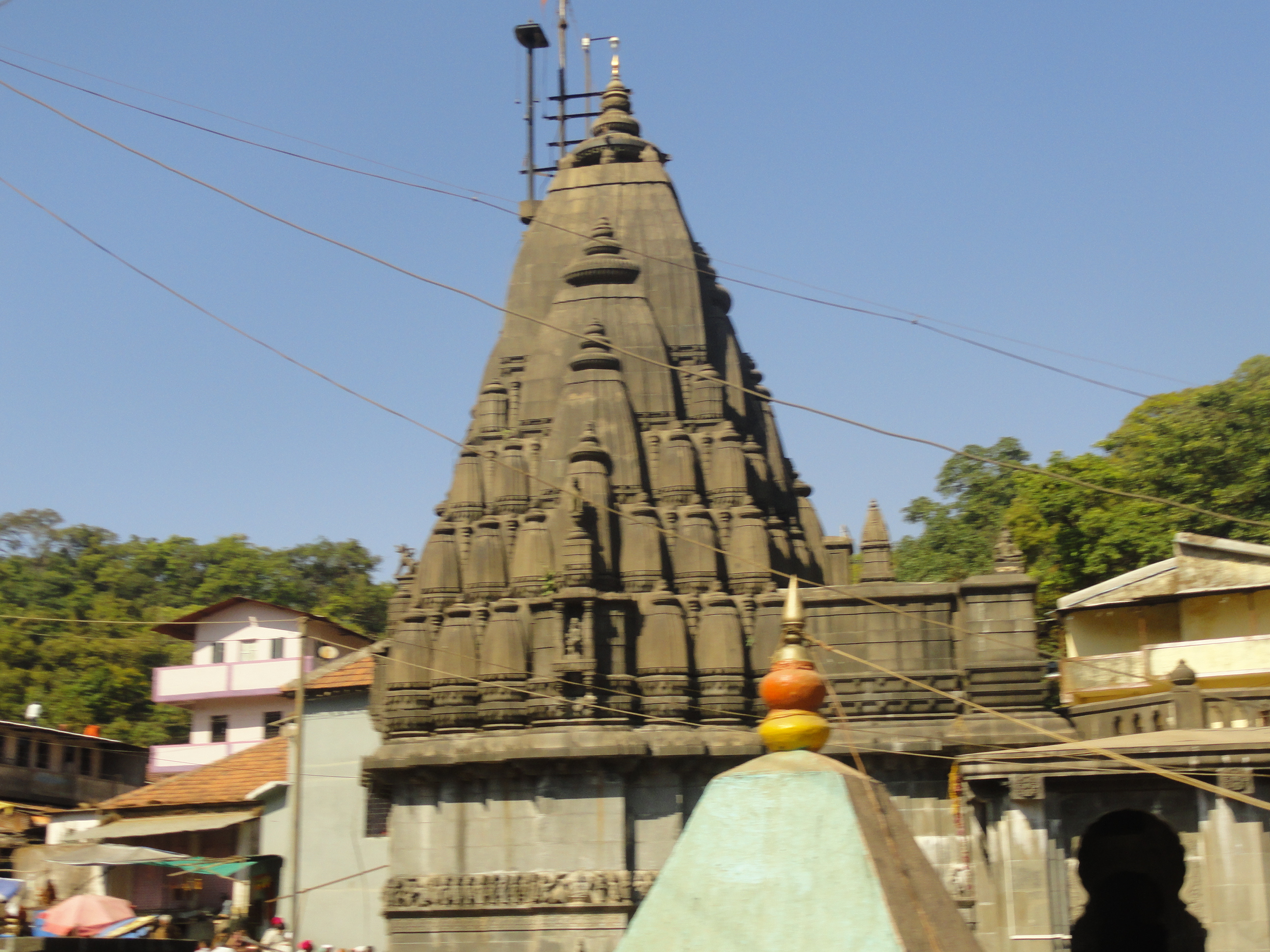
Bhimashankar Temple
Between two stone pillars in the Bhimashankar temple complex hangs an enormous bell. It is not Hindu in origin. It came from a Portuguese church in Vasai, captured in 1739 by the Maratha general Chimaji Appa after his victory over the Portuguese. That a Catholic bell should ring in one of the twelve most sacred Shiva temples in India tells you something about the layers of history compressed into this remote hilltop in the Sahyadri range of Maharashtra's Western Ghats.
Where a River Is Born
The Bhima River, one of the major tributaries of the Krishna, begins its 861-kilometer journey to the southeast from the village of Bhimashankar in Maharashtra's Pune district. According to Hindu tradition, the river formed from the sweat of Shiva himself, shed during a cosmic battle atop these very peaks. The mythology gives the temple its name: Shiva is said to have assumed the form of Bhima Shankara at the request of the gods, and the perspiration from his exertion became the Bhimarathi -- the river Bhima. Whatever the origin, the hydrology is real. Water seeps from these hills and gathers into a flow that sustains agriculture across hundreds of kilometers of the Deccan plateau. The surrounding hills of Manmad village bear old rock carvings of the deity Bhimashankar alongside images of Amba-Ambika, evidence that this has been a place of worship for centuries before the current temple was built.
Black Stone and a Nagara Spire
The temple dates to the 13th century, carved from black stone in the Nagara architectural style. Its core is ancient, but the building visitors see today reflects significant 18th-century renovations by Nana Phadnavis, the shrewd minister of the Peshwa court. He rebuilt the sabhamandap -- the central gathering hall -- and designed and constructed the shikhara, the tower that rises above the sanctum. King Shivaji himself endowed the temple earlier, granting the village of Kharosi to fund daily religious observances. The medieval saint Namdev, writing in the 13th century, records that the philosopher-saint Jnaneshwar traveled to Bhimashankar after visiting Tryambakeshwar. For at least seven hundred years, pilgrims have climbed these hills to reach the Shiva lingam within -- one of only twelve Jyotirlingas recognized across all of India.
Twelve Points of Light
The concept of the Jyotirlinga -- a radiant sign of Shiva -- holds that the god appeared as an infinite column of light at twelve locations across the subcontinent. Bhimashankar is one of three Jyotirlingas in Maharashtra alone, alongside Trimbakeshwar and Grishneshwar. This concentration makes the state a major axis of Shaivite pilgrimage. Devotees who visit Bhimashankar typically also take darshan at the surrounding shrines: the temple to Kamalaja Mata, an incarnation of Parvati who aided Shiva in his battle against the demon Tripurasura, and the smaller shrine to Lord Shani within the main complex. Behind the temple lies the Mokshakund Tirtha, a sacred pool where custom dictates bathing before entering the main sanctum. The pool is attributed to the legendary penance of the sage Kaushika. To the south, where the Kusharanya Tirtha sits, the Bhima River begins its eastward flow.
Forts, Forest, and the Bell Between Pillars
Outside the temple walls, the landscape opens into forested mountains with the remains of ancient forts perched on their summits. A narrow path behind the temple leads down to the riverbanks where the Bhima is still a stream. The temple complex itself holds more than devotional architecture. The Portuguese bell donated by Chimaji Appa, taken as a war trophy in 1739 after the Maratha campaign against Portuguese-held Vasai, is one of several such bells distributed to temples across Maharashtra. It is a striking artifact -- a piece of colonial-era conflict hanging in a space of ancient worship, marking the moment when Maratha military power reached the western coast. A statue of Nandi, Shiva's bull, faces the lingam inside the sanctum. The whole complex sits within a landscape that has remained, for the most part, unchanged: dense Sahyadri forest, mountain mist, and the sound of water beginning its long journey across the Deccan.
From the Air
Located at 19.072N, 73.536E in the Sahyadri hills (Western Ghats) of Pune district, Maharashtra. The temple sits in a remote, forested highland area at approximately 3,000-3,500 feet elevation. The surrounding terrain is rugged and mountainous with dense forest cover. The Bhima River originates nearby and flows eastward across the Deccan plateau. Nearest major airport is Pune Airport (VAPO), approximately 100 km to the southeast. Be cautious of mountainous terrain, reduced visibility in mist, and monsoon conditions June through September.