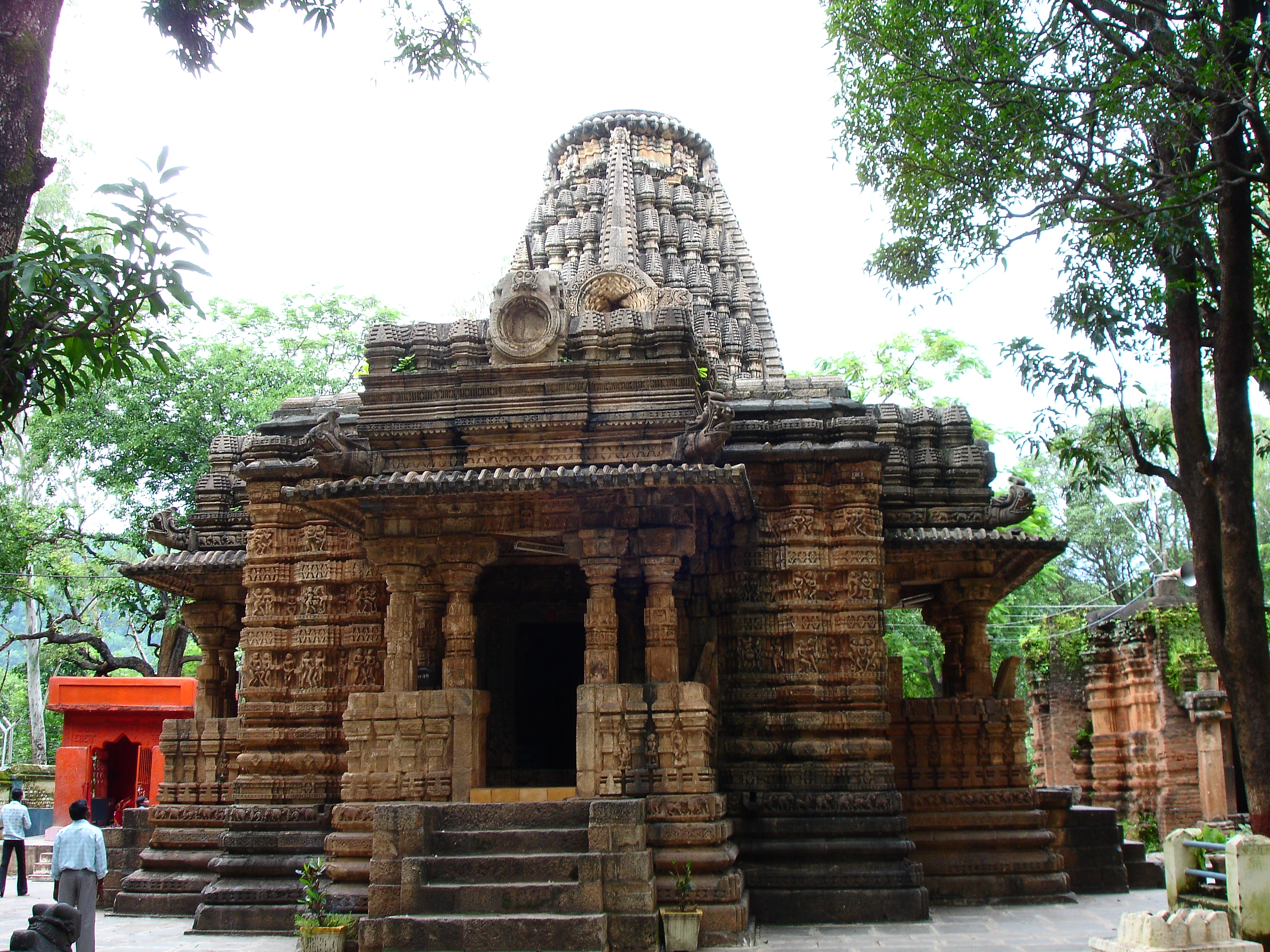
Bhoramdeo Temple
The Gond tribal people of central India had their own name for Lord Shiva. They called him Bhoramdeo, and at the foot of the thickly forested Maikal range in what is now Chhattisgarh, they built a temple to honor him. That temple gave its name to the village, and eventually to an entire complex of four sacred structures spanning centuries of construction -- from early brick shrines to an 11th-century stone masterwork whose exterior walls are so dense with erotic carvings that visitors have called it the "Khajuraho of Chhattisgarh." Unlike its more famous counterpart in Madhya Pradesh, Bhoramdeo sits in relative obscurity, 134 kilometers from the nearest airport in Raipur, reached by roads that wind through Kabirdham district. The isolation has preserved both the temple and the silence around it.
Layers of Stone and Brick
The Bhoramdeo complex comprises four temples, the earliest built of brick during the rule of the Pandu dynasty. These brick temples share characteristics with others built in the same era at Kharod, Palari, Rajim, and Sirpur across the state, suggesting a regional building tradition that predates the grander stone construction that followed. The main Bhoramdeo temple, built in stone and dated to the Kalachuri period of the 10th through 12th centuries, is the complex's crown. Archaeologists have linked its sculptural style to nearby sites at Janjgir, Narayanpur, and Ratanpur, all products of a dynasty that controlled broad swaths of central India. The Naga kings of Chakrakota, who practiced tantrism, are also credited with influence over the temple's creation. What emerges from this layered history is a sacred site shaped not by one ruler or one era, but by successive generations who each added to what came before.
Carved Desire on Sacred Walls
It is the exterior carvings that earned Bhoramdeo its famous comparison to Khajuraho. The walls are covered with a profusion of sculpted images, many explicitly erotic, rendered by local artists with a directness that can startle modern visitors. The erotic sculptures appear primarily on the lower sections of the temple tower, where the entrance hall meets the shikara above. These images are not aberrations; they sit alongside depictions of deities, mythological scenes, and decorative motifs in a visual program that treats human desire as one element of a sacred whole. The temple's architectural style is classified as the Gurur type, distinct from the north Indian Nagara style that dominates better-known temples. Its structural signature is a tower built in receding rows or tiers placed successively upward, each level stepping back from the one below to create a tapering silhouette against the forested hills behind it.
The Inner Sanctum
Past the elaborately embellished entrance, the temple's interior follows the traditional layout of a Hindu Shiva temple. The entrance hall, or mandapa, once supported a shikara that has since deteriorated and been crudely remodeled. Inside, an image of Nandi -- Shiva's bull mount -- faces the sanctum sanctorum in the posture of perpetual devotion. Beyond Nandi sits the Shiva Linga itself, the aniconic representation of the deity that the Gond people named Bhoramdeo. A stairway connects the main entrance to the sanctum, drawing visitors along a spatial sequence designed to narrow focus from the profusion of the exterior to the stillness of the inner chamber. The contrast is deliberate: outside, the walls teem with the full spectrum of worldly experience; inside, everything reduces to a single point of worship.
Forest, Hills, and Remoteness
Bhoramdeo's setting is inseparable from its character. The Maikal range rises behind the complex, its slopes thick with the forests of the Bhoramdev Wildlife Sanctuary. Kawardha, the nearest tehsil town, connects by road to Raipur at 116 kilometers, Rajnandgaon at 133, and Jabalpur at 220. The nearest railhead is on the Bombay-Howrah main line through Raipur. This remoteness is both the temple's vulnerability and its protection. It has kept visitor numbers low, preservation funding scarce, and the temple largely free from the commercial development that crowds more accessible heritage sites. For those who make the journey, Bhoramdeo offers something the heavily touristed monuments cannot: an encounter with sacred architecture in something close to its original context, framed by forest and hill rather than parking lots and souvenir stalls.
From the Air
Located at 22.116N, 81.148E at the foot of the Maikal Range in Kabirdham district, Chhattisgarh. The temple complex sits in a forested valley, not individually visible from high altitude but identifiable by the clearing near the village of Bhoramdeo against the backdrop of densely wooded hills. Nearest major airport is Swami Vivekananda Airport, Raipur (VARP), approximately 134 km to the southeast. The Maikal hills provide a strong visual reference from the air. Best viewed below 5,000 feet AGL in clear weather. The Bhoramdev Wildlife Sanctuary surrounds the area with thick forest canopy.