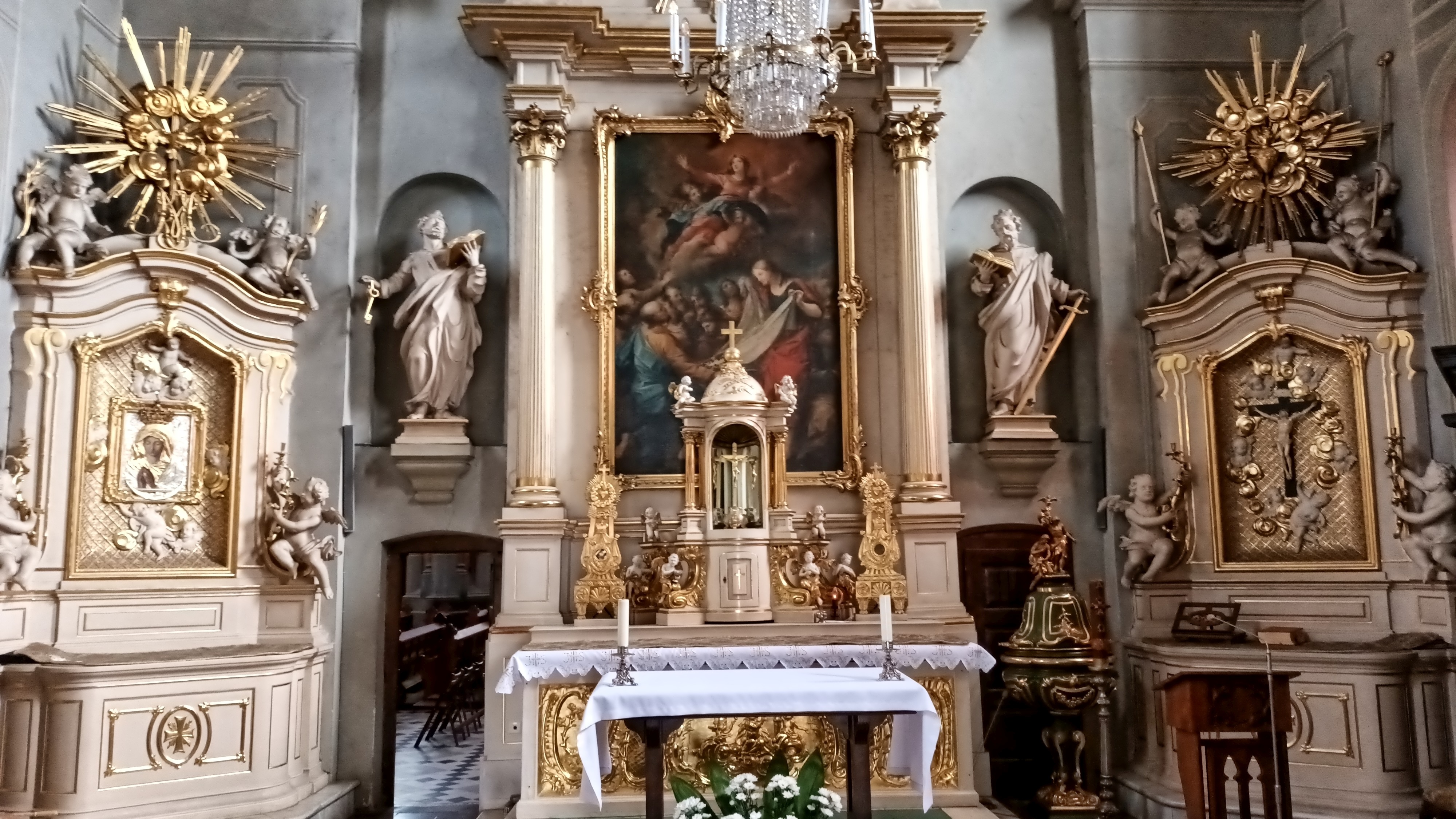
Białystok Cathedral
The Białystok dean had a plan and a problem. By the 1890s his parish had grown to twelve thousand souls, and the small Renaissance church his predecessors had built between 1617 and 1626 could fit only about a thousand of them. He wanted to tear it down and build a great cathedral. Tsar Nicholas II said no. As part of the policy of Russification of Poles, the empire would not allow new Catholic churches, only enlargements of existing ones. So the architect Józef Pius Dziekoński performed a quiet feat of legal engineering: he designed a 'large cathedral' that would be perpendicular to the old church, technically attached to it, and ten times its size. The tsar's officials approved the expansion. Białystok got its basilica anyway.
The Church Before the Church
The old parish church, funded in the early seventeenth century by the Wiesiołowski family, was a typical Renaissance Polish church of its era: brick, modestly proportioned, with a steeply pitched roof. For nearly three centuries it served the small town that grew around the Branicki Palace. Then Białystok industrialized. Textile mills multiplied along the Biała River and Polish, Belarusian, Russian, German, and Jewish workers poured in. Father Wilhelm Szwarc, the dean who began the cathedral campaign, contacted two of the era's leading church architects. He chose Dziekoński, a clerk of the Saint Petersburg Academy of Arts who had designed St. Florian's Church in Warsaw's Praga district. The first design, dated January 1, 1896, called for a Vistula-Baltic Gothic basilica: three naves, four bays, flying buttresses, two towers framing the main facade.
The Tsar Visits, the Tsar Refuses
In August 1897, Tsar Nicholas II came to Białystok. The parish committee met him and pleaded their case. He responded favorably. The faithful went home hopeful. In March 1898, the answer came back: permission only to expand the existing church, not to build a new one. This was the Russification policy at work, the same policy that closed Polish-language schools and pushed Orthodox replacements onto Catholic congregations across the partitioned territories. Dziekoński went back to his drawing board and produced a brilliant workaround. He would dismantle the presbytery of the old church and build a new church perpendicular to it, technically an extension. The new design added another bay, enlarged the towers with openwork tracery and pinnacles, and topped the crossing with a pointed bell tower. It cost 117,815 rubles and 88 kopecks.
Building a Cathedral by Stealth
Construction began on April 19, 1900. Father Szwarc blessed the cornerstone in June. The walls rose between 1902 and 1905, and on September 17, 1905, Bishop Edward von Ropp's prelate consecrated the new church. The completed structure measured 90 meters long with twin towers rising 72.5 meters above St. Roch Hill. It could hold 9,500 worshipers, almost the entire pre-war Catholic population of the town. Interior work continued for decades. Warsaw sculptor Wincenty Begnesy designed neo-Gothic stalls in 1925 and the Crucifixion altar in 1926. Plaster Stations of the Cross went up between 1926 and 1929. In 1938, a concrete retaining wall was added to secure the church on its embankment. The old Renaissance church, the legal pretext for the whole project, still stood beside the basilica it had birthed.
Surviving the Worst Year
When war came, the parish house and presbytery were occupied by Nazi or Soviet security services in turn. In June 1941, Dean Aleksander Chodyko was arrested by the Soviets, who claimed someone had been shooting at them from the church tower. He was lucky; many priests in the eastern voivodeships disappeared. On July 22 and 23, 1944, as the Wehrmacht retreated before the advancing Red Army, German units methodically burned the center of Białystok. The downtown was gutted. Yet the cathedral and its parish buildings survived nearly intact, an island of brick and stained glass in a sea of rubble. Pope John Paul II raised the church to the rank of basilica in 1985. A long restoration between 1996 and 2004 returned the interior to its early twentieth-century state. The basilica visitors see today is exactly the building Tsar Nicholas II thought he had forbidden.
From the Air
Białystok Cathedral stands at 53.13 N, 23.16 E in northeastern Poland, in the historic center of Białystok on St. Roch Hill. The twin neo-Gothic spires rise 72.5 meters and are visible from kilometers around. Best viewed at 3,000 to 5,000 feet for a close look at the spires, or 8,000 feet to take in the city and the surrounding Podlasie plain. Białystok-Krywlany Airport (EPBK) sits about 5 km south. Warsaw Chopin (EPWA) is roughly 180 km west.