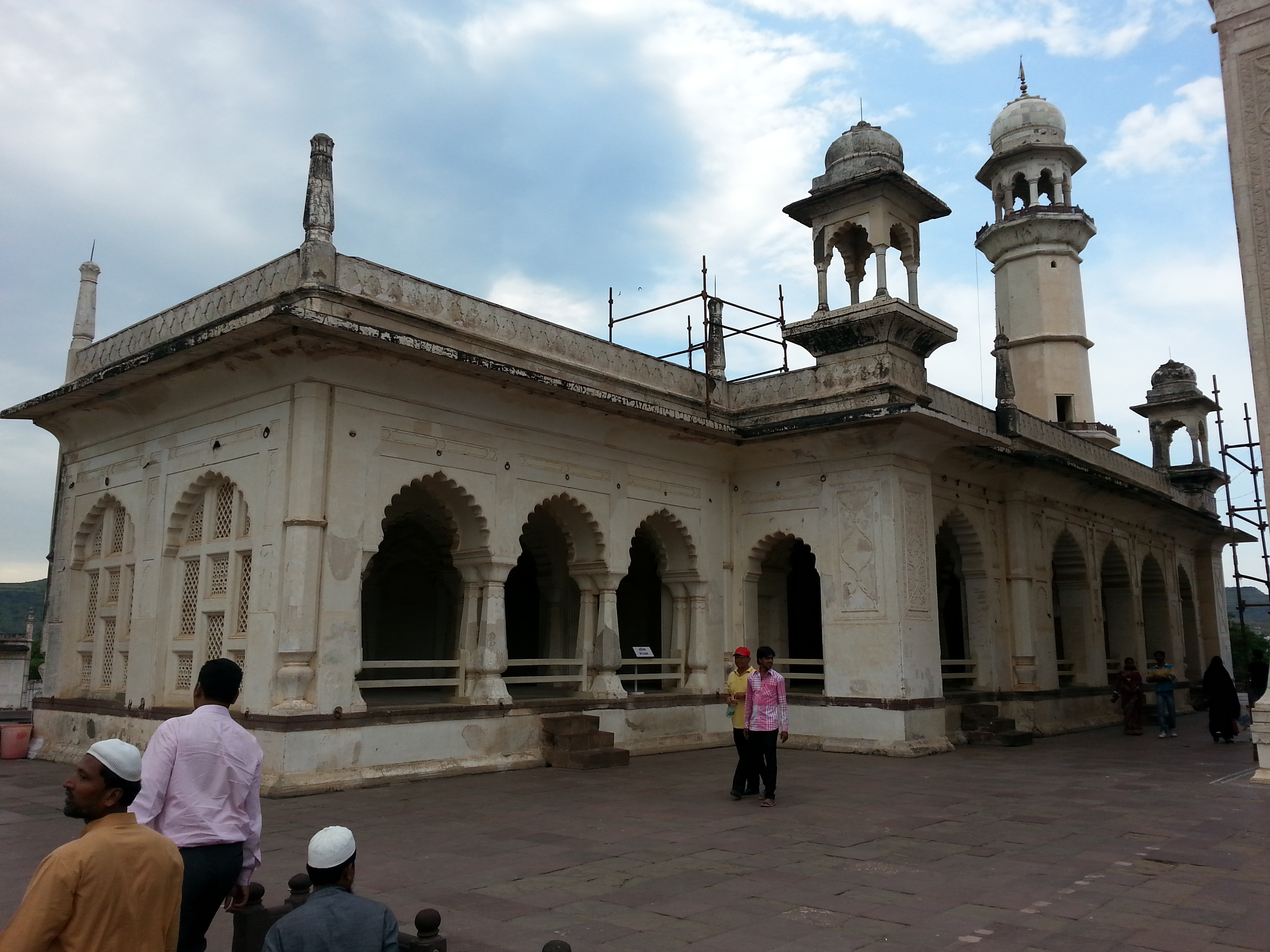
Bibi Ka Maqbara
The architect who designed the Bibi Ka Maqbara was the son of the man who designed the Taj Mahal. Ata-ullah, son of Ustad Ahmad Lahauri, received the commission around 1660 to build a mausoleum in Aurangabad for Dilras Banu Begum, the beloved first wife of Mughal emperor Aurangzeb. He knew exactly what was expected - his father's masterwork in Agra, 1,200 kilometers to the north, had set the standard for what love built in marble should look like. But where Shah Jahan had spent without limit on the Taj Mahal, Aurangzeb allocated only 700,000 rupees for his wife's tomb. The result is a monument that reaches for perfection and falls beautifully short, earning it the nickname Dakkhani Taj - the Taj of the Deccan.
A Love Story Twice Told
The parallels between the Taj Mahal and the Bibi Ka Maqbara are almost eerie. Mumtaz Mahal, Aurangzeb's mother, died in childbirth in 1631; Shah Jahan built the Taj Mahal to honor her memory. Dilras Banu Begum, Aurangzeb's first wife and favorite consort, died in 1657 after giving birth to their fifth child, Prince Muhammad Akbar, likely from puerperal fever. She was a princess of the Safavid dynasty of Iran, the daughter of Shahnawaz Khan, viceroy of Gujarat, and she had married the young prince Muhi-ud-din in Agra in 1637. Their twenty-year marriage produced five children. When Dilras died, Aurangzeb's grief was extreme. Their eldest son Azam Shah suffered a nervous breakdown so severe that his eldest sister, the poet-princess Zeb-un-Nissa, had to take charge of the newborn. Mother and daughter-in-law, both lost to childbirth, both memorialized in white marble - the Mughal dynasty's most intimate tragedies written in architecture.
Splendor Under Constraint
The Bibi Ka Maqbara was built between 1668 and 1669, and its construction cost came to 668,203 rupees and seven annas - just under the emperor's budget of 700,000. That frugality shows, but not always as a flaw. Where the Taj Mahal is clad entirely in Makrana marble, the Bibi Ka Maqbara uses marble only on the lower portions and the dome, switching to plaster on the upper walls. The marble that was used came from mines near Jaipur; the French traveler Jean-Baptiste Tavernier recorded seeing some three hundred carts laden with marble, each drawn by at least twelve oxen, on the road between Surat and Golconda. The proportions differ from the Taj - the minarets are shorter relative to the dome, the plinth lower, the gardens more compact. But these differences give the monument its own character. Seen at dusk, when the plaster catches golden light differently from the marble, the Bibi Ka Maqbara possesses a warmth the Taj Mahal's cold perfection never achieves.
The Father, the Son, the Blueprint
An inscription on the main entrance door records that the mausoleum was designed by Ata-ullah and engineered by Hanspat Rai. Ata-ullah's father, Ustad Ahmad Lahauri, is widely credited as the principal designer of the Taj Mahal. The son inherited his father's vocabulary - the octagonal plan, the bulbous dome, the flanking minarets, the Charbagh garden divided by water channels - but worked under constraints his father never faced. Shah Jahan poured the wealth of an empire into the Taj. Aurangzeb, who seized power from his father and imprisoned him within sight of the Taj, was notoriously austere. He believed in simple piety over worldly display, yet he could not deny his wife a monument. The tension between devotion and restraint defines every surface of the Bibi Ka Maqbara. The floral patterns on the marble panels are exquisite. The plasterwork above them is merely competent. The cenotaph inside sits behind a delicate marble screen. The whole structure reaches for transcendence and catches something just as valuable: sincerity.
The Deccan's Own Monument
For decades, the comparison with the Taj Mahal overshadowed the Bibi Ka Maqbara's own identity, reducing it to a pale imitation rather than a monument worth seeing on its own terms. That perception has been shifting. The mausoleum stands in formal Mughal gardens where geese paddle through the reflecting pool and the Deccan hills frame the white dome against a sky that is bluer, drier, and more intense than Agra's hazy plains. Aurangzeb himself is buried just a few kilometers away in Khuldabad, in a grave of bare earth that cost nothing - the emperor who paid so little for his wife's tomb paid even less for his own. The Archaeological Survey of India now maintains the site, and restoration work on the marble and plasterwork continues. Visitors come in increasing numbers, many finding what seasoned travelers have long known: that the Bibi Ka Maqbara, freed from the shadow of its more famous cousin, is the principal monument of Aurangabad and a masterwork of Deccani architecture in its own right.
From the Air
Located at 19.901N, 75.321E on the northern edge of Chhatrapati Sambhajinagar (Aurangabad), Maharashtra, India. The white-domed mausoleum is visible from moderate altitude as a bright structure set within formal Mughal gardens with a long axial approach. Nearest airport is Chhatrapati Sambhaji Nagar Airport (VAAU/IXU), approximately 8km to the southwest. The monument sits at roughly 580m elevation on the Deccan Plateau. From the air, look for the distinctive white dome and the rectangular garden layout with water channels in the Charbagh pattern. Aurangzeb's tomb at Khuldabad is approximately 24km to the northwest, near the Ellora Caves complex. Best viewing conditions October through March with clear skies.