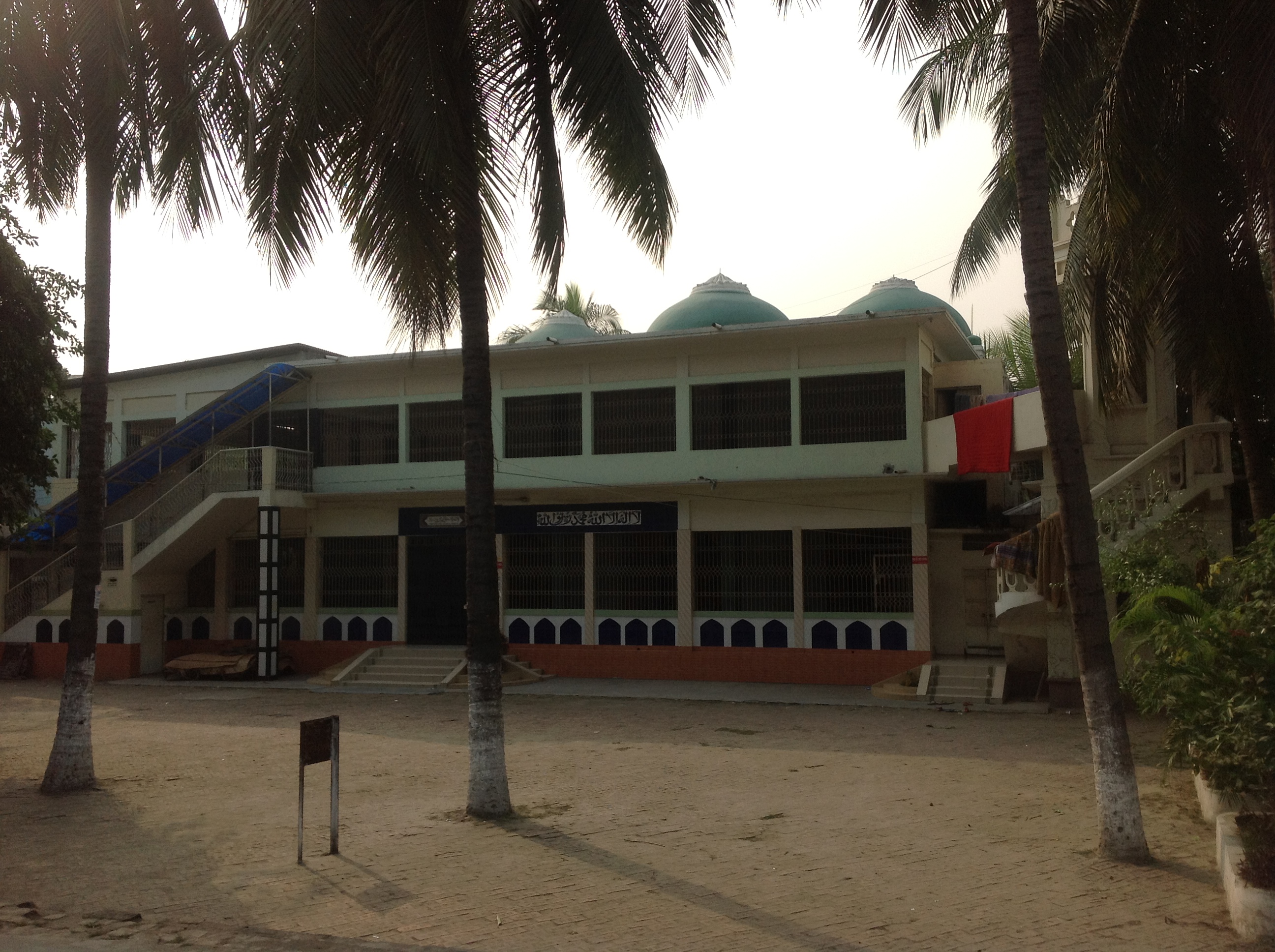
Bibi Maryam Mosque
Twenty-four years is a long time to build a mosque. Construction of the Bibi Maryam Mosque began in 1664, when Shaista Khan served as the Mughal governor of Bengal, and was not completed until 1688, the year his tenure ended. The timescale suggests something more than administrative ambition. Historians believe Khan named the mosque and its adjacent shrine after his daughter Bibi Maryam, who died young and was buried nearby. A father's grief, expressed in brick and dome, anchored a fortified complex in what is now Hajiganj, Narayanganj, that has survived more than three centuries of earthquakes, wars, and renovations, though the renovations may have done more damage than any of the rest.
A Father's Monument
Shaista Khan governed the Bengal Subah during one of the Mughal Empire's most expansive periods. His family and administration formed the core Muslim population of what is now Killarpul, and the mosque's modest size reflects that limited early community. Even as late as the 1950s, the area's population remained predominantly Hindu, with barely ten Muslims attending congregational prayer. That demographic reality has reversed completely; hundreds of worshippers now fill the mosque. But the building's origin was personal, not communal. The shrine of Bibi Maryam faces the mosque directly, their central axes aligned so that worshippers praying inside the mosque face the tomb of the young woman for whose salvation the entire complex was built.
Three Domes and a Secret Passage
The mosque follows the classic Mughal three-dome plan, with the central dome significantly larger than its flanking pair. This arrangement is a distinctive feature of Mughal mosque architecture, and at Bibi Maryam it was executed with striking vertical emphasis. The original single-storey structure was deliberately tall, its three mihrabs rising in the western wall from ground level to a third of what is now the first floor's height. Four engaged corner towers, nearly merged into the walls, extend beyond the parapet. The entire complex sits within fortifications marked by boundary walls four feet wide and twelve feet high. At the western end of the mosque, a secret passage once allowed Shaista Khan's soldiers to access the nearby Hajiganj Fort, a reminder that this was as much a military installation as a spiritual one.
The Cost of Good Intentions
What time could not destroy, renovation nearly did. In 2001, a first floor was inserted directly into the mosque's interior, severing the visual relationship between the soaring domes above and the mihrabs below. The roof of the new floor now completely obstructs the view of the domes from inside, and the mihrabs have been dramatically compressed in both width and height. The original open plaza on the east face, measuring 50 by 20 feet, has been enclosed by a veranda to accommodate more worshippers. Corner towers have been wholly modernized, stripped of their Mughal character. The floral and geometric motifs and plaques that once adorned the outer walls have vanished entirely, though their themes can still be deduced from the embellishments preserved on the adjacent shrine.
What the Shrine Remembers
While the mosque has lost much of its original architectural identity, the Bibi Maryam Shrine has retained its qualities through multiple rounds of conservation. The rectangular structure stands on a three-foot elevated platform, accessible from all directions through five arches on each facade, and topped by a single dome. Its surfaces are plastered in light brown and adorned with recessed rectangular panels that match the style of the fortified boundary walls. Pierced walls create patterns of voids and angular shapes that filter natural light, a strategy common in Islamic architecture. After the 1971 Liberation War, a girls' primary school consumed a substantial portion of the complex, requiring demolition of large sections of the eastern and southern fortifications. The shrine endures as the most authentic surviving element of Shaista Khan's grief, a monochromatic structure that still reflects the century in which it was built.
From the Air
Located at 23.632°N, 90.511°E in Hajiganj, Narayanganj, southeast of central Dhaka. The three-domed mosque and its fortified compound sit within dense residential development. Nearest major airport is Hazrat Shahjalal International Airport (VGHS), approximately 20 km to the northwest. The Shitalakshya River flows nearby to the west, providing a useful aerial reference.