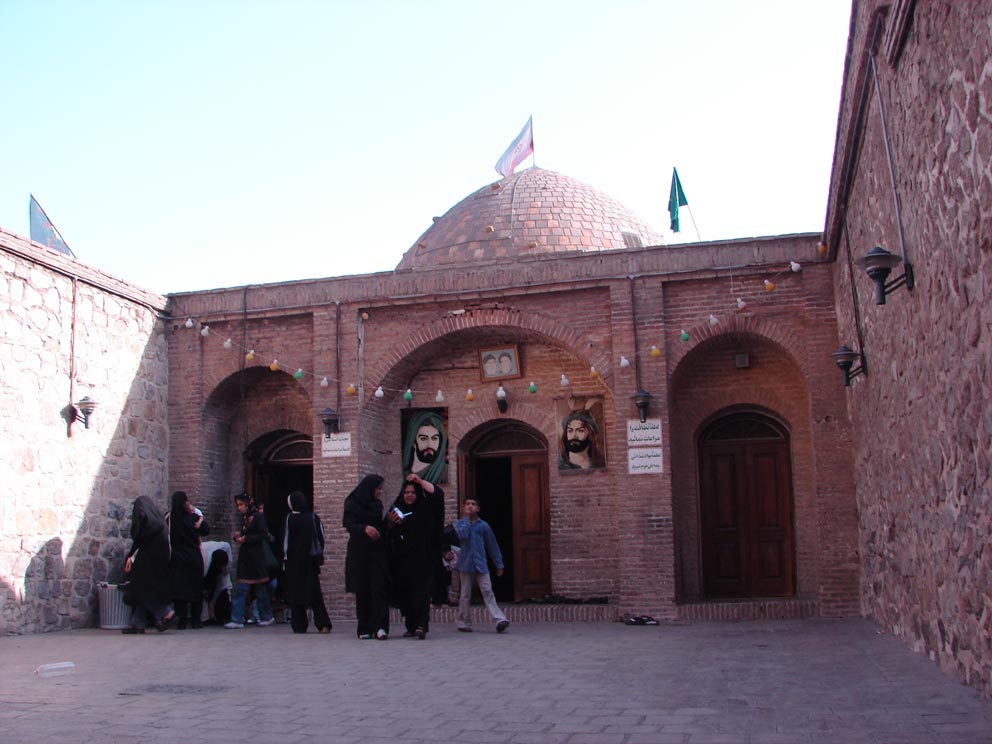
Bibi Shahrbanu Shrine
Before Islam reached Iran, before the Sasanian emperors carved their stone halls, before the name Shahrbanu meant anything to anyone, something sacred already occupied this mountainside above the ancient city of Rayy. Researchers have long debated whether the Bibi Shahrbanu Shrine, perched in the hills south of modern Tehran, preserves the memory of a pre-Islamic holy site, possibly a sanctuary dedicated to Anahita, the Zoroastrian goddess of water and fertility. What is certain is that the complex has been a place of devotion for well over a thousand years, accumulating layers of stone, brick, and belief as one dynasty after another left its mark on the structure.
The Princess and the Imam
According to tradition inscribed within the shrine itself, the tomb belongs to Shahrbanu, a Sasanian princess who became the wife of Hussein ibn Ali, the third Shi'ite Imam, and the mother of Ali al-Sajjad, the fourth Imam. If the tradition is accurate, Shahrbanu represents a direct link between pre-Islamic Persian royalty and the Shi'ite line of imams, a connection that has given the shrine extraordinary significance in Iranian Shia culture. Her name means "Lady of the Land," and the shrine bearing it has become one of the holiest sites in Shia Islam. Pilgrims climb the hillside to visit her tomb, drawn by a story that bridges two civilizations and two faiths.
Stone Upon Stone, Era Upon Era
The architecture of Bibi Shahrbanu reads like a geological cross-section of Iranian history. The shrine and its long southern room date from the Sasanian era, making them among the oldest surviving elements. The southeastern corner is a solid stone building with stone and brick cladding from the Buyid dynasty period. Outer courtyard walls belong to the Buyid and Seljuk eras. The dome over the tomb dates from the Daylamites period. In later centuries, builders added porticos, walls, rooms, and corridors that divided the original space into two courtyards and gave the complex its current form. A carved marquetry box beneath the tomb contains sayings of the Prophet Muhammad alongside the honorific titles of Shahrbanu, and records the names of the shrine's founders. In the southeast stands a marquetry panel from the reign of King Tahmasp I, marking the shrine's original main entrance, a Safavid-era addition to a structure already ancient when his craftsmen arrived.
Echoes of Anahita
The question that haunts this site is whether its sanctity predates Islam altogether. Researchers have noted that the name, the location on a mountainside above a major ancient city, and the persistent veneration all suggest the possibility of continuity from an earlier Zoroastrian sacred site. Anahita, the goddess of waters, fertility, and healing, was widely worshipped across pre-Islamic Iran, and her sanctuaries tended to occupy elevated positions near springs and ancient settlements. Rayy itself was one of the great cities of the ancient world, and the idea that its hillside would have hosted a Zoroastrian shrine is entirely plausible. If the connection holds, then the Bibi Shahrbanu Shrine represents something remarkable: a place where Zoroastrian holiness was absorbed and reinterpreted through an Islamic lens, with the Sasanian princess Shahrbanu serving as the human bridge between old devotion and new.
A Living Shrine
The complex was added to the Iran National Heritage List on July 31, 1933, recognition of both its architectural and spiritual significance. But designation as a heritage site has not turned Bibi Shahrbanu into a museum. It remains an active place of worship, visited by Shia pilgrims who come to honor Shahrbanu and connect with the lineage of the imams. The shrine sits in the neighborhood of Ebn-e Babooyeh in Shahr-e Ray, surrounded by the dense fabric of Tehran's southern suburbs, a reminder that ancient devotion and modern urbanity exist side by side in Iran. The Cultural Heritage, Handicrafts and Tourism Organization of Iran administers the complex, balancing preservation with the demands of a living religious site that continues to draw the faithful, just as it has for more than a millennium.
From the Air
Located at 35.59N, 51.49E, in the hills above Shahr-e Rey on the southern edge of the Tehran metropolitan area. The shrine occupies an elevated position on a mountainside, potentially visible from lower altitudes as a structure against the hillside terrain. Imam Khomeini International Airport (OIIE) lies approximately 25 km to the southwest. Mehrabad International Airport (OIII) is about 15 km to the northwest. The surrounding landscape transitions from the flat Tehran plain to the foothills south of the city, with the Elburz Mountains visible to the north.